
Paper: GS – II, Subject: Polity, Topic: Legislature, Issue: Right to Disconnect Bill.
Context:
The Right to Disconnect Bill, introduced as a private member’s Bill, seeks to protect employees from after-hours work-related communication.
Key Highlights:
The proposal emerges amid concerns that existing labour codes inadequately address digital labour, employee autonomy, and work–life balance, raising questions about enforceability, constitutional grounding under Article 21, and alignment with global best practices.
Ambiguity in Defining ‘Work’:
- Lack of Clarity: The Right to Disconnect Bill grants employees the right to not respond to work-related communications outside of working hours.
- However, it fails to define whethersuch after-hours engagement constitutes ‘work’ under the law.
- Interaction with Existing Codes: This ambiguity becomes problematic when considering the Occupational Safety, Health and Working Conditions Code, 2020, which governs working hours and overtime.
- The Bill doesn’t clarify if after-hours digital engagement qualifies as ‘work’ under this Code.
- Conceptual Gap: This creates a gap where communication is regulated without being integrated into the legal framework governing working time.
- The right to disconnect risks becoming a behavioral norm rather than a legally enforceable labor standard.
Mandatory Standard vs. Contractual Term:
- Unspecified Nature: The Indian labor code contains mandatory rules on working hours and contractual terms negotiated through employer policy and agreements.
- The Right to Disconnect Bill doesn’t specify whether the right is a mandatory labor
Statutory vs. Constitutional: It remains unclear whether the right to disconnect is purely statutory or indicative of a deeper constitutional engagement between work and individual autonomy.
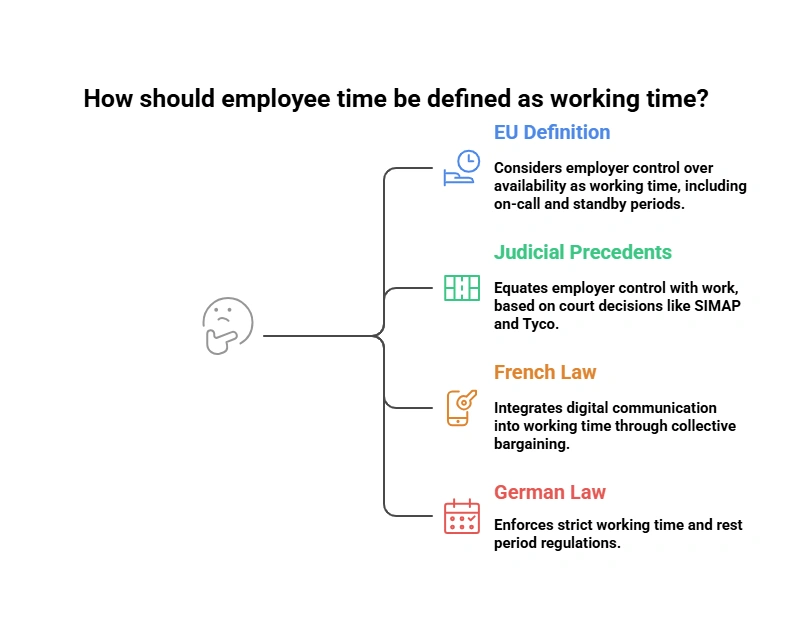
Way Forward:
- Legally redefine “working time” to include digital availability and employer-controlled communication.
- Embed the right within labour codes, not as a standalone statute.
- Clearly establish its constitutional grounding under Article 21.
- Ensure the right is non-waivable and enforceable.
The Right to Disconnect Bill is a necessary but incomplete reform. While it recognises the harms of constant digital work, it fails to redefine “work” in legal terms or integrate digital labour into existing labour codes. Without this, the right risks remaining symbolic rather than enforceable.
La Excellence IAS Academy, the best IAS coaching in Hyderabad, known for delivering quality content and conceptual clarity for UPSC 2025 preparation.
FOLLOW US ON:
◉ YouTube : https://www.youtube.com/@CivilsPrepTeam
◉ Facebook: https://www.facebook.com/LaExcellenceIAS
◉ Instagram: https://www.instagram.com/laexcellenceiasacademy/
GET IN TOUCH:
Contact us at info@laex.in, https://laex.in/contact-us/
or Call us @ +91 9052 29 2929, +91 9052 99 2929, +91 9154 24 2140
OUR BRANCHES:
Head Office: H No: 1-10-225A, Beside AEVA Fertility Center, Ashok Nagar Extension, VV Giri Nagar, Ashok Nagar, Hyderabad, 500020
Madhapur: Flat no: 301, survey no 58-60, Guttala begumpet Madhapur metro pillar: 1524, Rangareddy Hyderabad, Telangana 500081
Bangalore: Plot No: 99, 2nd floor, 80 Feet Road, Beside Poorvika Mobiles, Chandra Layout, Attiguppe, Near Vijaya Nagara, Bengaluru, 560040