
Paper: GS-II, Subject: International Relation, Topic: Global Issues, Issue: USAs Selective multilateralism
Context:
The US announced it would withdraw from 66 international bodies, including 31 in the UN system, signalling a major shift in how Washington engages global institutions. The move reflects a broader pattern of reversible multilateral commitments (exit – rejoin – exit), seen across UNESCO and climate frameworks across administrations.
Key Points: The Shift to Multilateralism à la carte:
- The US is increasingly selecting international institutions that serve its interests, bypassing or disabling those that don’t, and exiting those that impose constraints.
- This approach marks a departure from the traditional US commitment to multilateralism and a move towards leveraging power over adhering to rules.
Examples of US Actions:
- Withdrawal: Exiting UNESCO, the Paris Agreement, and numerous UN bodies.
- Obstruction: Blocking the appointment of appellate judges at the WTO and delaying the adoption of net-zero framework for shipping at the International Maritime Organization.
- Bypass: Forming selective coalitions like the Pax Silica initiative instead of working through established multilateral frameworks.
- Conditionality: Exiting the UN Human Rights Council and cutting funding to UNRWA, linking engagement to alignment with US interests.
- Making participation in multilateral institutions contingent on specific conditions and interests.
Consequences of the US Approach:
- Erosion of trust and reciprocity in the multilateral system.
- Hedging by allies and smaller states seeking patrons.
- Fragmentation of the international system and proliferation of standards.
- Increased inequality in shaping global norms and standards.
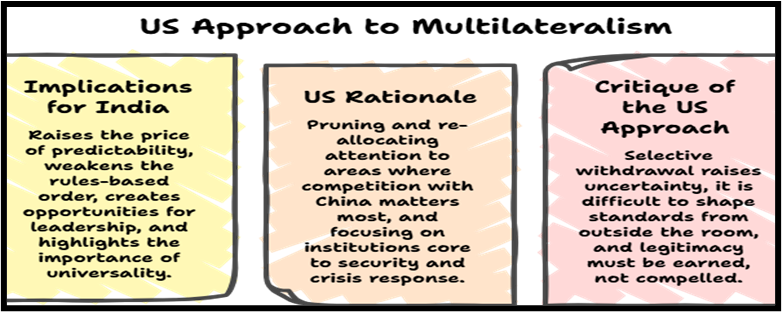
The Broader Impact:
- The US is shifting from converting strength into consent through multilateral institutions to prioritizing flexibility and short-term gains.
- The global system is being reshaped, with the future structure uncertain.
Way Forward:
For India:
- Strengthen coalitions of continuity: Work with EU, Japan, ASEAN, Africa, and middle powers.
- Lead “issue-based multilateralism”: build credible coalitions in climate adaptation finance, global health, and digital public infrastructure.
- Norm-setting strategy: proactively shape standards in AI, cyber, semiconductors, and supply chains to avoid being rule-taker.
For the multilateral system
- Reform, not retreat: improve transparency, efficiency, and representation to reduce the incentive for great-power exits.
- Build redundancy: alternative dispute settlement, multi-donor funding, and regional implementation to keep regimes running despite withdrawals.
US “multilateralism à la carte” turns governance transactional, favouring leverage over rules. It brings flexibility but erodes legitimacy, raises coordination costs, and fragments of systems. India must defend stability while shaping coalitions and standards.
Source: (The Indian Express)
La Excellence IAS Academy, the best IAS coaching in Hyderabad, known for delivering quality content and conceptual clarity for UPSC 2026 preparation.
FOLLOW US ON:
◉ YouTube : https://www.youtube.com/@CivilsPrepTeam
◉ Facebook: https://www.facebook.com/LaExcellenceIAS
◉ Instagram: https://www.instagram.com/laexcellenceiasacademy/
GET IN TOUCH:
Contact us at info@laex.in, https://laex.in/contact-us/
or Call us @ +91 9052 29 2929, +91 9052 99 2929, +91 9154 24 2140
OUR BRANCHES:
Head Office: H No: 1-10-225A, Beside AEVA Fertility Center, Ashok Nagar Extension, VV Giri Nagar, Ashok Nagar, Hyderabad, 500020
Madhapur: Flat no: 301, survey no 58-60, Guttala begumpet Madhapur metro pillar: 1524, Rangareddy Hyderabad, Telangana 500081
Bangalore: Plot No: 99, 2nd floor, 80 Feet Road, Beside Poorvika Mobiles, Chandra Layout, Attiguppe, Near Vijaya Nagara, Bengaluru, 560040