
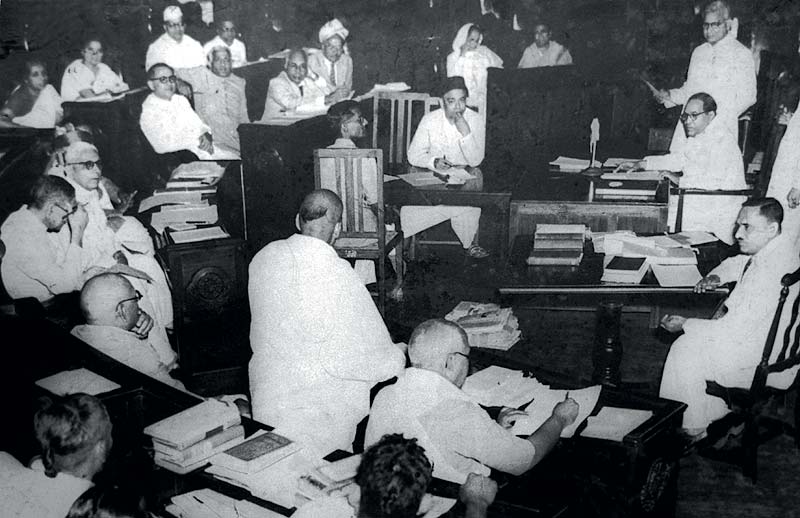
The Constituent Assembly of India, formed in 1946, was entrusted with the historic task of framing the Constitution for an independent nation. At a time marked by political transition and social diversity, the Assembly sought to create a constitutional framework that reflected India’s democratic ideals and plural character. Through sustained deliberation and consensus, it laid the foundations of India’s constitutional democracy.
What Is a Constituent Assembly?
A Constituent Assembly is a representative body specifically constituted to draft, frame, or amend a Constitution. It possesses the authority to determine the fundamental political, social, and legal principles governing a state. Unlike ordinary legislatures, which primarily perform law-making functions, a Constituent Assembly derives its legitimacy from its constitution-making mandate.
In the Indian context, the Constituent Assembly was formed in November 1946 under the Cabinet Mission Plan (1946). It was a partly elected and partly nominated body, with members indirectly elected by provincial legislative assemblies, which themselves were elected on a limited franchise.
The Assembly first convened on 9 December 1946. After completing its historic task, it held its final session on 24 January 1950 and thereafter functioned as the Provisional Parliament of India until the first general elections in 1951–52.
Why Did India Need a Constituent Assembly?
The demand for a Constituent Assembly arose from deep dissatisfaction with British-imposed constitutional arrangements, particularly the Government of India Act, 1919 and the Government of India Act, 1935.
Although these Acts introduced limited provincial autonomy, they retained British control over defence, finance, and foreign affairs. Indians were denied real sovereignty, and decision-making authority remained concentrated in British hands.
This constitutional inadequacy, combined with the growth of the national movement, strengthened the conviction that only a Constitution framed by Indians, for Indians, could reflect India’s plural society and democratic aspirations.
Leaders such as Mahatma Gandhi, Jawaharlal Nehru, and Dr. B.R. Ambedkar consistently argued that constitutional self-determination was inseparable from political freedom.
How Did the Idea of a Constituent Assembly Evolve?
The idea of a Constituent Assembly evolved gradually through political struggles and negotiations.
- 1934 – M.N. Roy first proposed the idea of a Constituent Assembly.
- 1935 – The Indian National Congress officially demanded a Constituent Assembly.
- 1938 – Jawaharlal Nehru declared that the Constitution of free India must be framed by a Constituent Assembly elected on the basis of adult franchise.
- 1940 – The British government accepted the demand in principle through the August Offer.
- 1942 – The Cripps Mission proposed constitution-making after the Second World War, but the proposal was rejected, particularly by the Muslim League.
- 1946 – The Cabinet Mission Plan provided the framework for elections to the Constituent Assembly.
#Constituent Assembly, #Constituent Assembly, #Constituent Assembly,
How Was the Constituent Assembly Constituted?
The Constituent Assembly was constituted under the Cabinet Mission Plan of May 1946.
What Was the Total Strength of the Assembly?
The total strength of the Constituent Assembly was 389 members, divided as follows:
- British India: 296 members
- Princely States: 93 members
After the Partition of India (1947), members belonging to Pakistani territory withdrew, reducing the effective strength of the Assembly to 299 members.
How Were Members Selected?
Members from British India were indirectly elected by provincial legislative assemblies. Seats were allocated among General, Muslim, and Sikh communities in proportion to population. Elections were conducted using Proportional Representation through the Single Transferable Vote (STV). Representatives of princely states were nominated by their respective rulers.
Although not elected by universal adult franchise, the Assembly included eminent jurists, administrators, social reformers, and national leaders, lending depth and credibility to the constitution-making process.
How Did the Constituent Assembly Function?
The Constituent Assembly functioned from December 1946 to January 1950 as a deliberative and representative body.
What Was the Duration and Nature of Its Work?
- Time taken: 2 years, 11 months, and 18 days
- Sessions held: 11
- Total sittings: 165
- Total hours of debate: More than 2,000 hours
The Assembly followed a democratic, transparent, and participatory procedure, with extensive discussions, amendments, and consensus-building. This ensured that the Constitution was not imposed but evolved through reasoned debate.
What Was the Objective Resolution and Why Was It Important?
On 13 December 1946, Jawaharlal Nehru introduced the historic Objective Resolution, which laid down the philosophical and ideological foundations of the Indian Constitution.
What Were the Key Principles of the Objective Resolution?
- India to be constituted as a Sovereign Democratic Republic
- A federal structure with distribution of powers between the Centre and the states
- Assurance of justice—social, economic, and political
- Guarantee of liberty of thought, expression, belief, faith, and worship
- Equality of status and opportunity
- Protection of minorities and backward sections
- Maintenance of territorial integrity and commitment to international peace
The Resolution was unanimously adopted on 22 January 1947 and later formed the basis of the Preamble to the Constitution of India.
How Did the Indian Independence Act, 1947 Change the Status of the Assembly?
The Indian Independence Act, 1947 fundamentally altered the legal and political position of the Constituent Assembly.
What Were the Key Changes?
- The Assembly became a fully sovereign body, free from British control.
- It was empowered to repeal or amend any law passed by the British Parliament concerning India.
- It was vested with legislative powers, functioning as the Dominion Legislature.
From this stage onwards, the Constituent Assembly framed the Constitution with complete constitutional autonomy.
How Was the Constitution of India Drafted and Adopted?
The drafting of the Constitution was carried out in multiple stages to ensure accuracy and consensus.
What Were the Major Milestones?
- 22 July 1947: Adoption of the National Flag
- February 1948: Publication of the Draft Constitution (315 Articles and 8 Schedules)
- November 1948: First Reading
- November 1948 – October 1949: Second Reading with clause-by-clause discussion
- November 1949: Third Reading
- 26 November 1949: Constitution adopted
On 24 January 1950, the Assembly elected Dr. Rajendra Prasad as the first President of India and adopted the National Anthem and National Song.
When Did the Constitution of India Come into Force?
Although adopted on 26 November 1949, the Constitution did not come into force immediately.
Certain provisions relating to citizenship, elections, provisional Parliament, and transitional arrangements came into effect on 26 November 1949. The remaining provisions came into force on 26 January 1950.
The date 26 January was chosen to commemorate the declaration of Poorna Swaraj at the Lahore Session of the Indian National Congress in 1929. This day is celebrated annually as Republic Day.
What Committees Were Appointed by the Constituent Assembly?
Given the vast scope of constitution-making, the Assembly appointed several committees to examine issues in detail.
What Were the Principal Committees?
- Drafting Committee – Dr. B.R. Ambedkar
- Advisory Committee on Fundamental Rights, Minorities, and Tribal Areas – Sardar Vallabhbhai Patel
- Union Powers Committee – Jawaharlal Nehru
- Provincial Constitution Committee – Sardar Vallabhbhai Patel
These committees played a crucial role in converting broad principles into precise constitutional provisions.
What Were the Major Criticisms of the Constituent Assembly?
Despite its achievements, the Constituent Assembly faced several criticisms:
- It was not directly elected on the basis of universal adult franchise.
- Initially, it was not a sovereign body.
- The process was considered time-consuming.
- It was allegedly dominated by the Congress Party.
- It was said to be dominated by lawyers and politicians.
- Some critics argued that it did not adequately represent all religious communities.
Why Is the Constituent Assembly Still Considered Successful?
Despite criticism, the Constituent Assembly must be regarded as a remarkable democratic institution. It succeeded in:
- Preventing constitutional instability after Partition
- Embedding social justice within political democracy
- Balancing unity with diversity
- Creating a flexible yet stable constitutional framework
What Is the Historical Significance of the Constituent Assembly?
The Constituent Assembly did not merely draft a legal document. It laid the constitutional foundations of modern India, ensuring democracy, rights, federalism, and unity in a deeply diverse society.
Its work continues to guide constitutional interpretation, democratic governance, and the protection of fundamental rights in India.
The Constituent Assembly played a decisive role in shaping India’s constitutional order. Despite limitations and criticism, it succeeded in framing a durable Constitution that balanced democracy, federalism, and social justice. Its legacy continues to guide India’s governance and constitutional interpretation.
For more such preparation strategies, you can read here: https://laex.in/category/preparation-strategy/
La Excellence IAS Academy, the best IAS coaching in Hyderabad, known for delivering quality content and conceptual clarity for UPSC 2025 preparation.
FOLLOW US ON:
◉ Youtube : https://www.youtube.com/@CivilsPrepTeam
◉ Facebook: https://www.facebook.com/LaExcellenceIAS
◉ Instagram: https://www.instagram.com/laexcellenceiasacademy/
GET IN TOUCH:
Contact us at info@laex.in, https://laex.in/contact-us/
or Call us @ +91 9052 29 2929, +91 9052 99 2929, +91 9154 24 2140
OUR BRANCHES:
Head Office: H No: 1-10-225A, Beside AEVA Fertility Center, Ashok Nagar Extension, VV Giri Nagar, Ashok Nagar, Hyderabad, 500020
Madhapur: Flat no: 301, survey no 58-60, Guttala begumpet Madhapur metro pillar : 1524, Rangareddy Hyderabad, Telangana 500081
Bangalore: Plot No: 99, 2nd floor, 80 Feet Road, Beside Poorvika Mobiles, Chandra Layout, Attiguppe, Near Vijaya Nagara, Bengaluru, 560040