
Paper: GS – III, Subject: Environment and Ecology, Topic: Wetlands, Mangroves and Corals, Issue: Wetlands Management in India.
Context:
The critical role of wetlands in India, highlighting their ecological and economic significance, deeply intertwined with traditional community practices.
- Despite existing policy frameworks, wetlands face severe threats from encroachment, pollution, and inadequate implementation.
Key Highlights:
The Importance of Wetlands in India:
- Traditional Knowledge and Community Livelihoods: Wetlands in India are historically linked to community practices that ensure ecosystem sustainability. Examples include:
- Tamil Nadu: Ancient water management systems (kulams) for irrigation.
- Wayanad, Kerala: Kenis (shallow wells) supporting drinking water and rituals.
- Srikakulam, Andhra Pradesh: Wetlands sustaining traditional fishing practices.
- Threats to Wetlands: Despite their benefits, wetlands are endangered due to their location at the intersection of land, water, and development
Policy Background and Challenges:
- Existing Frameworks: India has laws like the Wetlands (Conservation and Management) Rules, 2017, National Plan for Conservation of Aquatic Ecosystems (NPCA), and Coastal Regulation Zone (CRZ) framework.
- Implementation Gaps: Nearly 40% of India’s wetlands have vanished in the last three decades, with 50% of the remainder showing ecological degradation due to inconsistent implementation.
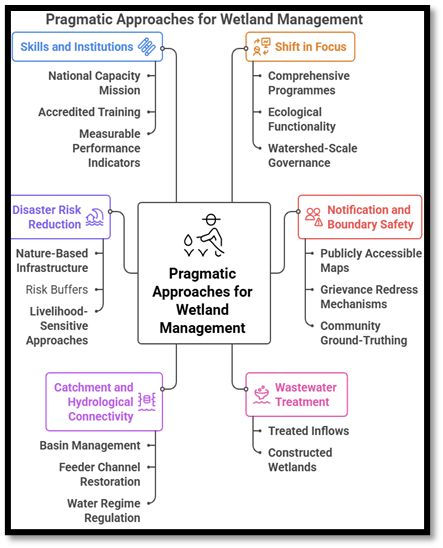
Key Challenges:
- Encroachment and Land Conversion: Approximately 40% of natural wetlands have been lost to infrastructure, real estate, and road networks.
- Hydrological Disruption: Dams, embankments, channelization, sand mining, and groundwater over-extraction disrupt natural water flows.
- Pollution: Untreated sewage, industrial effluents, agricultural runoff, and solid waste lead to eutrophication and biodiversity loss.
- Coastal Vulnerability: Sea-level rise, cyclones, and shoreline changes threaten mangroves and lagoons.
- Capacity Constraints: State wetland authorities lack sufficient staff, funding, and training in key areas like hydrology, ecology, and legal enforcement.
By aligning science with policy and engaging communities, India can restore wetlands as thriving ecosystems, ensuring water security and resilience for the future.
Source: (The Hindu)
La Excellence IAS Academy, the best IAS coaching in Hyderabad, known for delivering quality content and conceptual clarity for UPSC 2026 preparation.
FOLLOW US ON:
◉ YouTube : https://www.youtube.com/@CivilsPrepTeam
◉ Facebook: https://www.facebook.com/LaExcellenceIAS
◉ Instagram: https://www.instagram.com/laexcellenceiasacademy/
GET IN TOUCH:
Contact us at info@laex.in, https://laex.in/contact-us/
or Call us @ +91 9052 29 2929, +91 9052 99 2929, +91 9154 24 2140
OUR BRANCHES:
Head Office: H No: 1-10-225A, Beside AEVA Fertility Center, Ashok Nagar Extension, VV Giri Nagar, Ashok Nagar, Hyderabad, 500020
Madhapur: Flat no: 301, survey no 58-60, Guttala begumpet Madhapur metro pillar: 1524, Rangareddy Hyderabad, Telangana 500081
Bangalore: Plot No: 99, 2nd floor, 80 Feet Road, Beside Poorvika Mobiles, Chandra Layout, Attiguppe, Near Vijaya Nagara, Bengaluru, 560040