
Paper: GS – III, Subject: Environment and Ecology, Topic: Climate Change and Global Warming, Issue: Ecological Discoloration.
Context:
The vibrant colors of nature are fading, and the consequences are profound. Over the past two decades, more than half of the oceans have turned greener, forests are prematurely browning, and various species are altering their pigmentation in response to rising temperatures and pollution.
Key Takeaways:
The Color Changes in Nature:
1. Oceanic and Forest Changes:
- Greener Oceans: Over the last 20 years, a significant portion of the oceans has become greener, indicating shifts in phytoplankton communities and nutrient availability.
- Browning Forests: Deforestation, particularly in the Amazon, is leading to a loss of biodiversity, with many species, including butterflies, losing their vibrant colors.
2. Adaptive Coloration in Species:
- Survival Mechanisms: Colors in living organisms serve critical functions such as camouflage, mate attraction, and thermoregulation. As habitats change, species are forced to adapt.
- Butterfly Studies: Research published in Biodiversity and Conservation indicates that butterflies in deforested areas exhibit less vibrant colors, as less colorful species are better at camouflage.
3. Historical Context: Industrial Revolution Parallel: The changes in coloration echo historical events like the Industrial Revolution, where pollution altered the natural camouflage of species such as the peppered moth.
Mechanisms of Color Change:
Melanin Production:
- Types of Melanin: Eumelanin (dark shades) and pheomelanin (lighter hues) are the two primary pigments in animals. Climate change is leading to reduced melanin production, resulting in lighter colors.
- Insect Adaptations: A 2024 study in Ecology and Evolution found that insects like ladybirds and dragonflies are becoming lighter due to increased heatwaves, which helps them avoid overheating.
Ecological Rules:
- Bogert’s Rule: Suggests that cold-blooded animals in warmer regions will be lighter in color, while Gloger’s Rule states that warm-blooded animals are darker in humid areas.
- Tawny Owl Study: A 2024 study found that milder winters have led to a dominance of brown tawny owls in Europe, as darker colors provide better UV protection.
Urbanization and Pollution:
- Impact on Birds: A study of 547 bird species in China revealed that urban birds tend to be darker and duller, potentially due to heavy metals affecting melanin production.
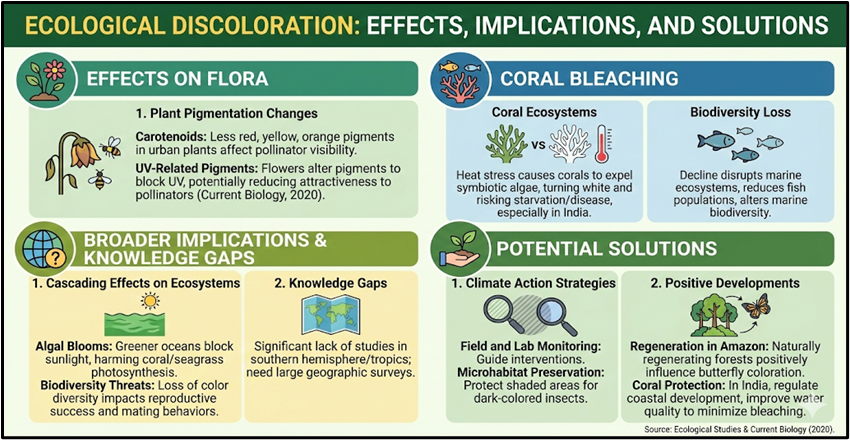
Global warming and pollution are fading nature’s colors, threatening biodiversity. However, by understanding these changes and implementing effective conservation strategies, we can mitigate damage and restore the planet’s vibrant ecosystem health before it is too late.
Source: (The Hindu)
La Excellence IAS Academy, the best IAS coaching in Hyderabad, known for delivering quality content and conceptual clarity for UPSC 2026 preparation.
FOLLOW US ON:
◉ YouTube : https://www.youtube.com/@CivilsPrepTeam
◉ Facebook: https://www.facebook.com/LaExcellenceIAS
◉ Instagram: https://www.instagram.com/laexcellenceiasacademy/
GET IN TOUCH:
Contact us at info@laex.in, https://laex.in/contact-us/
or Call us @ +91 9052 29 2929, +91 9052 99 2929, +91 9154 24 2140
OUR BRANCHES:
Head Office: H No: 1-10-225A, Beside AEVA Fertility Center, Ashok Nagar Extension, VV Giri Nagar, Ashok Nagar, Hyderabad, 500020
Madhapur: Flat no: 301, survey no 58-60, Guttala begumpet Madhapur metro pillar: 1524, Rangareddy Hyderabad, Telangana 500081
Bangalore: Plot No: 99, 2nd floor, 80 Feet Road, Beside Poorvika Mobiles, Chandra Layout, Attiguppe, Near Vijaya Nagara, Bengaluru, 560040