
Paper: GS – I, Subject: History-Art and Culture, Topic: Literature, Issue: Indian Inscriptions in Egyptian Tombs.
Context:
In Egypt’s Valley of the Kings, famous for housing New Kingdom pharaohs’ tombs, over 2,000 Greek graffiti inscriptions were catalogued in 1926.
- However, a 2024–25 study by Charlotte Schmid (EFEO, Paris) and Ingo Strauch (University of Lausanne) discovered nearly 30 Indian inscriptions in Tamil-Brahmi, Sanskrit, and Prakrit, dating between the 1st and 3rd centuries CE.
Key Takeaways:
Historical Context:
- The Valley of the Kings is renowned for its tombs of New Kingdom pharaohs.
- In 1926, over 2,000 Greek graffiti inscriptions were documented, showcasing the influence of Greek culture in the region.
Linguistic Blend: Sanskrit and Tamil Roots:
- The name reflects cultural hybridity: “Cikai” may derive from the Sanskrit śikhā, meaning tuft or crown.
- “Koṟṟaṉ” is distinctly Tamil, linked to roots meaning victory or slaying, and associated with Koṟṟavai, the Chera warrior goddess, and koṟṟavaṉ (king).
This fusion highlights the multilingual and cosmopolitan character of early historic Indian merchant communities.
Links to Tamilagam and Trade Networks:
- The name Koṟṟaṉ also appears in:
- A pottery sherd from Berenike, a Red Sea port with Indian inscriptions.
- The Sangam corpus, where the Chera ruler Piṭṭāṅkoṟṟaṉ is addressed as Koṟṟaṉ.
These parallels firmly connect the Egyptian graffiti to the literary and epigraphic traditions of ancient Tamilagam, reinforcing evidence of deep Indo-Mediterranean interactions.
“Kopāṉ Came and Saw”: Indian Voices in Egyptian Tombs:
- Another striking inscription discovered in Egypt’s Valley of the Kings reads: “Kopāṉ varata kantan”– “Kopāṉ came and saw.”
- Scholars note that this phrasing closely mirrors common Greek graffiti formulae found in the same tombs.
It suggests that Indian visitors were consciously adopting an existing Mediterranean tradition of marking presence at sacred sites.
Historical Significance:
- Confirms movement of Indian traders or visitors beyond Red Sea ports into the Nile valley.
- Strengthens evidence of Indo Roman trade links.
- Earlier excavations at Berenike had already shown Indian trade presence.
- This discovery shifts focus from coastal trade points to inland Egyptian sites.
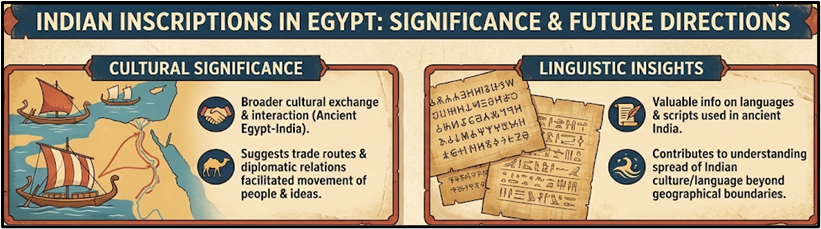
The Indian inscriptions in the Valley of the Kings deepen understanding of ancient cultural exchanges and highlight long-distance interconnectedness, opening new avenues for further historical research.
Source: (The Indian Express)
La Excellence IAS Academy, the best IAS coaching in Hyderabad, known for delivering quality content and conceptual clarity for UPSC 2026 preparation.
FOLLOW US ON:
◉ YouTube : https://www.youtube.com/@CivilsPrepTeam
◉ Facebook: https://www.facebook.com/LaExcellenceIAS
◉ Instagram: https://www.instagram.com/laexcellenceiasacademy/
GET IN TOUCH:
Contact us at info@laex.in, https://laex.in/contact-us/
or Call us @ +91 9052 29 2929, +91 9052 99 2929, +91 9154 24 2140
OUR BRANCHES:
Head Office: H No: 1-10-225A, Beside AEVA Fertility Center, Ashok Nagar Extension, VV Giri Nagar, Ashok Nagar, Hyderabad, 500020
Madhapur: Flat no: 301, survey no 58-60, Guttala begumpet Madhapur metro pillar: 1524, Rangareddy Hyderabad, Telangana 500081
Bangalore: Plot No: 99, 2nd floor, 80 Feet Road, Beside Poorvika Mobiles, Chandra Layout, Attiguppe, Near Vijaya Nagara, Bengaluru, 560040