
Paper: GS – II, Subject: Polity, Topic: Judiciary, Issue: Freebies vs Welfare Measures.
Context:
The Supreme Court has expressed strong disapproval of state governments distributing freebies without proper differentiation between the affluent and the underprivileged.
- The court raised concerns about the potential “appeasement” policies that may be in place, especially ahead of elections.
Key Takeaways:
Legal Context:
- The remarks came during a hearing related to a writ petition filed by Tamil Nadu Power Distribution Corporation Limited (TNPDCL), challenging the constitutional validity of Rule 23 of the Electricity (Amendment) Act, 2024.
- TNPDCL argued that the financial gap in the electricity sector has significantly widened, leading to unsustainable burdens on the public exchequer.
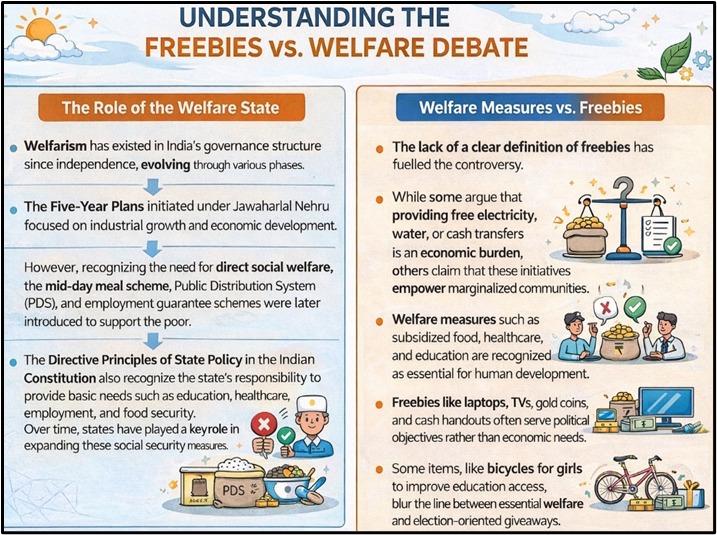
Constitutional & Institutional Framework:
Directive Principles of State Policy (DPSP):
- Articles 38, 39 & 41 promote welfare state principles.
- Direct the State to ensure social, economic justice & public welfare.
- Non-justiciable, but form moral – political basis of welfare schemes
Supreme Court’s View:
- Expressed concern over irrational freebies causing fiscal instability.
- Warned of potential economic disaster.
- Suggested formation of an expert body to examine and regulate the issue.
Challenges of Excessive Freebies:
- Fiscal Stress: Rising debt; Punjab ranked lowest (Fiscal Health Index 2025).
- Dependency Culture: Reduces work incentive (e.g., labour shortage concerns).
- Competitive Populism: States copy each other (free electricity schemes).
- Distorted Spending: Cuts funds for infra, health, education.
- Environmental Damage: Free power – groundwater overuse (Punjab, Haryana).
Way Forward:
- Amend Representation of the People Act (RPA): Regulate manifesto promises; disclose funding source.
- Fiscal Cap: Limit freebies to % of GSDP/tax revenue.
- Empower ECI: Regulate manifestos; introduce Model Manifesto.
- Voter Awareness: Demand fiscal transparency.
The Supreme Court urged states to reassess welfare policies, stressing responsible governance over electoral populism, and highlighting equitable resource distribution, infrastructure development, fiscal discipline, and long-term sustainable public welfare.
Source: (The Indian Express, The Hindu)
La Excellence IAS Academy, the best IAS coaching in Hyderabad, known for delivering quality content and conceptual clarity for UPSC 2026 preparation.
FOLLOW US ON:
◉ YouTube : https://www.youtube.com/@CivilsPrepTeam
◉ Facebook: https://www.facebook.com/LaExcellenceIAS
◉ Instagram: https://www.instagram.com/laexcellenceiasacademy/
GET IN TOUCH:
Contact us at info@laex.in, https://laex.in/contact-us/
or Call us @ +91 9052 29 2929, +91 9052 99 2929, +91 9154 24 2140
OUR BRANCHES:
Head Office: H No: 1-10-225A, Beside AEVA Fertility Center, Ashok Nagar Extension, VV Giri Nagar, Ashok Nagar, Hyderabad, 500020
Madhapur: Flat no: 301, survey no 58-60, Guttala begumpet Madhapur metro pillar: 1524, Rangareddy Hyderabad, Telangana 500081
Bangalore: Plot No: 99, 2nd floor, 80 Feet Road, Beside Poorvika Mobiles, Chandra Layout, Attiguppe, Near Vijaya Nagara, Bengaluru, 560040