
Paper: GS – III, Subject: Science & Technology, Topic: Indigenisation and Development of Technologies, Issue: Mineral Security as a Pillar of Strategic Autonomy.
Context:
Critical minerals have moved from the margins of policy discourse to the strategic core of India’s economic planning, institutionalised through the National Critical Mineral Mission (NCMM) and a ₹16,300 crore budgetary commitment.
Key Takeaways:
Power Reconfiguration:
- Access Equals Power: Access to critical minerals is now tied to national power, determining technological capability and strategic autonomy.
- Integrated Value Chain: Strategic sovereignty is achieved not just through resource extraction but through high-end component manufacturing and advanced processing and refining.
The Strategic Bottleneck:
- Possession vs. Leverage: Simple geological possession of raw ore does not translate into strategic leverage.
- China’s Dominance: China controls up to 90% of global processing capacity for several critical minerals.
- Vulnerability: Global concentration of advanced processing and refining creates structural vulnerability, making downstream industrial ecosystems the primary constraint.
Geoeconomic Reorientation:
- From Commodity to Leverage: Critical minerals have evolved into instruments of geoeconomic influence, essential for EV batteries, semiconductors, and renewable energy systems.
- Cross-Sector Convergence: Mineral governance now operates at the intersection of climate transition, industrial policy, and national security planning.
- Technological Drivers: Technology, including AI, is key to the partnership for mineral exploration and processing, alongside AI and quantum.
Institutional Design and Alignment:
- Execution over Policy: Sustainable advantage requires moving from policy announcements (such as NCMM with its 1,200 exploration targets) to coordinated execution, regulatory harmonisation, and infrastructure for deep refining.
- Supply Chain Diversification: Partnerships with Australia, the US, and the EU, alongside new tech-focused alliances like the India-Israel Critical & Emerging Technologies Partnership, aim to reduce dependency on concentrated suppliers.
The Deeper Strategic Question:
- The central challenge is whether India can ascend the value chain from extraction to advanced processing and high-end manufacturing and thereby translate mineral access into technological sovereignty.
- This progression from extraction to sovereignty is not automatic; it requires deliberate value-chain integration.
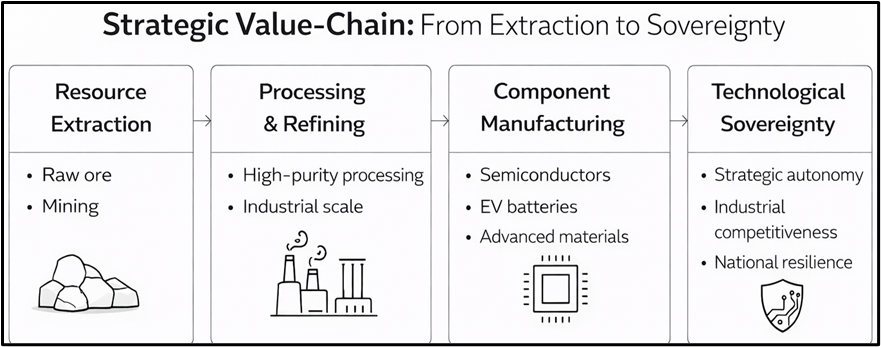
The value-chain framework illustrates that sovereignty emerges not from raw extraction alone, but from sustained movement toward processing depth and manufacturing capability.
The centrality of critical minerals marks a structural shift in India’s economic and strategic thinking. Long-term strategic autonomy will depend not merely on resource discovery, but on sustained value-chain integration, processing capacity, and coordinated institutional execution.
Source: (The Hindu)
La Excellence IAS Academy, the best IAS coaching in Hyderabad, known for delivering quality content and conceptual clarity for UPSC 2026 preparation.
FOLLOW US ON:
◉ YouTube : https://www.youtube.com/@CivilsPrepTeam
◉ Facebook: https://www.facebook.com/LaExcellenceIAS
◉ Instagram: https://www.instagram.com/laexcellenceiasacademy/
GET IN TOUCH:
Contact us at info@laex.in, https://laex.in/contact-us/
or Call us @ +91 9052 29 2929, +91 9052 99 2929, +91 9154 24 2140
OUR BRANCHES:
Head Office: H No: 1-10-225A, Beside AEVA Fertility Center, Ashok Nagar Extension, VV Giri Nagar, Ashok Nagar, Hyderabad, 500020
Madhapur: Flat no: 301, survey no 58-60, Guttala begumpet Madhapur metro pillar: 1524, Rangareddy Hyderabad, Telangana 500081
Bangalore: Plot No: 99, 2nd floor, 80 Feet Road, Beside Poorvika Mobiles, Chandra Layout, Attiguppe, Near Vijaya Nagara, Bengaluru, 560040