
Paper: GS – III, Subject: Environment and Ecology, Topic: India’s Initiative, Issue: India’s Carbon Credit Plan
Context:
Recent announcement in India’s Union Budget 2026 regarding a substantial allocation for a carbon credit program. The allocation of ₹20,000 crore has led to confusion about its intended purpose whether it is aimed at funding Carbon Capture, Utilization, and Storage (CCUS) technologies for heavy industries or if it is designed to help farmers earn carbon credits through sustainable agricultural practices.
Key Highlights:
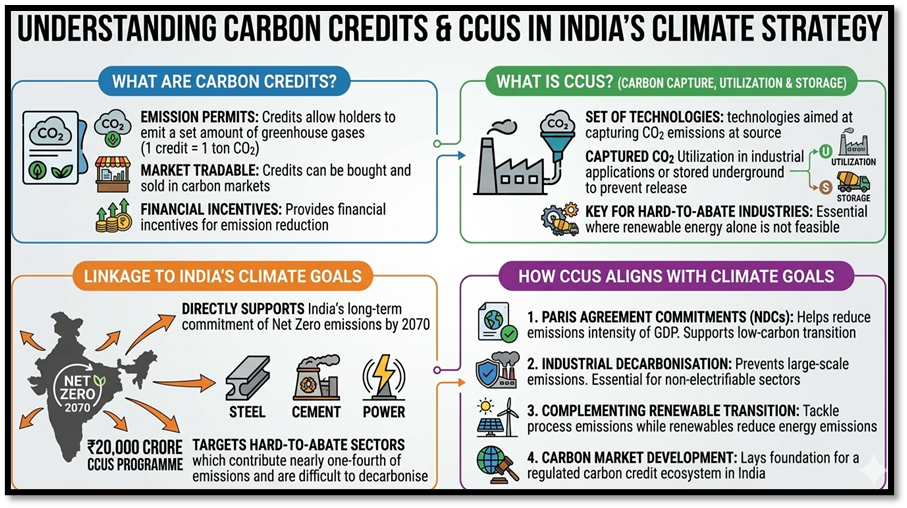
The Confusion Surrounding the Budget Announcement
- ₹20,000 Cr Allocation Focus: Budget 2026 funding is primarily for CCUS (Carbon Capture, Utilisation & Storage) in industrial sectors.
- Targeted Sectors: Power, steel, cement, refineries, and chemicals identified in DST’s R&D roadmap.
- The Role of Agriculture: Agriculture is not included in the CCUS sectors outlined in the roadmap. While agriculture does contribute to greenhouse gas emissions, primarily in the form of methane and nitrous oxide, these emissions are diffuse and biologically mediated, making them unsuitable for point-source capture technologies.
- However, Agriculture also contributes to carbon dioxide removal via soil carbon sequestration, agroforestry etc. Farmers can participate in carbon credit markets by adopting practices that reduce or sequester carbon, getting the reductions verified, and selling the resulting carbon credits.
- Farmer Narrative: Misinterpretation that funds will support farmers via carbon markets; actually refers to separate voluntary carbon market mechanisms.
- The Communication Gap: A communication gap between the DST’s technical roadmap and broader Budget language caused confusion; the usage of the words “carbon credit program” in budget announcement led to expectations of farmer support, though the focus is industrial carbon capture.
- Clarifying the Announcement: Govt must clearly separate CCUS funding (industry-focused) from potential farmer carbon market initiatives.
Way forward:
While CCUS targets major industrial emissions, a separate framework is needed to support agricultural carbon credits. Government must include all stakeholders farmers, experts, and industry in policy design. India’s climate strategy should simultaneously focus on reducing industrial emissions (“smokestack”) and enhancing carbon sequestration through agriculture and land use (“soil”).
Source: (The Hindu)
La Excellence IAS Academy, the best IAS coaching in Hyderabad, known for delivering quality content and conceptual clarity for UPSC 2026 preparation.
FOLLOW US ON:
◉ YouTube : https://www.youtube.com/@CivilsPrepTeam
◉ Facebook: https://www.facebook.com/LaExcellenceIAS
◉ Instagram: https://www.instagram.com/laexcellenceiasacademy/
GET IN TOUCH:
Contact us at info@laex.in, https://laex.in/contact-us/
or Call us @ +91 9052 29 2929, +91 9052 99 2929, +91 9154 24 2140
OUR BRANCHES:
Head Office: H No: 1-10-225A, Beside AEVA Fertility Center, Ashok Nagar Extension, VV Giri Nagar, Ashok Nagar, Hyderabad, 500020
Madhapur: Flat no: 301, survey no 58-60, Guttala begumpet Madhapur metro pillar: 1524, Rangareddy Hyderabad, Telangana 500081
Bangalore: Plot No: 99, 2nd floor, 80 Feet Road, Beside Poorvika Mobiles, Chandra Layout, Attiguppe, Near Vijaya Nagara, Bengaluru, 560040