
Paper: GS – II, Subject: Governance, Topic: Government Policies, Issue: Telangana’s Gig Workers Bill, 2026.
Context:
Telangana’s new law on gig workers reflects a structural shift in India’s labour policy as the gig economy expands rapidly without adequate worker protection. The core issue is balancing growth of platform-based services with legal recognition, social security, fair wages, and accountability of digital platforms.
Key Takeaways:
BACKGROUND:
- Gig economy refers to a labour market based on short-term, flexible, task-based work mediated through digital platforms rather than formal employment.
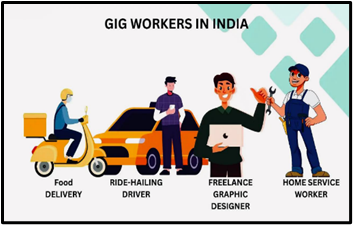
- Workers earn through services like ride-hailing, food delivery, logistics, freelancing via platforms such as Uber, Ola, Swiggy, Zomato, Urban Company.
- India has around 7–12 million gig workers, projected to reach 23.5 million by 2030.
- It contributes to employment generation, digital economy growth, and urban services expansion.
- Labour laws historically excluded gig workers as they are treated as independent contractors.
- Code on Social Security, 2020 recognised gig workers but lacks enforceable standards.
- Labour is in the Concurrent List, enabling states to legislate; hence multiple state-level laws have emerged.
- Globally, regulation is evolving toward hybrid models combining flexibility with social protection.
CORE ANALYSIS: LAW, ISSUES AND POLICY RESPONSE
- Telangana’s law provides legal recognition, mandatory registration, and unique IDs for gig workers to enable welfare delivery. Some other provisions are:
- A 1–2 percent levy on platform transactions creates a welfare fund managed by a statutory board providing insurance, pensions, and maternity benefits.
- Platforms must disclose transaction data, payment structures, and deductions, addressing opacity in algorithm-driven work allocation.
- Penalties and grievance redressal mechanisms aim to ensure compliance and protect workers from arbitrary actions.
- Similar laws in Rajasthan, Karnataka, Bihar, and Jharkhand reflect a broader policy trend, but implementation remains weak due to disputes over levies, delayed rules, and political changes. Jharkhand is the only state with operational progress.
- The gig economy drives employment, supports MSMEs, promotes digitalisation, and increases female labour participation, but workers face income instability, long hours, unsafe conditions, and lack of social security.
- Algorithmic management creates “black box” decision-making with no transparency or appeal, worsening worker vulnerability.
- India’s regulatory gap persists as over 80 percent of gig workers remain informal without minimum wage guarantees or legal safeguards.
- Policy responses include welfare boards, social security funds, and proposals for minimum pay standards, algorithm transparency, and grievance mechanisms.
- Effective reform requires combining national standards with state-level implementation, using platforms like e-Shram for portability and targeted welfare delivery.
WAY FORWARD:
- Establish a national framework ensuring minimum wages, social security, and worker rights.
- Ensure time-bound implementation of state laws with clear rules and stakeholder consensus.
- Mandate algorithm transparency and fair grievance redressal.
- Strengthen welfare delivery using digital infrastructure and portable benefits.
- Balance innovation with labour protection to sustain inclusive growth.
Syllabus Linkage: GS2 (Governance – Govt Interventions, Welfare schemes, labour policies) GS3 (Indian economy, employment, inclusive growth & Digital Economy).
Source: (The Indian Express)
La Excellence IAS Academy, the best IAS coaching in Hyderabad, known for delivering quality content and conceptual clarity for UPSC 2026 preparation.
FOLLOW US ON:
◉ YouTube : https://www.youtube.com/@CivilsPrepTeam
◉ Facebook: https://www.facebook.com/LaExcellenceIAS
◉ Instagram: https://www.instagram.com/laexcellenceiasacademy/
GET IN TOUCH:
Contact us at info@laex.in, https://laex.in/contact-us/
or Call us @ +91 9052 29 2929, +91 9052 99 2929, +91 9154 24 2140
OUR BRANCHES:
Head Office: H No: 1-10-225A, Beside AEVA Fertility Center, Ashok Nagar Extension, VV Giri Nagar, Ashok Nagar, Hyderabad, 500020
Madhapur: Flat no: 301, survey no 58-60, Guttala begumpet Madhapur metro pillar: 1524, Rangareddy Hyderabad, Telangana 500081
Bangalore: Plot No: 99, 2nd floor, 80 Feet Road, Beside Poorvika Mobiles, Chandra Layout, Attiguppe, Near Vijaya Nagara, Bengaluru, 560040