
Paper: GS – III, Subject: Economy, Topic: Infrastructure, Issue: India’s Nuclear Power Push: Targeting 100 GW by 2047.
Context:
India is planning a major expansion of nuclear power capacity to 100 GW by 2047, supported by proposed legal and policy reforms under the SHANTI Act, aiming to bring private participation and accelerate clean, reliable energy generation.
Key Takeaways:
BACKGROUND:
- Nuclear energy is the power stored within the nucleus (core) of an atom, released by splitting atoms (fission) or joining them (fusion). It releases vast amounts of energy, used primarily to generate low-carbon electricity in nuclear power plants by heating water into steam.
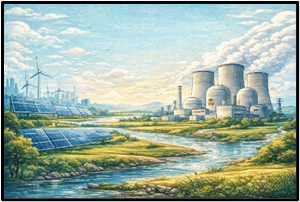
- Nuclear energy provides a consistent, 24/7 power source, while renewables are intermittent (solar/wind depend on weather). Hence, Nuclear energy complements renewables by providing stable baseload power.
- Current capacity: 8,180 MW across 24 reactors; contributes ~3% of electricity.
- Nuclear Power Corporation of India Limited (NPCIL): Public sector entity responsible for nuclear power generation.
CORE ANALYSIS:
Present development:
- In the Union Budget 2025–26, Government announced an ambitious plan to expand India’s nuclear power capacity from about 8,180 MW to 100 GW by 2047.
- The government also introduced the SHANTI Act (2025) – Sustainable Harnessing and Advancement of Nuclear Energy for Transforming India – to reform and modernise the nuclear energy sector.
- Earlier system: India’s nuclear sector was fully controlled by the Department of Atomic Energy, with a complete government monopoly and no role for private or foreign participation in nuclear power generation.
- Present system (SHANTI Act, 2025): Introduces private and foreign participation, strengthens regulation, reforms liability laws, and shifts the sector from a state monopoly to a mixed public–private model.
- India’s targets: India also have the target of Net zero by 2070 and energy transition away from fossil fuels.
- SHANTI Act aims to open the sector to private and possibly foreign investment, replacing restrictive frameworks like the 1962 Atomic Energy Act and the 2010 Civil Liability for Nuclear Damage Act (CLNDA).
Rationale:
- Rising electricity demand with economic growth and electrification.
- Renewables face intermittency; nuclear offers reliable baseload power.
- Coal dominance (75% generation) conflicts with climate commitments.
Key challenges:
- Nuclear power projects involve very high upfront capital costs and long construction periods, which pose financial and implementation challenges.
- Earlier liability laws, particularly under CLNDA, created legal uncertainties and high risks for suppliers, discouraging private and foreign investment.
- Several nuclear projects such as Jaitapur and Kovvada have faced prolonged delays, reflecting issues in project execution and regulatory clearances.
- India faces limitations in domestic manufacturing capacity and advanced reactor technology, which slows down rapid expansion.
Technological and policy solutions:
- There is increasing focus on Small Modular Reactors (SMRs), which are smaller, flexible, and potentially more cost-effective, enabling quicker deployment and suitability for industrial use.
- India’s Pressurised Heavy Water Reactor (PHWR) technology, particularly in the 220–700 MW range, has been successfully indigenised and offers a proven, scalable model for expansion.
- Investment in thorium-based nuclear fuel cycles and High Assay Low Enriched Uranium (HALEU) is being explored to leverage India’s abundant thorium reserves and ensure long-term energy security.
- Adoption of fleet-mode construction, where multiple reactors are built using standardised designs, can help achieve economies of scale and reduce construction time and costs.
Governance and regulatory issues:
- There is a need to strengthen the Atomic Energy Regulatory Board (AERB) as an independent and autonomous regulator to ensure safety and credibility.
- Clear policies are required on tariffs, fuel supply chains, radioactive waste management, insurance, and dispute resolution mechanisms to ensure smooth functioning of the sector.
- Transparent and innovative financing models are essential to attract large-scale private investment, given the capital-intensive nature of nuclear energy.
Global comparison:
- China rapidly expanding nuclear fleet with cost efficiency.
- Developed countries integrating nuclear with clean energy transitions.
CONCLUSION / WAY FORWARD:
- Implement SHANTI Act with clear regulatory and liability frameworks.
- Scale up indigenous technology and manufacturing capacity.
- Promote SMRs and advanced reactors for faster deployment.
- Ensure transparent pricing, financing, and regulatory independence.
- Integrate nuclear with renewables for a balanced energy mix.
UPSC SYLLABUS LINKAGE – GS PAPER III (Economy – Energy infrastructure; Science & Technology – Nuclear Technology; Environment – Sustainable development).
Source: (The Hindu)
La Excellence IAS Academy, the best IAS coaching in Hyderabad, known for delivering quality content and conceptual clarity for UPSC 2026 preparation.
FOLLOW US ON:
◉ YouTube : https://www.youtube.com/@CivilsPrepTeam
◉ Facebook: https://www.facebook.com/LaExcellenceIAS
◉ Instagram: https://www.instagram.com/laexcellenceiasacademy/
GET IN TOUCH:
Contact us at info@laex.in, https://laex.in/contact-us/
or Call us @ +91 9052 29 2929, +91 9052 99 2929, +91 9154 24 2140
OUR BRANCHES:
Head Office: H No: 1-10-225A, Beside AEVA Fertility Center, Ashok Nagar Extension, VV Giri Nagar, Ashok Nagar, Hyderabad, 500020
Madhapur: Flat no: 301, survey no 58-60, Guttala begumpet Madhapur metro pillar: 1524, Rangareddy Hyderabad, Telangana 500081
Bangalore: Plot No: 99, 2nd floor, 80 Feet Road, Beside Poorvika Mobiles, Chandra Layout, Attiguppe, Near Vijaya Nagara, Bengaluru, 560040