
In economics, goods are items that satisfy human wants. However, not all are the same. They differ based on how they are produced, used, and how people respond to them when income or prices change.
Understanding different types of goods helps us:
- Understand consumer behavior
- Analyze production and growth
- Design government policies
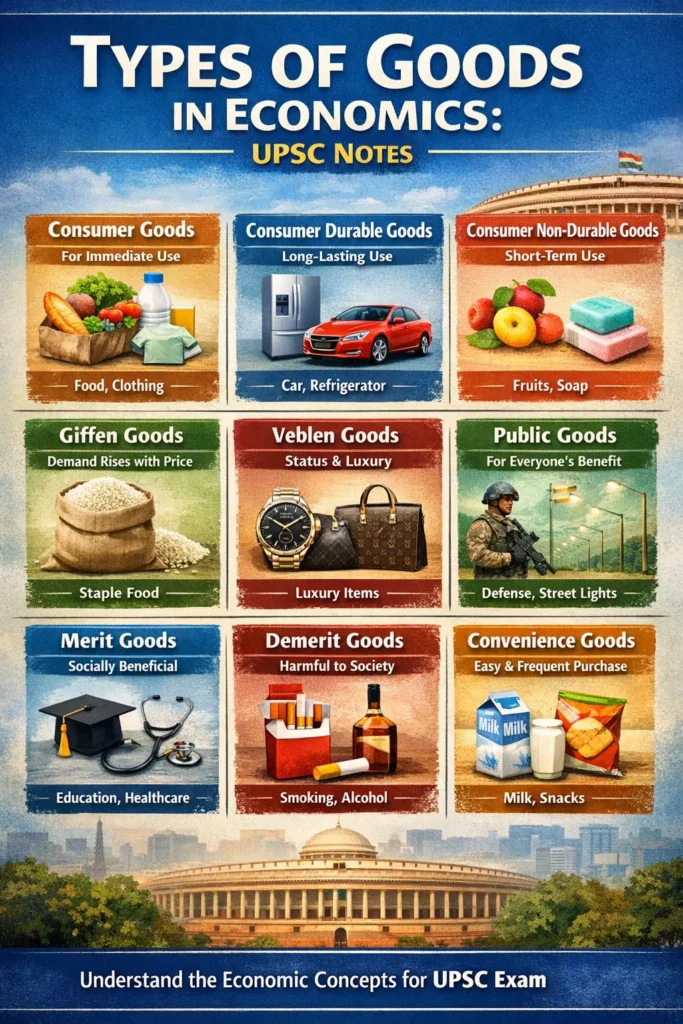
The following classifications explain these differences in a simple and structured way.
1. Normal Goods:
Normal goods are they whose demand increases as people’s income increases. When people earn more, they tend to buy more of these goods or choose better-quality versions.
They are commonly used in daily life and reflect improving living standards as income rises.
- Nature: Regular and commonly consumed goods
- Role: Increase consumption with rising income
- Utility: Improves as income increases
Examples:
- Clothing → Better quality → Higher demand
As income rises, people move from basic clothes to branded or higher-quality options. - Home appliances → Comfort → Increased use
People may upgrade from basic appliances to advanced ones like washing machines or air conditioners.
Normal goods show how better income leads to better consumption choices.
2. Inferior Goods:
Inferior goods are they whose demand decreases as income increases. When people earn more, they shift to better-quality or more preferred goods.
These are usually consumed when income is low and act as budget-friendly options.
- Nature: Lower-quality or less-preferred ones
- Role: Used when income is limited
- Utility: Reduces as income increases
Examples:
- Coarse grains → Basic food → Shift to better food
As income rises, people prefer rice, wheat, or processed foods instead. - Public transport → Daily travel → Shift to private vehicles
With higher income, people prefer bikes or cars.
They reflect how people upgrade their lifestyle as income improves.
3. Complementary Goods:
Complementary goods are those which are used together to satisfy a particular need. The demand for one depends on the demand for the other.
- Nature: Interdependent goods
- Role: Used together
- Utility: More useful when combined
Examples:
- Car → Petrol → Transportation
A car is useful only when fuel is available. - Mobile → Charger → Usage
A phone needs charging to function properly.
Complementary goods show how some goods depend on each other for usefulness.
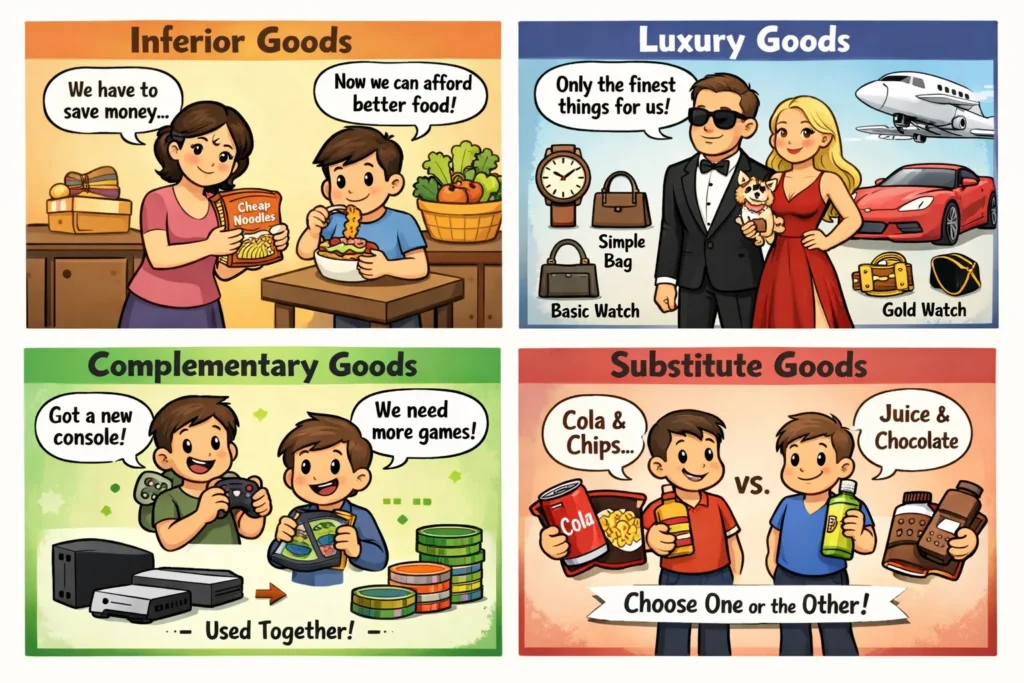
4. Substitute Goods:
Substitute goods are those that can replace each other and provide similar satisfaction. Consumers switch between them based on price or preference.
- Nature: Alternative options
- Role: Provide choice
- Utility: Similar satisfaction
Examples:
- Tea → Coffee → Beverage choice
If tea becomes expensive, people may switch to coffee. - Butter → Margarine → Replacement
Both can be used for similar purposes.
Substitute goods show how consumers adjust their choices based on changing conditions.
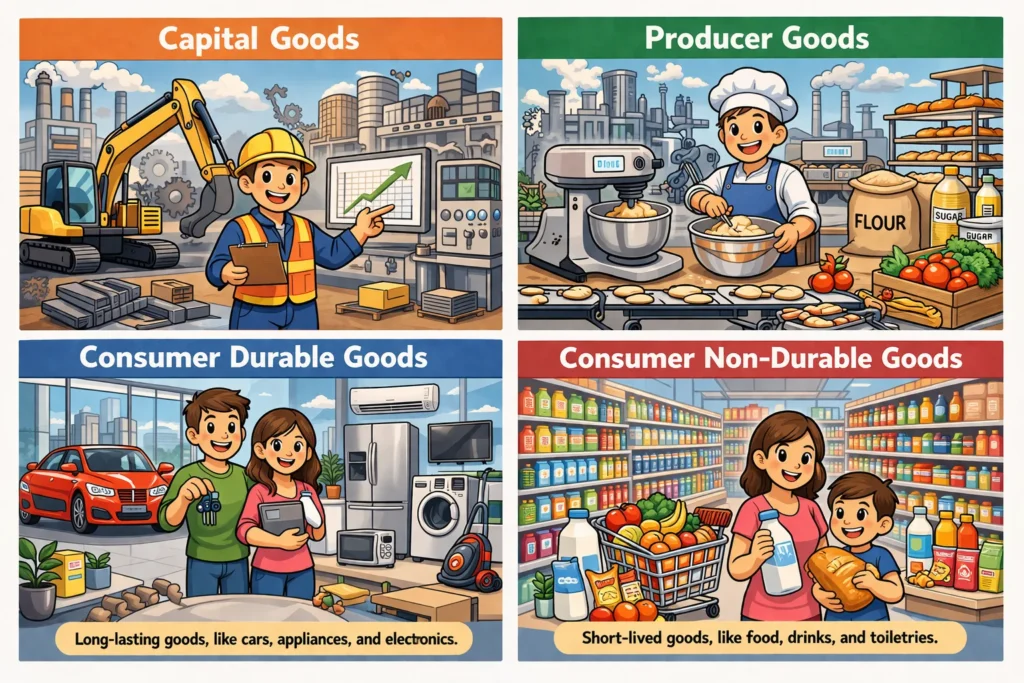
5. Capital Goods:
Capital goods are durable goods that are used in the production process to produce other goods and services. They are not used for direct consumption and can be used repeatedly over a long period of time.
These goods help in improving efficiency and increasing the overall capacity of production in an economy.
- Nature: Long-lasting and productivity-enhancing
- Role: Increase production capacity and efficiency
- Utility: Indirect, through the goods they help produce
Examples:
- Machinery → Factory → Production
Machines are used in factories to produce goods faster and in larger quantities. - Tools → Construction → Infrastructure
Tools are used in building roads, bridges, and buildings.
Capital goods represent investment in future growth, as they help expand production and support long-term economic development.
6. Consumer Goods:
Consumer goods are those that are used directly by people to satisfy their needs and wants. They are the final products of the production process and do not require any further transformation.
They provide immediate satisfaction and are the ultimate purpose for which all economic activities are carried out.
- Nature: Consumption-based and user-oriented
- Role: Provide direct satisfaction of human needs and wants
- Utility: Immediate and direct
a. Consumer Durable Goods:
Consumer durable goods are those that last for a long time and can be used repeatedly over a period of years. They are not consumed in a single use and continue to provide utility over time.
They usually require a higher initial spending, so consumers often plan before purchasing them.
- Nature: Long-lasting and non-perishable
- Role: Provide long-term use and repeated service
- Utility: Repeated over time
Examples:
- Refrigerator → Storage → Preservation
A refrigerator is used daily to store and preserve food for a long period. - Car → Travel → Mobility
A car provides transportation services over many years.
Consumer durables reflect planned and future-oriented consumption, where people invest in goods that provide value over a longer period.
b. Consumer Non-Durable Goods:
Consumer non-durables are those that are consumed quickly or have a short lifespan, and therefore need to be purchased frequently.
Thesy are essential for daily life and are used regularly to meet basic needs.
- Nature: Short-lasting and perishable
- Role: Immediate and regular consumption
- Utility: Short-term
Examples:
- Fruits → Eating → Nutrition
Fruits are consumed quickly and need to be bought again regularly. - Soap → Cleaning → Hygiene
Soap is used daily and gets finished in a short time.
Consumer non-durables reflect daily consumption patterns, where goods are repeatedly purchased to meet routine needs.
7. Giffen Goods:
Giffens are a rare type of inferior goods where demand increases even when the price increases, mainly among low-income consumers.
This happens because when the price of a basic good rises, poor consumers cannot afford better alternatives, so they end up buying more of the same cheaper ones to meet their basic needs.
- Nature: Rare and unusual type of inferior good
- Role: Survival-based consumption under income constraints
- Utility: Basic necessity
Examples:
- Staple food → Price rise → Higher consumption
If the price of a staple like rice or wheat increases, poor households may reduce spending on costly items like vegetables or meat and consume more of the staple food instead.
Giffens show an exception to the normal law of demand, where demand increases despite a rise in price due to strong income pressure.
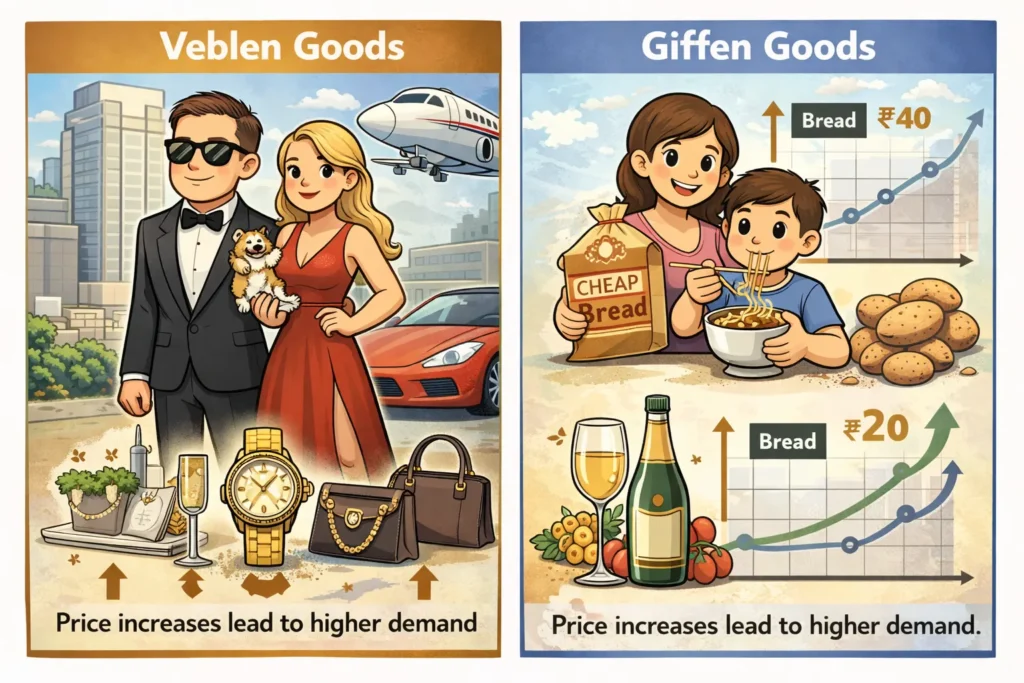
8. Veblen Goods:
Veblen goods are those whose demand increases as their price increases because they are seen as status symbols. People buy these goods not just for their use, but to show wealth, success, or social position.
In this case, a higher price makes the good more attractive, as it signals exclusivity and prestige.
- Nature: Prestige-driven and high-status goods
- Role: Show wealth and social standing
- Utility: Symbolic, along with functional use
Examples:
- Luxury watches → Status → Demand rises
Expensive watches are purchased not just to tell time, but to reflect success and lifestyle. - Designer brands → Prestige → Identity
People prefer high-end brands to express identity and social position.
Veblens show how consumer behavior is influenced by social status and perception, where higher prices can actually increase demand.
9. Public Goods:
Public goods are those that are available to everyone and cannot be restricted to specific individuals. Once they are provided, all people can use them without reducing their availability to others.
They are usually not provided efficiently by the market, so the government plays an important role in supplying them.
- Nature: Non-rival (one person’s use does not reduce others’) and non-excludable (cannot be restricted)
- Role: Provide benefits to the entire society
- Utility: Shared by all individuals
Examples:
- National defence → Security → Public benefit
Protection provided by the army benefits all citizens equally. - Street lights → Safety → Community use
Street lighting improves safety and can be used by everyone in the area.
Public goods highlight the importance of government provision, as they ensure collective welfare and cannot be efficiently managed through private markets.
10. Private Goods:
Private goods are goods that are owned and consumed by individuals, and others can be excluded from using them. Also, when one person uses them, they are not available for others.
These goods are usually bought and sold in the market and are allocated through prices.
- Nature: Rival (one person’s use reduces availability for others) and excludable (can restrict others from using)
- Role: Satisfy individual needs through market transactions
- Utility: Direct and personal
Examples:
- Food → Consumption → Individual use
If one person eats food, it cannot be consumed by someone else. - Clothing → Wearing → Personal use
Clothes are owned and used by individuals and cannot be shared in the same way simultaneously.
Private goods represent market-based consumption, where goods are distributed based on purchasing power and ownership.
11. Merit Goods:
Merit goods are goods that are beneficial for individuals as well as society, but are often under-consumed in a free market. This happens because people may not fully understand their long-term benefits or may not be able to afford them.
They create positive effects not only for the individual but also for society as a whole.
- Nature: Socially beneficial and welfare-enhancing
- Role: Improve individual well-being and overall social welfare
- Utility: Long-term benefits
Examples:
- Education → Skills → Growth
Education improves individual skills and also contributes to economic development. - Healthcare → Health → Productivity
Good health increases productivity and reduces the burden on society.
Merit goods show why the government encourages their consumption, often through subsidies, schemes, or public provision, to ensure better outcomes for society.
12. Demerit Goods:
Demerit goods are those that are harmful to individuals and society and are often over-consumed in a free market. People may consume them because of addiction, lack of awareness, or short-term satisfaction, without considering their long-term negative effects.
These goods create negative impacts not only on individuals but also on society as a whole.
- Nature: Socially harmful and welfare-reducing
- Role: Lead to negative social and economic outcomes
- Utility: Provides short-term pleasure but long-term harm
Examples:
- Smoking → Health damage → Social cost
Smoking harms health and increases healthcare burden on society. - Alcohol → Addiction → Economic burden
Excessive alcohol consumption can lead to addiction, reduced productivity, and social issues.
Demerit goods show why the government discourages their consumption, through measures like taxes, regulations, and awareness campaigns to protect public welfare.
UPSC Prelims 2021 Question:
Consider the following statements:.
1Q. Other things remaining unchanged, market demand for a good might increase if:
- price of its substitute increases
- price of its complement increases
- the good is an inferior good and income of the consumers increases
- its price falls
Which of the above statements are correct?
(a) 1 and 4 only
(b) 2, 3 and 4
(c) 1, 3 and 4
(d) 1, 2 and 3
For more such preparation strategies, you can read here: https://laex.in/category/preparation-strategy/
La Excellence IAS Academy, the best IAS coaching in Hyderabad, known for delivering quality content and conceptual clarity for UPSC 2025 preparation.
FOLLOW US ON:
◉ Youtube : https://www.youtube.com/@CivilsPrepTeam
◉ Facebook: https://www.facebook.com/LaExcellenceIAS
◉ Instagram: https://www.instagram.com/laexcellenceiasacademy/
GET IN TOUCH:
Contact us at info@laex.in, https://laex.in/contact-us/
or Call us @ +91 9052 29 2929, +91 9052 99 2929, +91 9154 24 2140
OUR BRANCHES:
Head Office: H No: 1-10-225A, Beside AEVA Fertility Center, Ashok Nagar Extension, VV Giri Nagar, Ashok Nagar, Hyderabad, 500020
Madhapur: Flat no: 301, survey no 58-60, Guttala begumpet Madhapur metro pillar : 1524, Rangareddy Hyderabad, Telangana 500081
Bangalore: Plot No: 99, 2nd floor, 80 Feet Road, Beside Poorvika Mobiles, Chandra Layout, Attiguppe, Near Vijaya Nagara, Bengaluru, 560040.