
Paper: GS – II, Subject: Polity/Governance, Topic: Rights issues/ Accountability and Transparency, Issue: Custodial Deaths: Bridging Law and Reality.
Context:
The article analyses the conviction of police personnel in the Sathankulam custodial deaths case (2020, Tamil Nadu) and highlights it as a moment of accountability and systemic reflection.
Key Takeaways:
SATHANKULAM CASE:
- During the COVID-19 lockdown, Jayaraj was arrested on false charges of curfew violation, and his son Benicks was also detained when he went to inquire.
- Both were brutally tortured in police custody and later died, revealing deep-rooted police brutality.
- After six years, nine police officials were convicted, marking a rare instance of accountability and partial justice.
- The case, investigated by the CBI amid wider data on custodial deaths, highlights a systemic problem of police impunity rather than an isolated incident.
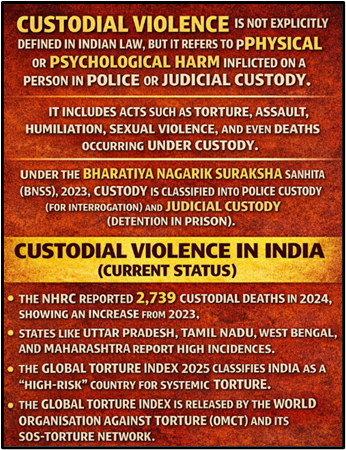
HOW IS CUSTODIAL VIOLENCE REGULATED IN INDIA?
CONSTITUTIONAL PROVISIONS:
- Article 21 guarantees the right to life and personal liberty, including protection from torture and inhuman treatment.
- Article 20(1) prohibits retrospective and excessive punishment.
- Article 20(3) protects against self-incrimination and coerced confessions.
LEGAL PROVISIONS:
- Bharatiya Nyaya Sanhita (2023) penalises causing hurt or grievous hurt to extract confessions.
- Bharatiya Nagarik Suraksha Sanhita (BNSS, 2023) mandates lawful arrest procedures and documentation.
- Bharatiya Sakshya Adhiniyam (2023) invalidates confessions obtained through coercion.
INTERNATIONAL SAFEGUARDS:
- The Universal Declaration of Human Rights (1948) and ICCPR (ratified by India in 1979) prohibit torture and ensure dignity.
- The UN Convention against Torture (UNCAT), adopted in 1984 and effective from 1987, obligates states to prevent and punish torture and uphold non-refoulement.
- India signed UNCAT in 1997 but has not ratified it, limiting enforceability of its provisions domestically.
DIRECTIVES & REFORMS:
- The Law Commission (273rd Report, 2017) recommended ratification of UNCAT and a dedicated anti-torture law.
- In DK Basu vs State of West Bengal (1997), the Supreme Court laid down mandatory arrest guidelines and held the State accountable for custodial violence.
CORE TAKEAWAY:
- Custodial violence in India persists despite strong constitutional and legal safeguards due to weak enforcement and accountability.
- The Sathankulam conviction is significant but highlights the need for deeper police reforms and institutional oversight.
- Bridging the gap between legal protections and ground reality is essential for ensuring justice and protecting human dignity.
Source: (The Indian Express)
La Excellence IAS Academy, the best IAS coaching in Hyderabad, known for delivering quality content and conceptual clarity for UPSC 2026 preparation.
FOLLOW US ON:
◉ YouTube : https://www.youtube.com/@CivilsPrepTeam
◉ Facebook: https://www.facebook.com/LaExcellenceIAS
◉ Instagram: https://www.instagram.com/laexcellenceiasacademy/
GET IN TOUCH:
Contact us at info@laex.in, https://laex.in/contact-us/
or Call us @ +91 9052 29 2929, +91 9052 99 2929, +91 9154 24 2140
OUR BRANCHES:
Head Office: H No: 1-10-225A, Beside AEVA Fertility Center, Ashok Nagar Extension, VV Giri Nagar, Ashok Nagar, Hyderabad, 500020
Madhapur: Flat no: 301, survey no 58-60, Guttala begumpet Madhapur metro pillar: 1524, Rangareddy Hyderabad, Telangana 500081
Bangalore: Plot No: 99, 2nd floor, 80 Feet Road, Beside Poorvika Mobiles, Chandra Layout, Attiguppe, Near Vijaya Nagara, Bengaluru, 560040