
Lessons from the essay toppers and a better structure to stay ahead of the curve
JUN 24, 2026
With gratitude to the toppers whose published strategies and copies inform this piece Anudeep Durishetty (AIR 1, 2017), whose guide is the foundation many of us learned from, along with Ramesh Verma (AIR 150, CSE 2023), Gautam Vivekanandan (AIR 211, CSE 2022), Mehak Jain (AIR 17), and Kalpana Pandey (Rank 102). Links to their original posts and copies are at the end.
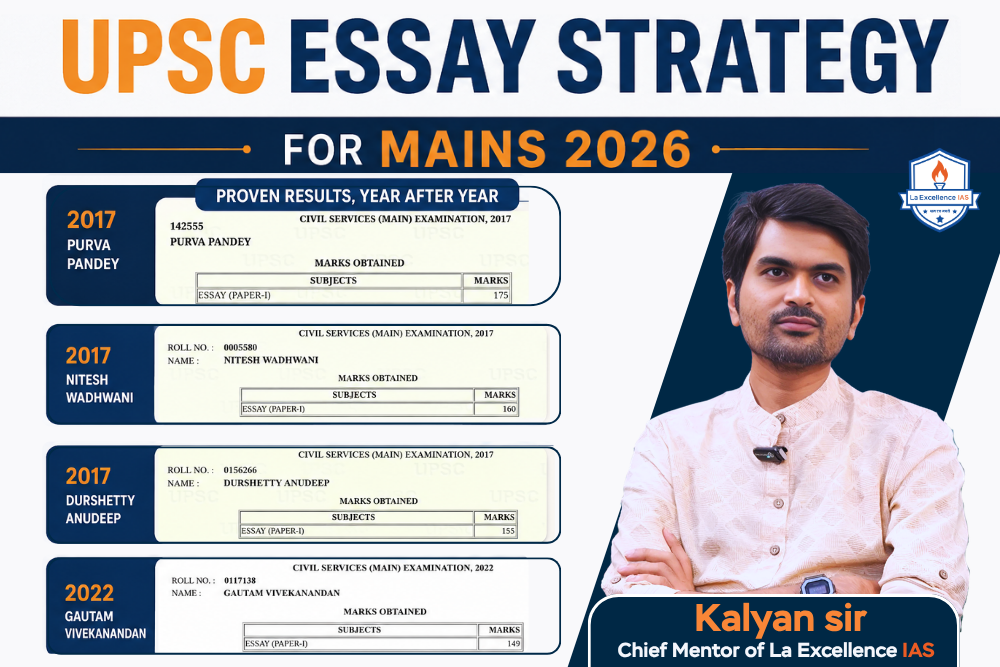
Let me begin with a little history because you cannot understand where the essay paper is going until you see where it has been.
When I started watching this paper closely, around 2011 to 2014, the topics were dynamic. They were not philosophical riddles they were issues. You could take a topic and simply run with it, applying one lens after another: the political angle, the economic angle, the historical angle, the social angle. We tried permutations and combinations. Some worked, some backfired, but the game was clear show range, cover dimensions, don’t miss an angle.
Then from roughly 2014 to 2020, UPSC more or less rewarded the PESTLE / SPELIH approach. You took the topic, you marched it through Social–Political–Economic–Legal–International–Historical, and a competent, well-stocked candidate could score respectably. The structure was the strategy.
But since 2020, something has shifted and in my humble opinion, in the last two years the PESTLE/SPELIH approach is no longer merely unrewarded, it is quietly punished. The topics have turned philosophical. The evaluators have started rewarding something the old template cannot produce: originality, organic thinking, and above all, flow.
Here is the uncomfortable truth that follows from this. The community has, by now, more or less standardised the thesis–antithesis–synthesis structure. Almost everyone accepts it. Whenever you praise something (thesis), you then show its negatives (antithesis), and then you find the balance (synthesis). The toppers may not name it, but subconsciously they do it. So why are so many sincere, hard-working aspirants still stuck at 100?
Because everyone is now following the same template. When a structure becomes universal, it stops being a differentiator. It becomes the floor, not the ceiling.
And yet look at the copies of Gautam Vivekanandan, of Harshita Goyal, of Kalpana Pandey in recent years. While the crowd scores 100, these candidates scored 140 and above. They did not abandon thesis–antithesis–synthesis. They brought something newto the table inside it. What was that something? In a word: they wrote like people thinking, not like candidates filling slots. Their essays had originality, flow, and a kind of simplicity that never tips into verbosity.
For me, that is the whole game. When I read your essay, I should feel that you are on the paper that a real person is thinking in front of me. My three parameters for a high-scoring essay are simple: originality, flow, and simplicity (not verbosity). I genuinely believe Gautam Vivekanandan is outstanding on exactly these three. That is the standard.
And you needn’t take my word for it take his. In his own strategy note, Gautam (AIR 211, CSE 2022) writes that “essays should be free flowing and creative,” that the writing “should not feel like paragraphs are mechanically placed together,” and most tellingly that “repetitive use of any set template may make your essay boring and it will also not allow your brain to be more creative.”
That is the 149-scorer himself telling you why the templated crowd is stuck at 100. He also makes a point I want you to underline: he chose his topics “Poets are the unacknowledged legislators of the world” and “A smile is the chosen vehicle for all ambiguities” not because they were unusual, but because he was comfortable in them and could write with conviction. He is emphatic that unique topics do not equal good marks. So do not chase the rare topic; choose the one you can write honestly and well.
So what should be your benchmark for 2026? This is my small contribution to the community.
We will keep the thesis–antithesis–synthesis spirit but I want to make it more organic, and I would like to give it a fourth move that almost everyone is missing. I will name the four moves like this:
1. Agree Limitations Reality Balance.
Please understand from the start: this is not a template you must obey. This is a direction for your thinking a way to walk through a topic so that nothing important is missed. The reader should never see these four labels on your page. They should only feel a person reasoning, clearly and honestly. Let me explain each in two lines, and then we will walk through one topic together.
- Agree Make the strongest case for the statement. Lead with the reason the thesis holds, then bring an example to prove it. This room runs on argument-plus-example, not on examples alone.
- Limitations Test the limits of the statement. Where does the idea break? What does it quietly assume? Here you attack the idea itself this is analysis, supported by a few examples.
- Reality This is the move that separates 140 from 100. Even granting the idea is true and beautiful, who actually gets to live it? You stop judging the idea and start mapping the people the idea leaves out. This is observation of how the ideal is distributed across real lives.
- Balance Close the gap between the ideal and the reality. Offer the way forward on two levels: Inner (values, resilience, awareness) and Outer (institutions, law, policy, the ecosystem).
A word on why I add the third move, Reality, when most frameworks do not. The finest published essay anatomies including the well-known guide by Anudeep Durishetty (AIR 1, 2017), which runs introduction → elaboration → antithesis → synthesis → conclusion give you thesis, antithesis and synthesis, and then stop. That is Hegel’s dialectic, and it is genuinely good.
But notice what it leaves out: even after you have argued an idea, conceded its limits, and resolved them, you have said nothing about who in the real world actually gets to live the ideal. That is the gap Reality fills, and it is, in my experience, exactly the gap between a 110 essay and a 145 one.
2. The golden rule before we start: rationale first, example second
Here is the single most useful idea I can hand you for the elaboration, and it comes from Ramesh Verma (AIR 150, CSE 2023), who scored one of the highest essay marks in his year comfortably above 145 and is an IAS officer today. He noticed a fundamental flaw in how almost everyone writes the body of an essay. The common approach is to give example after example across the political, economic, social and other dimensions and stop there, as if examples alone prove a point.
But an argument is not proved by examples alone. It is proved by stating the underlying rationale the reason the thesis holds and then supporting that reason with an example. The example illustrates the argument; it is not the argument itself.
Let me show you the difference with his own illustration, on the topic “Thinking is like a game…”. The ordinary candidate walks straight into the example:
“In 1991, India faced the Balance of Payments crisis, which forced us to rethink our economic policy and led to liberalisation, privatisation and globalisation. Hence, thinking is like a game.”
Ramesh Verma’s tweak states the rationale first, and only then brings the same example in to support it:
“Often we are confronted with problems that threaten our survival or our way of life. Such situations naturally force us to think and to find solutions to overcome them. For example, the 1991 Balance of Payments crisis…”
Same example. But the whole structure has shifted. Instead of:
Example 1, hence proved. Example 2, hence proved. Example 3, hence proved.
you now have:
Rationale 1 (+ supporting example). Rationale 2 (+ example). Rationale 3 (+ example). These reasons together lead us to believe the thesis is true.
That is a far more persuasive way to put across your points and it is the difference between an essay that lists and an essay that argues. So the rule is simple: never lead with the example. Lead with the reason, and let the example follow to prove it. And the more unique, organic and dynamic the example you choose, the better.
One small thing students forget, but which matters: neatness and good handwriting help. Not as a rule, but on a sliding scale the neater your presentation, the better your essay is received. The evaluator is human, reading hundreds of copies.
Now here is the part nobody trains enough, and it is the real hero of this paper: brainstorming.
It is not enough to brainstorm; you must brainstorm for the right example. Imagine every possible example on a scale of one to ten. There is a “two” example and there is a “nine” example for the same point. Your job in those first thirty minutes is to find the nine, or at least a six or seven.
Think of a good essay like an ECG report. Small peak, small peak, then a big spike, then the steady beat, then another big spike. As long as the line stays above the baselineas long as your examples stay at six, seven, eight, nine the reader’s interest never drops. A “two” or “three” example sends the line below the baseline, and the essay suddenly feels ordinary and boring.
You cannot run at nine throughout that is impossibly hard, and it would exhaust the reader. But the floor should never fall below six, and once in a while a perfect ten lands and elevates the reader’s mood he actually feels happy reading it. That rhythm steady high, occasional spike, never a dip below the line is what a wonderful essay feels like.
So: brainstorm hard, wrap arguments around your best examples, keep the ECG above the line. Now let us walk through a real topic.
Worked example: “Not all who wander are lost”
Agree the wanderer is the one who finds the new road
The first move is to make the case and remember Ramesh Verma’s rule: rationale first, example second. Do not open with the name. Open with the reason, then let the example prove it.
Some truths cannot be reached by the straight road. The deepest answers often lie off the map entirely, and only the one willing to leave the familiar path will ever stumble upon them. Consider the Buddha: he left his palace with no destination, and it was precisely that wandering that refusal to settle for the answers he had been handed that led him, years later, to enlightenment under the Bodhi tree. His was not aimless drifting. It was searching.
Notice the order. First the rationale (some truths lie off the straight road), then the example (the Buddha) arriving to prove it. The reason is the steady line of the ECG; the example is the spike. You may then add a second rationale with its own example Darwin’s undirected voyage on the Galápagos, a founder who “wandered” into the idea that made him each one carrying a thought, none of them a mere name in a list. Build three or four such rationale-plus-example pairs, and you have not listed your way to the thesis; you have argued your way there.
#Essay. #Essay. #Essay. #Essay. #Essay
Limitations but wandering without a compass is just drifting
Now turn and test the limits of the statement itself. Be careful: here you question the idea, not the people.
But is every wanderer truly not lost? Sometimes, when you wander, you are lost because you have no inner compass, no thesis, no sense of why you set out. A founder who pivots endlessly with no conviction is not exploring; he is failing slowly. The maxim flatters the drifter exactly as warmly as it honours the seeker, and it gives us no way to tell the two apart. Wandering becomes wisdom only when there is something beneath it a direction the eye cannot see.
That is a genuine limitation of the claim. It is incomplete: it assumes a compass that may not be there.
Reality the road is open to some and closed to others
This is the most interesting move, and the one I most want you to learn. Reality is not another counter-argument. You already questioned the idea in Limitations. Reality asks a completely different question: granting the idea is true who can actually afford to live it?
Here is the test that keeps the two apart forever:
If your sentence judges the idea, it is Limitations. If your sentence maps the people the idea leaves out, it is Reality.
Now watch. To wander, you first need a choice and the choice to wander is not equally distributed.
Consider scientific research, which is wandering in its purest form following curiosity with no guaranteed destination. But to wander in research, you need budget. You need the bandwidth to fail. A frugal agency like ISRO, or an Indian startup counting every rupee, cannot afford to wander too far it must hit its target on the first attempt, because it has no margin to explore and fail and explore again.
Contrast this with SpaceX: Elon Musk could let rocket after rocket explode on the launchpad, because he had the resources to treat failure as exploration. Both are “wandering” toward the stars but one is free to wander and the other is not. Wandering, it turns out, is a privilege that money buys.
And the same truth runs at the human level:
The rich man’s son backpacks across Europe for a year and calls it “finding himself.” The poor man’s son who leaves his job to find himself simply becomes unemployed. The privileged choose to wander; the migrant, the displaced, the desperate are forced onto the road and we must never confuse the two. For most of humanity, wandering does not end under a Bodhi tree. It ends in being genuinely, permanently lost.
Feel the difference? Nobody is saying the idea is wrong. We are mapping who gets to live it institutions with budget versus institutions without, the cushioned versus the precarious. That is Reality, and it is the move that lifts an essay from good to extraordinary.
When students ask me how to generate this on the spot, I give them a small set of templates. Keep two in your pocket and you will never be empty:
- The privilege template: “To live X, you quietly need Y money, time, a safety net. Those without Y are shut out before they begin.”
- The chosen-vs-forced template: “For some, X is freely chosen; for others the very same X is forced upon them and the two must never be confused.”
- The most-people-don’t template: “The statement assumes people do X; most don’t X at all they are too pressed, too scared, too constrained.”
- The survivorship template: “We celebrate the few for whom X worked; we never count the many for whom the same X ended in ruin.”
You need only two of these per essay, built well. Two real Reality paragraphs beat ten thin ones.
Balance clearing the road for everyone
The final move closes the gap between the ideal and the reality, on two levels.
- Inner: Cultivate the compass that turns wandering into exploration curiosity, reflection, the resilience to fail and continue. Without an inner direction, wandering is only drifting.
- Outer: Build the ecosystem that lets everyone afford to wander research funding that tolerates failure, a forgiving education system that allows second chances, a society that lets the explorer return without shame. When ISRO is funded to fail and learn, and when a young person can take a risk without falling through the floor, wandering stops being a luxury of the privileged and becomes a path open to all.
One iron rule for this room: every solution must answer a problem you raised in Limitations or Reality. If your “way forward” replies to nothing earlier in the essay, it is the boilerplate the examiner has read ten thousand times.
Conclusion circle back to where you began
If you have walked the four moves honestly, your conclusion is already in your hand. Concede the truth, add the caveat Reality demands, and return to your opening image.
Not all who wander are lost but only those who can afford to wander are truly free to find themselves. The Buddha could leave his palace because he had one to leave. A just society does not merely admire the wanderer; it funds the failing experiment and builds the floor beneath the seeker, so that everyone and not only the fortunate may set out without fear of never finding the way home.
What gives you the edge in 2026?
Notice what just happened. Nowhere in that essay did the words “Agree,” “Limitations,” “Reality,” or “Balance” appear. The reader saw only a person thinking making a case, testing it, noticing who gets left out, offering a way forward. The four moves were invisible. They lived in the thirty minutes of brainstorming before the writing, and then they disappeared into flow.
If you want to stay ahead of the crowd next year, here is the simplest advice I can give you. Most candidates will deploy the same tired examples in the same tired order. You should aim, on any point, for roughly two well-known examples and one fresh or unexpected one a unique perspective, an angle the evaluator has not seen in the previous four hundred copies. The ISRO-versus-SpaceX framing of “wandering” above is exactly that kind of move: a familiar idea seen through a window nobody else opened.
And never lose the three parameters. Simplicity, flow, and clarity of thought. Not verbosity. Not jargon. Not a parade of frameworks. Just clean, honest, well-built thinking that the reader can follow without effort the steady ECG that never dips below the line.
The four moves are your training wheels. Drill them until the walk becomes instinct, until you no longer need to think “now I am in Reality.” And then do the bravest thing a writer can do: forget the scaffolding entirely, and write your own essay. That is the day your line stays above the baseline on its own and that is the day UPSC rewards you the way it rewarded Gautam, Harshita, and Kalpana.
The framework was never the destination. It was only the road. And not all who wander through it are lost.
#Essay. #Essay. #Essay. #Essay. #Essay
Sources and further reading
The topper strategies and copies that inform this piece are worth studying in full, in their own words:
- Anudeep Durishetty (AIR 1, 2017) the foundational guide on how to approach the essay paper, from which the dialectical anatomy used here descends: anudeepdurishetty.in/writing-a-good-essay-in-upsc-mains-explained
- Ramesh Verma (AIR 150, CSE 2023) on the rationale-first method and the anatomy of a philosophical essay: t.me/air150rameshverma
- Gautam Vivekanandan (AIR 211, CSE 2022) his essay strategy and the copies behind his 149: t.me/GautamAIR211CSE22/14
- Mehak Jain (AIR 17) essay approach and copy: t.me/mehak_jainAIR17/304
My gratitude to all of them. The Agree-Limitations-Reality-Balance approach above is my own synthesis, but it stands on the shoulders of their generosity in sharing what worked for them.
Please share your thoughts on the same, if you like it, please share it with others.
Thank you
Kalyan
Chief Mentor, La Excellence IAS Academy, Hyderabad
For more such preparation strategies, you can read here: https://laex.in/category/preparation-strategy/
La Excellence IAS Academy, the best IAS coaching in Hyderabad, known for delivering quality content and conceptual clarity for UPSC 2025 preparation.
FOLLOW US ON:
◉ Youtube : https://www.youtube.com/@CivilsPrepTeam
◉ Facebook: https://www.facebook.com/LaExcellenceIAS
◉ Instagram: https://www.instagram.com/laexcellenceiasacademy/
GET IN TOUCH:
Contact us at info@laex.in, https://laex.in/contact-us/
or Call us @ +91 9052 29 2929, +91 9052 99 2929, +91 9154 24 2140
OUR BRANCHES:
Head Office: H No: 1-10-225A, Beside AEVA Fertility Center, Ashok Nagar Extension, VV Giri Nagar, Ashok Nagar, Hyderabad, 500020
Madhapur: Flat no: 301, survey no 58-60, Guttala begumpet Madhapur metro pillar : 1524, Rangareddy Hyderabad, Telangana 500081
Bangalore: Plot No: 99, 2nd floor, 80 Feet Road, Beside Poorvika Mobiles, Chandra Layout, Attiguppe, Near Vijaya Nagara, Bengaluru, 560040.