
Context
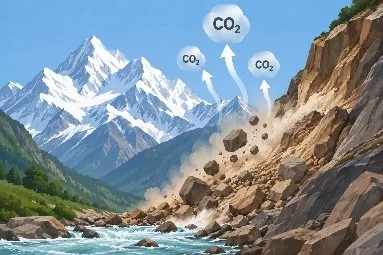
A study of the upper Indus basin finds that rapid glacier-driven erosion exposes sulphide minerals such as pyrite. Their oxidation can trigger chemical reactions that release CO₂, partly counteracting the carbon-removal effect of silicate weathering.
Explanation
- Himalayan uplift and glaciers continuously expose fresh rocks to air and water.
- Silicate weathering consumes atmospheric CO₂ and stores carbon in ocean sediments over geological time.
- However, exposed pyrite, an iron sulphide, undergoes oxidation and produces sulphuric acid.
- This acid reacts with carbonate rocks, releasing geological CO₂ into the atmosphere.
- Researchers used sulphur and oxygen isotopes to trace the process.
- In the upper Indus basin, CO₂ release from sulphide oxidation may exceed uptake by silicate weathering.
- Steep, rapidly eroding mountains can become net carbon sources, while flatter downstream floodplains may act as carbon sinks.
La Excellence IAS Academy, the best IAS coaching in Hyderabad, known for delivering quality content and conceptual clarity for UPSC 2026 preparation.
FOLLOW US ON:
◉ YouTube : https://www.youtube.com/@CivilsPrepTeam
◉ Facebook: https://www.facebook.com/LaExcellenceIAS
◉ Instagram: https://www.instagram.com/laexcellenceiasacademy/
GET IN TOUCH:
Contact us at info@laex.in, https://laex.in/contact-us/
or Call us @ +91 9052 29 2929, +91 9052 99 2929, +91 9154 24 2140
OUR BRANCHES:
Head Office: H No: 1-10-225A, Beside AEVA Fertility Center, Ashok Nagar Extension, VV Giri Nagar, Ashok Nagar, Hyderabad, 500020
Madhapur: Flat no: 301, survey no 58-60, Guttala begumpet Madhapur metro pillar: 1524, Rangareddy Hyderabad, Telangana 500081
Bangalore: Plot No: 99, 2nd floor, 80 Feet Road, Beside Poorvika Mobiles, Chandra Layout, Attiguppe, Near Vijaya Nagara, Bengaluru, 560040
Himalayan Erosion Can Release Carbon Dioxide