
Paper: GS – II, Subject: Polity, Topic: Legislature, Issue: Indian Parliament – Effectiveness.
Context:
India’s parliamentary democracy is weakening as the executive increasingly dominates decision-making, reducing legislative debate, scrutiny, and accountability undermining the intended balance of the Westminster model.
Key Highlights:
Key Evidence of Decline:
- Sharp Drop in Sitting Days: The first Lok Sabha averaged 135 days annually (1952-1957), while the 17th Lok Sabha (2019-2024) averaged only 55 days, the lowest for any full-term house, with 274 total sittings affected by early adjournments and the 2020 pandemic.
- Minimal Legislative Scrutiny: 58% of bills passed within two weeks of introduction, 35% with under an hour’s debate, and only 16% referred to committees, far below prior Lok Sabhas.
- Disrupted Accountability Tools: Question Hour ran 60% of scheduled time; no adjournment motions discussed; private members’ bills (729 introduced) saw just two debated.
Increasing Executive Dominance:
- The executive sets the legislative agenda and often sidelines the Opposition.
- Notices for discussions, adjournment motions, and demands for urgent debate are routinely rejected.
- Important Bills are passed within minutes, with minimal discussion. This disrupts the foundational democratic principle: “The government may have its way, but the Opposition must have its say.”
Weakening of Accountability Mechanisms:
- Question Hour and Zero Hour, crucial daily tools for holding the government accountable, are frequently disrupted or curtailed.
- These sessions traditionally allow members to question ministers and raise public issues.
Role of Anti-Defection Law:
- Enacted to prevent floor-crossing, the 1985 law now binds MPs to party whips, risking disqualification for dissent and stifling independent judgment on budgets, impeachments, or key votes.
- This shifts MPs from constituency representatives to party delegates, paralyzing debate and fostering executive control.
Dilution of Parliamentary Committees:
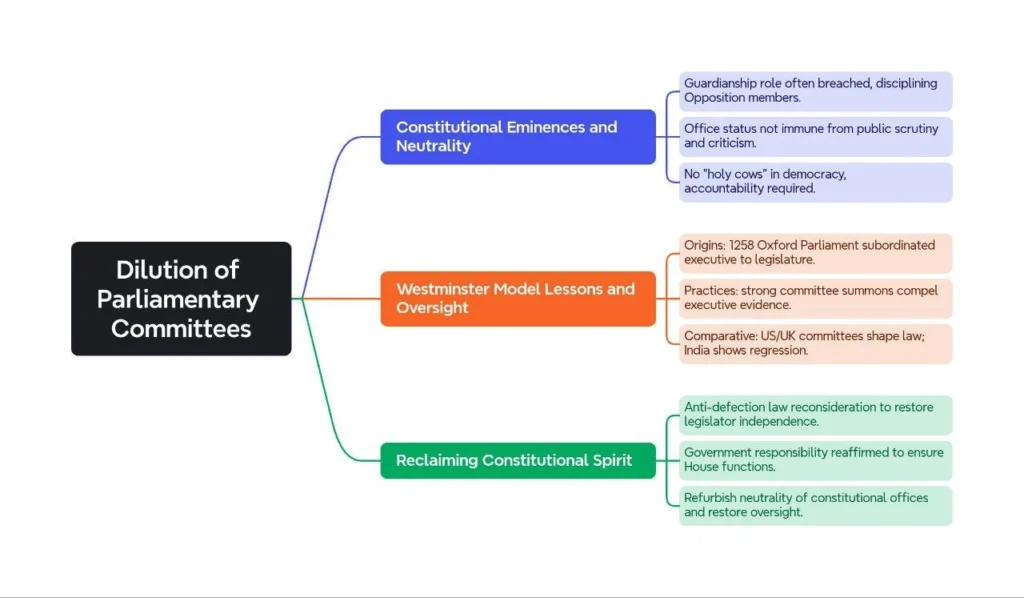
India’s parliamentary decline is not irreversible. But reversing it requires collective political will and strong institutional reforms. Parliament must once again become a forum of free debate, legislative scrutiny, and democratic vibrancy.
La Excellence IAS Academy, the best IAS coaching in Hyderabad, known for delivering quality content and conceptual clarity for UPSC 2025 preparation.
FOLLOW US ON:
◉ YouTube : https://www.youtube.com/@CivilsPrepTeam
◉ Facebook: https://www.facebook.com/LaExcellenceIAS
◉ Instagram: https://www.instagram.com/laexcellenceiasacademy/
GET IN TOUCH:
Contact us at info@laex.in, https://laex.in/contact-us/
or Call us @ +91 9052 29 2929, +91 9052 99 2929, +91 9154 24 2140
OUR BRANCHES:
Head Office: H No: 1-10-225A, Beside AEVA Fertility Center, Ashok Nagar Extension, VV Giri Nagar, Ashok Nagar, Hyderabad, 500020
Madhapur: Flat no: 301, survey no 58-60, Guttala begumpet Madhapur metro pillar: 1524, Rangareddy Hyderabad, Telangana 500081
Bangalore: Plot No: 99, 2nd floor, 80 Feet Road, Beside Poorvika Mobiles, Chandra Layout, Attiguppe, Near Vijaya Nagara, Bengaluru, 560040