
Paper: GS – III, Subject: Indian Economy, Topic: Service Sector, Issue: Aviation and Telecom Disruptions’.
Context:
The rise and fall of two disruptive forces in the Indian market: IndiGo in aviation and Vodafone in telecom. Both companies initially injected competition, lowered prices, and improved services.
- However, their success was short-lived due to factors like market shifts, policy weaknesses, and regulatory challenges.
Key Highlights:
IndiGo: The Rise and Regulatory Turbulence:
- Disruption: IndiGo launched in 2006 as a low-cost carrier, revolutionizing the Indian aviation sector.
- Impact: Domestic passenger traffic surged from 25 million in 2005-06 to over 152 million by 2024.
- IndiGo’s focus on cost efficiency led to lower airfares.
- Market Dominance: IndiGo currently controls over 60% of the domestic market with a large fleet and extensive route network.
- Regulatory Issues: IndiGo faced regulatory scrutiny for allegedly ignoring revised flight duty time limitations designed to reduce pilot fatigue.
- Strategic Miscalculation: IndiGo may have strategically assumed that the regulator would not strictly enforce the new rules, leading to flight cancellations and fare increases.
- Regulatory Intervention: The regulator intervened with capacity cuts and fare controls, highlighting the consequences of non-compliance.
Vodafone: From Innovation to Policy Predicament:
- Early Entry: Vodafone (formerly Hutchison Max) entered the Indian telecom market in 1994, contributing to its growth and competitiveness.
- Price Reduction: Vodafone’s innovations, such as low-value prepaid packs, drove down telecom tariffs significantly.
- Market Growth: Teledensity rose from 2.3% in 1999 to nearly 86% by 2024, partly due to Vodafone’s contributions.
- Policy Weaknesses: Vodafone’s decline is attributed to India’s policy and regulatory weaknesses.
- AGR Dues: In 2019, Vodafone was required to pay massive dues based on a broader definition of “adjusted gross revenues,” which severely impacted its financial stability.
- Government Ownership: Vodafone is now partially owned by the government, reflecting the impact of policy decisions on the company’s fate.
Conclusion:
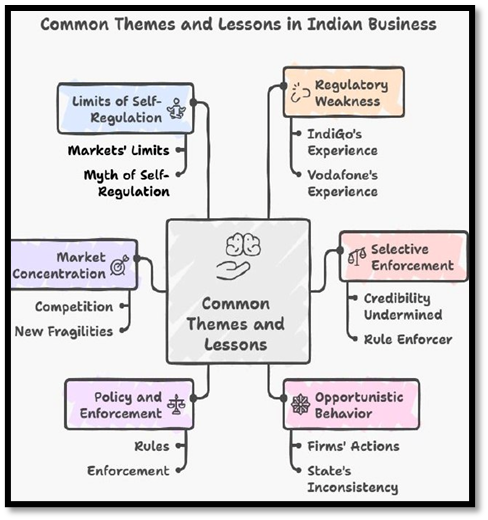
The experiences of IndiGo and Vodafone show how inconsistent regulation in India can shape business outcomes, highlighting the need for balanced, predictable policy enforcement to ensure sustainable growth and stable competition.
Source: (Live Mint)
La Excellence IAS Academy, the best IAS coaching in Hyderabad, known for delivering quality content and conceptual clarity for UPSC 2026 preparation.
FOLLOW US ON:
◉ YouTube : https://www.youtube.com/@CivilsPrepTeam
◉ Facebook: https://www.facebook.com/LaExcellenceIAS
◉ Instagram: https://www.instagram.com/laexcellenceiasacademy/
GET IN TOUCH:
Contact us at info@laex.in, https://laex.in/contact-us/
or Call us @ +91 9052 29 2929, +91 9052 99 2929, +91 9154 24 2140
OUR BRANCHES:
Head Office: H No: 1-10-225A, Beside AEVA Fertility Center, Ashok Nagar Extension, VV Giri Nagar, Ashok Nagar, Hyderabad, 500020
Madhapur: Flat no: 301, survey no 58-60, Guttala begumpet Madhapur metro pillar: 1524, Rangareddy Hyderabad, Telangana 500081
Bangalore: Plot No: 99, 2nd floor, 80 Feet Road, Beside Poorvika Mobiles, Chandra Layout, Attiguppe, Near Vijaya Nagara, Bengaluru, 560040