
Paper: GS – II, Subject: Polity, Topic: Federalism/Governance, Issue: Delimitation Dilemma: Population vs Federal Fairness.
Context:
India is preparing for the 2027 Census, which will be the first fully digital Census and will be followed by delimitation of constituencies after 2026. Simultaneously, debates have intensified regarding seat redistribution, women’s reservation, and inclusion of marginalised communities like Denotified Tribes (DNTs).
Key Takeaways:
Background:
- The Census of India is conducted every 10 years under the Census Act, 1948, by the Office of the Registrar General and Census Commissioner under the Ministry of Home Affairs, and it forms the basis for governance, planning, and representation.
- Delimitation is the process of redrawing constituencies and reallocating seats in Parliament based on population, as mandated by Article 81 of the Constitution.
- Since the 1971 Census, seat allocation has been frozen to encourage population control, and this freeze will end after 2026.
- Currently, multiple debates are ongoing regarding delimitation, federal balance, and Social Justice (women’s reservation, and enumeration of marginalised communities), making Census 2027 politically and constitutionally significant.
- The core concern is how to balance population-based representation, federal fairness, and social justice in the upcoming political restructuring.
Census 2027, Digital Transformation, and Legal Framework:
- The upcoming 16th Census (2027) will be India’s first fully digital and synchronous Census, including provisions for self-enumeration followed by verification.
- The Census is a Union subject (Entry 69, Seventh Schedule) and is conducted under the Census Act, 1948.
- As per the law, Census data is strictly confidential, and respondents are required to provide information to the best of their knowledge.
- Only aggregate data is released, and individual-level data cannot be shared with States, judiciary, or under the Right to Information Act.
- This confidentiality ensures trust, accuracy, and participation, but it also limits the use of Census data for individual-level policy targeting.
- The Census will also include household-level socio-economic details, including caste enumeration debates, although methodology is still under consideration.
- The accuracy of Census is critical because it directly affects delimitation, fiscal transfers, welfare schemes, and political representation.
Delimitation and Federalism Debate (Based on the Opinion in THE HINDU: “Ensuring federalism within delimitation”)
- Article 81 mandates that representation in Lok Sabha should be proportional to population, ensuring equality of vote value.
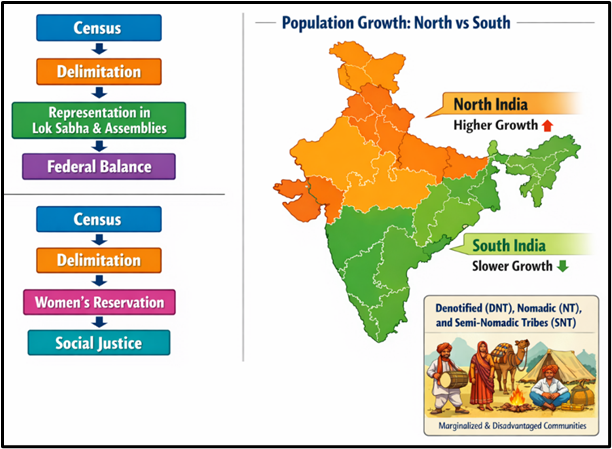
- However, due to population control disparities, states have diverged significantly in demographic growth patterns.
- Southern states like Tamil Nadu, Kerala, and Karnataka have achieved replacement fertility rates (TFR ~2.1 or lower) earlier, while northern states like Bihar and Uttar Pradesh still have higher fertility rates.
- If delimitation is conducted purely on population basis, northern states will gain more seats, and southern states will lose relative political influence.
- This creates a federal tension, as states that controlled population growth may be penalised.
- The article suggests a Demographic Performance (DemPer) model, which gives weight to both population size and fertility reduction performance.
- For example, 10% weight may be given to early achievers of fertility control and 90% to recent improvements, ensuring fairness.
- This approach is similar to the Finance Commission formula, which balances equity and efficiency.
- The proposal ensures that all states gain seats in absolute terms, but better-performing states do not lose their share disproportionately.
- It emphasises that democracy is not just about numbers but also about fairness and federal stability.
- The article argues that delimitation should not be seen as a north versus south issue, as many northern states have also adopted population control measures.
Government Proposals and Political Dynamics (Based on the Article in INDIAN EXPRESS: “The long game behind BJP govt rethink on women’s quota: What comes next?”)
- There is a proposal to increase Lok Sabha seats from 543 to 816, adding 273 seats, partly aligning with women’s reservation.
- Another proposal suggests linking delimitation to the 2011 Census instead of 2026–27 Census, which has raised concerns about outdated data usage.
- It has also been proposed that the proportion of seats among states may not be altered, even if total seats increase, meaning all states get proportional increases.
- A Delimitation Commission is expected to be constituted, which will implement decisions once approved politically.
- Southern states fear that delimitation may favour northern states politically, leading to a regional imbalance.
- Additionally, southern states argue that they are already losing out in central fiscal allocations due to population control success.
- Constitutional amendments will be required for major changes, needing two-thirds majority in Parliament and ratification by half of the states.
- Critics question the logic of conducting delimitation using older Census data, as it may undermine democratic accuracy and makes new delimitation exercise irrelevant.
Women’s Reservation and Its Link to Delimitation (Based on the Article in INDIAN EXPRESS: “The long game behind BJP govt rethink on women’s quota: What comes next?”)
- The Women’s Reservation law proposes 33% reservation for women in Lok Sabha and State Assemblies.
- However, its implementation is linked to delimitation, meaning reservation will come into effect only after constituencies are redrawn.
- Women’s reservation is expected to transform policy priorities, including health, education, welfare, and gender justice.
- Evidence from Panchayati Raj institutions shows that greater women’s participation improves governance outcomes.
- However, concerns remain regarding political feasibility, opposition response, and constitutional requirements.
- Women’s reservation combined with delimitation may reshape electoral politics and representation patterns significantly.
Denotified and Nomadic Tribes (DNT/NT) and Census Inclusion (Based on the Article in INDIAN EXPRESS: “Denotified, Nomadic Tribes have always been ignored. Census can fix that”)
- Denotified and Nomadic Tribes are the communities, which were historically labelled as “criminal tribes” under Criminal Tribes Act 1871 Act by the British (i.e labelled as born criminals). Government of India later denotified these tribes after independence by removing the Act in 1952.
- Despite this, they continue to face extreme marginalisation, lack of recognition, and policy invisibility.
- These communities are not uniformly classified and may appear under SC, ST, OBC, or remain unclassified.
- The key demand of these communities is based on three Cs: Cognisance, Categorisation, and Counting.
- They demand separate enumeration in Census 2027 and creation of a new constitutional category beyond SC and ST.
- The Renke Commission (2008) estimated their population at around 10.74 crore, highlighting their scale.
- The Idate Commission (2017) identified around 1,200 communities and recommended proper classification and enumeration.
- The Anthropological Survey of India and Tribal Research Institutes (2023) have attempted to fill data gaps.
- Community leaders have approached the Supreme Court demanding inclusion in Census, making it a major policy issue.
- The lack of enumeration results in exclusion from welfare schemes, political representation, and affirmative action benefits.
- The article highlights that invisibility in Census leads to invisibility in governance.
Broader Implications: Democracy, Federalism, and Social Justice
- The upcoming Census and delimitation exercise will redefine political representation in India for decades.
- It raises fundamental questions about the nature of democracy:
- Whether representation should be purely population-based or adjusted for fairness.
- It highlights the tension between democratic equality and federal balance.
- It brings attention to social justice gaps, especially for communities like DNTs that remain outside formal classification.
- It also shows that data (Census) is the foundation of power (representation).
- The debate reflects a shift from quantitative democracy (numbers) to qualitative democracy (fairness, inclusion, stability).
- The success of this transition will determine whether India can maintain unity, federal stability, and inclusive governance.
FINAL UPSC TAKEAWAY:
The Census and delimitation exercise is not merely administrative but a constitutional rebalancing of power. India must ensure that the process simultaneously upholds democratic equality, federal fairness, and social inclusion.
Source: (The Indian Express, The Hindu)
La Excellence IAS Academy, the best IAS coaching in Hyderabad, known for delivering quality content and conceptual clarity for UPSC 2026 preparation.
FOLLOW US ON:
◉ YouTube : https://www.youtube.com/@CivilsPrepTeam
◉ Facebook: https://www.facebook.com/LaExcellenceIAS
◉ Instagram: https://www.instagram.com/laexcellenceiasacademy/
GET IN TOUCH:
Contact us at info@laex.in, https://laex.in/contact-us/
or Call us @ +91 9052 29 2929, +91 9052 99 2929, +91 9154 24 2140
OUR BRANCHES:
Head Office: H No: 1-10-225A, Beside AEVA Fertility Center, Ashok Nagar Extension, VV Giri Nagar, Ashok Nagar, Hyderabad, 500020
Madhapur: Flat no: 301, survey no 58-60, Guttala begumpet Madhapur metro pillar: 1524, Rangareddy Hyderabad, Telangana 500081
Bangalore: Plot No: 99, 2nd floor, 80 Feet Road, Beside Poorvika Mobiles, Chandra Layout, Attiguppe, Near Vijaya Nagara, Bengaluru, 560040