
Paper: GS – III, Subject: Economy, Topic: Inclusive Growth and Development, Issue: The Political Economy of India’s North–South Divide.
Context:
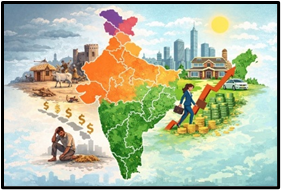
The article discusses the growing economic and political divide between North India (Hindi heartland) and South India (Peninsular states) and warns that this divide may deepen further due to future delimitation of parliamentary seats based on population.
Key Takeaways:
- Background: India’s development trajectory historically rested on the belief that faster-growing regions would eventually pull slower regions forward, creating a balanced economy, but this assumption is now weakening as regional disparities persist and harden into structural inequalities. Two broad economic geographies have emerged, where southern and peninsular States show higher per capita incomes, better human development indicators, and stronger institutional outcomes, while the Hindi heartland continues to lag in income, health, education, and social indicators, creating a mismatch between economic productivity and demographic weight. This divergence creates a fundamental imbalance in a democracy, where economic power lies in the South while political power is increasingly concentrated in the more populous northern States, setting the stage for long-term tension.
- Structural Divide and Dual Economies: India today resembles two distinct economies coexisting within one sovereign space, where the southern States display characteristics similar to upper middle-income economies in terms of income, literacy, and health, while large parts of the northern heartland remain comparable to lower-income regions, indicating that the gap is no longer transitional but structural and persistent.
- Mismatch Between Economic and Political Power: Unlike stable federations (like USA, Canada and Australia etc) where economic strength aligns with political representation, India is witnessing a situation where regions generating higher economic output have lower demographic weight, while regions with higher population but lower productivity dominate political representation, creating a productive minority versus political majority dynamic that may distort incentives and policy priorities.
- Delimitation as a Potential Flashpoint: Future delimitation based on population may significantly increase parliamentary representation of northern States while reducing the relative voice of southern States, thereby amplifying the imbalance between economic contribution and political influence and potentially weakening the voice of regions driving national growth.
- Possible Future Scenarios: If current trends continue, the country may move toward regional conflict where economically productive regions feel overburdened by redistribution pressures, or alternatively adopt a new balanced representation model that combines population with State equality to prevent dominance by larger States and preserve federal stability.
- Internal Crisis Within the South: Despite higher incomes, the southern States face deep internal inequalities where wealth is concentrated in urban clusters while rural areas and labour segments experience stagnation, indicating that growth has been uneven and captured by a narrow elite rather than distributed across society.
- Middle Income Trap Risk: The South risks getting trapped in a middle-income stage where growth slows because benefits do not translate into widespread consumption, productivity gains, or social mobility, as high incomes coexist with low wages and persistent inequality, limiting long-term progress.
- Lack of convergence: The expectation that poorer regions would naturally catch up has not materialised, as income gaps remain large and persistent, suggesting that market-led growth alone cannot ensure balanced regional development.
- Migration and social tension: Migration from northern to southern States helps meet labour demand but creates a class of internal migrants who remain socially and politically disconnected, leading to the emergence of internal outsiders rather than integration.
- Institutional constraints: Weak governance structures, uneven institutional capacity and persistent social inequalities limit the ability of even advanced regions to convert economic growth into broad-based development outcomes.
- Rethinking development: Development cannot be measured only through GDP growth or urban wealth, but must reflect improvements in wages, rural conditions and inclusivity, highlighting the gap between headline growth and lived reality.
- Need for dialogue and federal balance: Rising tensions require calm and evidence-based dialogue that recognises regional concerns of both Northern India and Southern India, while avoiding excessive centralisation and ensuring a balanced federal structure.
Conclusion:
India must move towards a model of balanced federalism that aligns economic contribution with fair representation, reduces regional disparities, strengthens institutions and ensures that growth benefits reach all sections of society, as failure to address this divide could deepen structural fault lines and threaten long-term national unity.
Source: (The Hindu)
La Excellence IAS Academy, the best IAS coaching in Hyderabad, known for delivering quality content and conceptual clarity for UPSC 2026 preparation.
FOLLOW US ON:
◉ YouTube : https://www.youtube.com/@CivilsPrepTeam
◉ Facebook: https://www.facebook.com/LaExcellenceIAS
◉ Instagram: https://www.instagram.com/laexcellenceiasacademy/
GET IN TOUCH:
Contact us at info@laex.in, https://laex.in/contact-us/
or Call us @ +91 9052 29 2929, +91 9052 99 2929, +91 9154 24 2140
OUR BRANCHES:
Head Office: H No: 1-10-225A, Beside AEVA Fertility Center, Ashok Nagar Extension, VV Giri Nagar, Ashok Nagar, Hyderabad, 500020
Madhapur: Flat no: 301, survey no 58-60, Guttala begumpet Madhapur metro pillar: 1524, Rangareddy Hyderabad, Telangana 500081
Bangalore: Plot No: 99, 2nd floor, 80 Feet Road, Beside Poorvika Mobiles, Chandra Layout, Attiguppe, Near Vijaya Nagara, Bengaluru, 560040