
Paper: GS – II, Subject: Polity, Topic: Elections and RPA, Issue: Increase of Election Expenditure in India and Unequal Political Participation.
Context:
Elections in India are increasingly becoming expensive, raising concerns about unequal access to political participation and the growing influence of money power, potentially leading towards a plutocratic tendency in democracy.
Key Takeaways:
BACKGROUND:
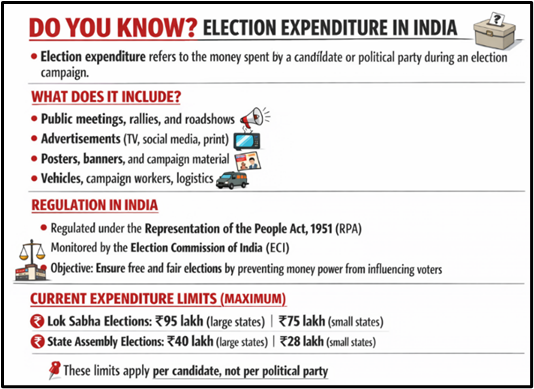
- Plutocracy refers to a system where power is concentrated in the hands of the wealthy.
- India follows a first-past-the-post electoral system where candidates with the highest votes win, increasing incentives for high spending.
Explanation:
- The article discusses the problem of high election spending in India and how it affects fairness in democracy.
- It highlights that many candidates spend far more than the legal limit, often through unaccounted or cash transactions.
- It explains that election spending is difficult to monitor, because:
- A large portion of money is spent informally (Ex: Cash transactions).
- There are loopholes in reporting and enforcement.
- The article points out that wealthy candidates and big political parties have an advantage because:
- They can mobilize more financial resources.
- They can spend heavily on campaigns, advertisements, and outreach.
- As a result, smaller parties and independent candidates are pushed out, since:
- They cannot compete financially.
- Elections become less about ideas and more about money power.
- The concept of a “level playing field” is questioned, meaning:
- Ideally, all candidates should have equal opportunity.
- In reality, money creates unequal competition.
- Some experts suggest raising the limit because they claim candidates spend illegally because current allowed spending limits are low.
- The article also discusses whether raising the spending limit is a solution:
- Increasing limits may help candidates spend legally.
- But it may also further benefit already rich candidates.
- Hence, it is described as a “catch-22 situation” (a problem with no easy solution).
- Transparency and accountability are essential principles of democratic elections.
- Electoral funding includes donations, corporate funding, and earlier instruments like electoral bonds.
- Corporate funding and opaque donation mechanisms increase the influence of vested interests in policymaking.
- The Supreme Court’s scrapping of electoral bonds improved transparency partially, but opacity in political funding persists.
- The idea of State funding of elections (Funding comes from govt to all candidates preventing personal funding) is debated but faces challenges due to India’s multi-party system and scale of elections.
- Imposing strict expenditure caps on parties may push spending underground, increasing black money usage.
- Increasing limits may legitimise higher spending without addressing inequality.
- Lack of transparency in corporate donations raises ethical concerns, as companies do not have voting rights but influence elections.
- Civil society plays a role in spreading awareness, but voter behaviour is still influenced by money and patronage.
- Structural issues such as voter expectations and clientelism sustain high spending patterns.
Way forward:
It highlights that political reforms require strong political will, which is currently lacking. Ensuring free and fair elections requires a balance between transparency, accountability, and realistic regulation of campaign finance, alongside electoral reforms and greater public awareness.
Source: (The Hindu)
La Excellence IAS Academy, the best IAS coaching in Hyderabad, known for delivering quality content and conceptual clarity for UPSC 2026 preparation.
FOLLOW US ON:
◉ YouTube : https://www.youtube.com/@CivilsPrepTeam
◉ Facebook: https://www.facebook.com/LaExcellenceIAS
◉ Instagram: https://www.instagram.com/laexcellenceiasacademy/
GET IN TOUCH:
Contact us at info@laex.in, https://laex.in/contact-us/
or Call us @ +91 9052 29 2929, +91 9052 99 2929, +91 9154 24 2140
OUR BRANCHES:
Head Office: H No: 1-10-225A, Beside AEVA Fertility Center, Ashok Nagar Extension, VV Giri Nagar, Ashok Nagar, Hyderabad, 500020
Madhapur: Flat no: 301, survey no 58-60, Guttala begumpet Madhapur metro pillar: 1524, Rangareddy Hyderabad, Telangana 500081
Bangalore: Plot No: 99, 2nd floor, 80 Feet Road, Beside Poorvika Mobiles, Chandra Layout, Attiguppe, Near Vijaya Nagara, Bengaluru, 560040