
Paper: GS – II, Subject: Polity, Topic: Judiciary, Issue: POCSO Fast-Track Courts.
Context:
India expanded fast-track POCSO courts to over 400 in 2025, but despite quicker case disposal, falling conviction rates and persistent investigative and support gaps raise concerns about justice for child survivors.
Key Takeaways:
The Promise and the Reality of POCSO:
- The POCSO Act, enacted in 2012, aimed to address the specific vulnerabilities of child victims of sexual offences.
- It promised child-friendly procedures, time-bound trials, and a system that prioritized the child’s well-being.
- To expedite justice, fast-track special courts were established, and by 2025, these courts appeared to be making significant progress, clearing more cases than were registered
The Numbers Don’t Tell the Whole Story:
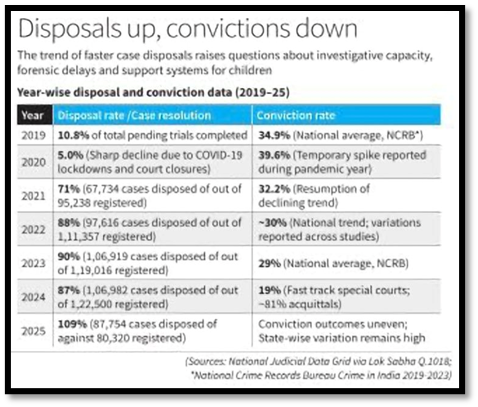
While the increased disposal rate of POCSO cases by fast-track courts might seem like a victory, the data reveals a concerning decline in conviction rates.
- Declining Conviction Rates: Conviction rates have fallen from 35% in 2019 to 29% by 2023. This indicates that while cases are being processed faster, the quality of justice is suffering.
- Expected vs. Actual Convictions: Based on the 2019 baseline, a 90% disposal rate should have resulted in a 45% conviction rate. The actual rate of 29% is significantly lower, indicating a systemic problem.
- Weaker Convictions: The faster pace of trials appears to be compromising the strength of convictions, with many accused walking free.
Systemic Issues Undermining Justice:
Several factors contribute to the decline in conviction rates and the overall failure to deliver true justice to child survivors:
- Hurried Investigations: Investigations are often rushed, leading to incomplete charge sheets and delayed forensic reports. Overcrowded courts in states like Uttar Pradesh and Maharashtra.
- Lack of Support Persons: Support persons, mandated by the Supreme Court to guide children through the legal process, are often absent.
- Absence of Para-Legal Volunteers (PLVs): PLVs, intended to be the first line of defense at police stations, are often missing.
- Inadequate Compensation: Courts often delay ordering interim compensation, even when a child’s schooling or health is at risk.
- Financial Burden on Families: Marginalized families often incur significant debt to cover travel and legal expenses, further exacerbating their hardship.
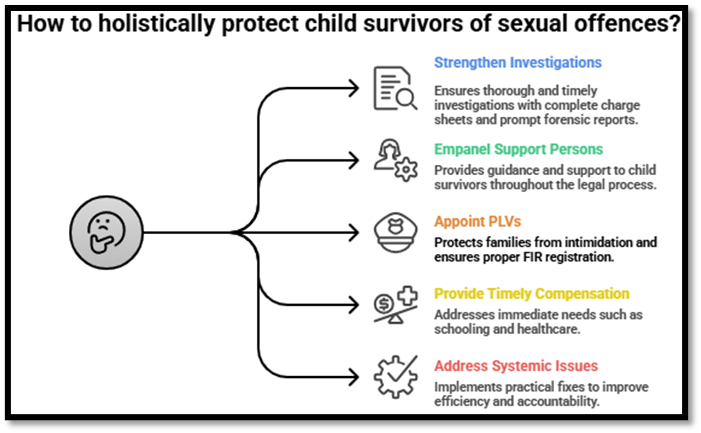
While the establishment of fast-track special courts for POCSO cases is a positive step, the focus on speed should not come at the expense of justice. The declining conviction rates and the lack of adequate support for child survivors indicate that the system is failing to deliver on its promise.
Source: (The Hindu)
La Excellence IAS Academy, the best IAS coaching in Hyderabad, known for delivering quality content and conceptual clarity for UPSC 2026 preparation.
FOLLOW US ON:
◉ YouTube : https://www.youtube.com/@CivilsPrepTeam
◉ Facebook: https://www.facebook.com/LaExcellenceIAS
◉ Instagram: https://www.instagram.com/laexcellenceiasacademy/
GET IN TOUCH:
Contact us at info@laex.in, https://laex.in/contact-us/
or Call us @ +91 9052 29 2929, +91 9052 99 2929, +91 9154 24 2140
OUR BRANCHES:
Head Office: H No: 1-10-225A, Beside AEVA Fertility Center, Ashok Nagar Extension, VV Giri Nagar, Ashok Nagar, Hyderabad, 500020
Madhapur: Flat no: 301, survey no 58-60, Guttala begumpet Madhapur metro pillar: 1524, Rangareddy Hyderabad, Telangana 500081
Bangalore: Plot No: 99, 2nd floor, 80 Feet Road, Beside Poorvika Mobiles, Chandra Layout, Attiguppe, Near Vijaya Nagara, Bengaluru, 560040