
Paper: GS – II, Subject: International Relations, Topic: India relations with Major Nations, Issue: Comparison of India–U.S. Strategic Relations.
Context:
In 2005, India and the U.S. were reshaping a historic strategic partnership, symbolised by the civil nuclear deal, amidst optimism about India’s rise. In 2025, the U.S. National Security Strategy (NSS) reflects a more defensive, uncertain America, viewing India less as a global partner and more through its competition with China.
Key Highlights:
The Retreat Reflected in the 2025 NSS:
- Self-Praise and Defensive Assertiveness:
- The 2025 NSS is characterized by self-congratulatory rhetoric and a defensive tone.
- It projects a nation unsure of its global role, yet unwilling to acknowledge this uncertainty.
- Shift from Partnership to Burden-Sharing:
- The U.S. now speaks the language of burdens, seeking to minimize its global leadership responsibilities.
- The focus has shifted from elevating the international system to lightening America’s load.
- Instrumental View of India:
- Cooperation with India is acknowledged, but it is primarily instrumental.
- India is framed as a component in America’s China strategy, rather than as a civilizational actor in its own right.
- The NSS emphasizes the need to improve relations with India to encourage its contribution to Indo-Pacific security, particularly through the Quad.
- India’s Rise as a Function, Not an Objective:
- In 2005, India’s rise was seen as a positive objective in itself.
- Now, it is viewed as a function of U.S. strategic interests.
- Inward Turn and Unilateralism:
- The U.S. is exhibiting an inward turn, exemplified by the “Trump Corollary to the Monroe Doctrine.”
- This involves asserting and enforcing hemispheric exclusivity.
- The U.S. is claiming expansive and unilateral autonomy, which it terms “realism.”
Implications for India
- Reduced Reliance on U.S. Support:
- India cannot assume that the U.S. will invest in its rise as a matter of strategic design.
- India’s rise will depend on its own capabilities and strategic confidence.
- Conditional and Limited Support:
- U.S. support will be conditional and limited, with partners expected to assume primary responsibility for their regions.
- Burden-Shifting, Not Burden-Sharing:
- The U.S. is increasingly focused on burden-shifting rather than genuine burden-sharing.
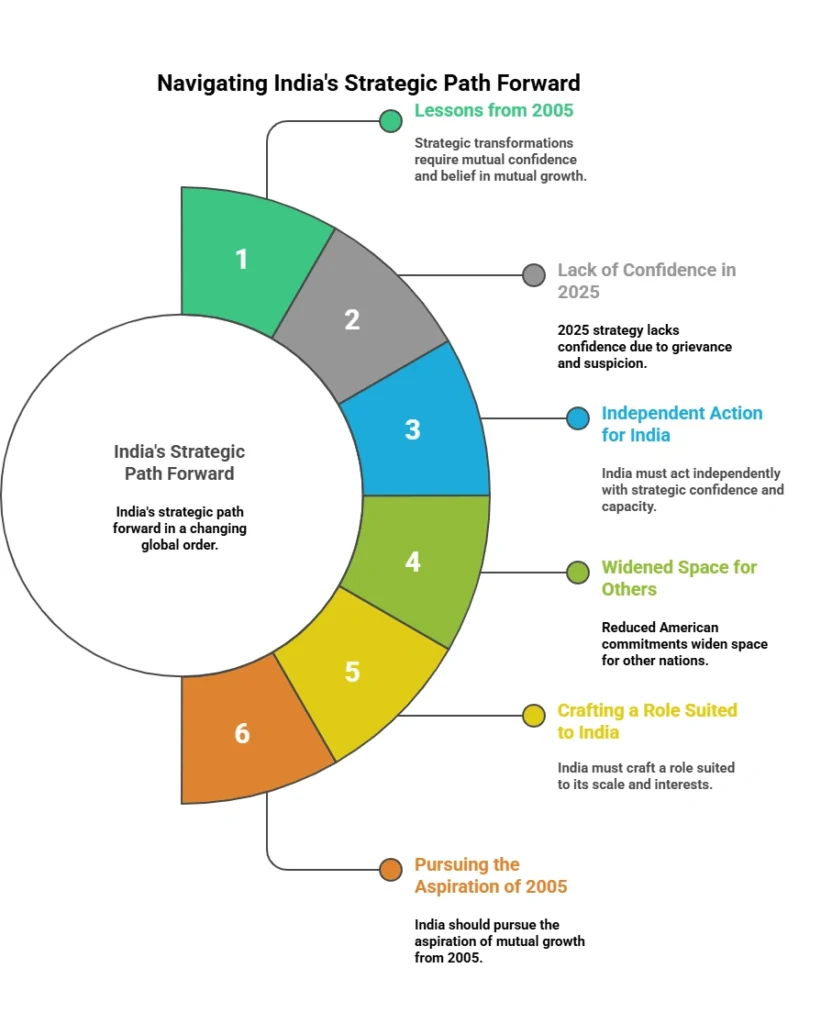
India–U.S. relations have shifted from the optimism of 2005 to the pragmatism of 2025, driven by global power realignments and U.S. strategic insecurities. India must now shape its own independent strategic vision while engaging the U.S. on equal, interest-based terms.
https://www.thehindu.com/opinion/op-ed/india-and-the-us-2005-versus-2025/article70403395.ece
La Excellence IAS Academy, the best IAS coaching in Hyderabad, known for delivering quality content and conceptual clarity for UPSC 2025 preparation.
FOLLOW US ON:
◉ YouTube : https://www.youtube.com/@CivilsPrepTeam
◉ Facebook: https://www.facebook.com/LaExcellenceIAS
◉ Instagram: https://www.instagram.com/laexcellenceiasacademy/
GET IN TOUCH:
Contact us at info@laex.in, https://laex.in/contact-us/
or Call us @ +91 9052 29 2929, +91 9052 99 2929, +91 9154 24 2140
OUR BRANCHES:
Head Office: H No: 1-10-225A, Beside AEVA Fertility Center, Ashok Nagar Extension, VV Giri Nagar, Ashok Nagar, Hyderabad, 500020
Madhapur: Flat no: 301, survey no 58-60, Guttala begumpet Madhapur metro pillar: 1524, Rangareddy Hyderabad, Telangana 500081
Bangalore: Plot No: 99, 2nd floor, 80 Feet Road, Beside Poorvika Mobiles, Chandra Layout, Attiguppe, Near Vijaya Nagara, Bengaluru, 560040