
Paper: GS – III, Subject: Environment and Ecology, Topic: Global Warming and Climate Change, Issue: India’s Climate Resilience Through Water-Centred Strategy.
Context:
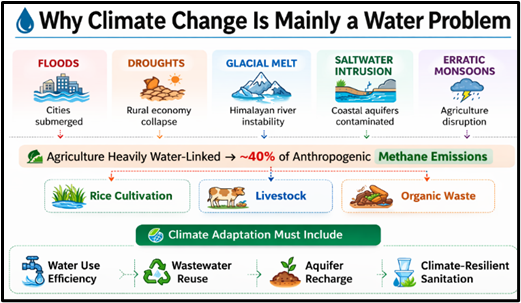
COP30 in Belém introduced adaptation indicators integrating water, sanitation, and hygiene (WASH) into climate accountability. For India, strengthening water management is essential to address floods, droughts, and increasingly erratic monsoon patterns
Key Takeaways:
Key Highlights/Main idea of the Article:
- Earlier: Climate policy focused mainly on mitigation (reducing emissions).
- Now: Focus of the world is shifting towards adaptation (surviving climate impacts).
- Established at COP30, the Belém Adaptation Indicators are 59 voluntary metrics used to track global adaptation progress across sectors like water, food, and health.
- Most climate impacts occur through water systems. Hence Water management decisions influence greenhouse gas emissions.
Belém Adaptation Indicators (COP30 Framework):
- Focus on climate-resilient water systems – reducing water scarcity, improving flood and drought resilience, and ensuring universal drinking water and sanitation.
- Emphasise stronger risk governance – developing multi-hazard early warning systems, strengthening hydrometeorological services, and updating national vulnerability assessments.
- Together, these indicators integrate water, health and climate policy and improve countries’ capacity to anticipate and manage climate risks.
Good news: India doesn’t have to start from scratch (Building on Existing Foundations):
- India strengthened integrated water governance by creating the Ministry of Jal Shakti in 2019 to coordinate drinking water, sanitation and river management.
- Long-term planning through Water Vision 2047 aligns with Belém’s adaptation framework and aims to ensure sustainable, equitable and climate-resilient water systems.
- The National Aquifer Mapping and Management Programme (NAQUIM) is shifting groundwater policy from merely mapping aquifers to implementing aquifer-level management plans.
- River rejuvenation initiatives like the National Mission for Clean Ganga (NMCG) now include biodiversity restoration and digital monitoring, helping rivers act as buffers against climate shocks.
However, there are Systemic Risks to Progress:
- Water Scarcity: Water scarcity is acute and unevenly distributed in India, with most climate disasters in India being water-related.
- Weak funding for climate adaptation: Even though the world says it will mobilise about $1.3 trillion per year by 2035 to deal with climate impacts, there is still no clear system on who will provide the money, how it will be distributed, and how long the funding will continue. Because of this uncertainty, many important water projects needed to protect people from floods and droughts do not get enough funding.
- Digital Fragmentation: There is a lack of real-time integration of hydrological and meteorological data into planning and governance systems in India.
Institutional Landscape and Opportunities:
- Existing Domestic Missions: Many global adaptation targets have corresponding domestic missions, including: Drinking water coverage, Sanitation expansion., Irrigation efficiency and Urban water reforms.
- Embedding Climate Stress Indicators: Government programme dashboards should also display climate warning signals like drought levels, flood risks, and rainfall shortages. This helps officials identify problems early and respond faster, making schemes more accountable and effective during climate shocks.
- Leveraging Digital Infrastructure: India’s strength in digital public infrastructure such as Aadhaar, UPI, & AgriStack etc can facilitate the integration of hydrological data, crop advisories, and financial flows into interoperable platforms.
Water is emerging as the central axis of climate resilience and adaptation policy. By aligning its water governance reforms with global adaptation frameworks, India can strengthen domestic climate resilience while positioning itself as a leader for the Global South in climate adaptation.
Source: (The Hindu)
La Excellence IAS Academy, the best IAS coaching in Hyderabad, known for delivering quality content and conceptual clarity for UPSC 2026 preparation.
FOLLOW US ON:
◉ YouTube : https://www.youtube.com/@CivilsPrepTeam
◉ Facebook: https://www.facebook.com/LaExcellenceIAS
◉ Instagram: https://www.instagram.com/laexcellenceiasacademy/
GET IN TOUCH:
Contact us at info@laex.in, https://laex.in/contact-us/
or Call us @ +91 9052 29 2929, +91 9052 99 2929, +91 9154 24 2140
OUR BRANCHES:
Head Office: H No: 1-10-225A, Beside AEVA Fertility Center, Ashok Nagar Extension, VV Giri Nagar, Ashok Nagar, Hyderabad, 500020
Madhapur: Flat no: 301, survey no 58-60, Guttala begumpet Madhapur metro pillar: 1524, Rangareddy Hyderabad, Telangana 500081
Bangalore: Plot No: 99, 2nd floor, 80 Feet Road, Beside Poorvika Mobiles, Chandra Layout, Attiguppe, Near Vijaya Nagara, Bengaluru, 560040