
Paper: GS – III, Subject: Environment and Ecology and Disaster Management, Topic: Disaster Management, Issue: Rebuilding Fiscal Federalism in Disaster Response.
Context:
India’s disaster-financing system is increasingly centralised, underfunding States and causing delays.
Key Highlights:
The Widening Gap in Disaster Response:
The Wayanad Tragedy: Wayanad landslides (2024) exposed major gaps in disaster financing.
- Centre approved only ~11% of Kerala’s requested relief funds, revealing a severe mismatch between needs and allocations.
- India’s current disaster-financing system is struggling to meet increasing demands and requires structural reform.
The Disaster-Response Financing Framework:
Two-Tier Structure: India’s disaster-response financing framework, established under the Disaster Management Act, 2005, consists of two funds:
- State Disaster Response Fund (SDRF): Financed jointly by the Centre and States (75:25 ratio, 90:10 for Himalayan and north-eastern States), providing immediate relief.
- National Disaster Response Fund (NDRF): Fully funded by the Union government, supplementing the SDRF when a calamity is classified as severe.
Drift Towards Central Control:
Outdated and Rigid Relief Norms: Compensation ceilings for loss of life and property damage have remained stagnant for a decade, failing to meet actual reconstruction costs.
- Ambiguity in Classification: The Act lacks a clear definition of a ‘severe disaster,’ granting the Union government significant discretion in deciding eligibility for NDRF aid.
- Procedural Delays: Aid releases are subject to sequential clearances, including State memorandum, central assessment, and high-level approval, causing delays when urgency is paramount.
- Weak Allocation Criteria: The Finance Commission’s allocation criteria, based on population and geographical area, fail to accurately reflect actual hazard patterns and disaster vulnerability.
Institutional Flaws in Disaster Financing and Global Fixes:
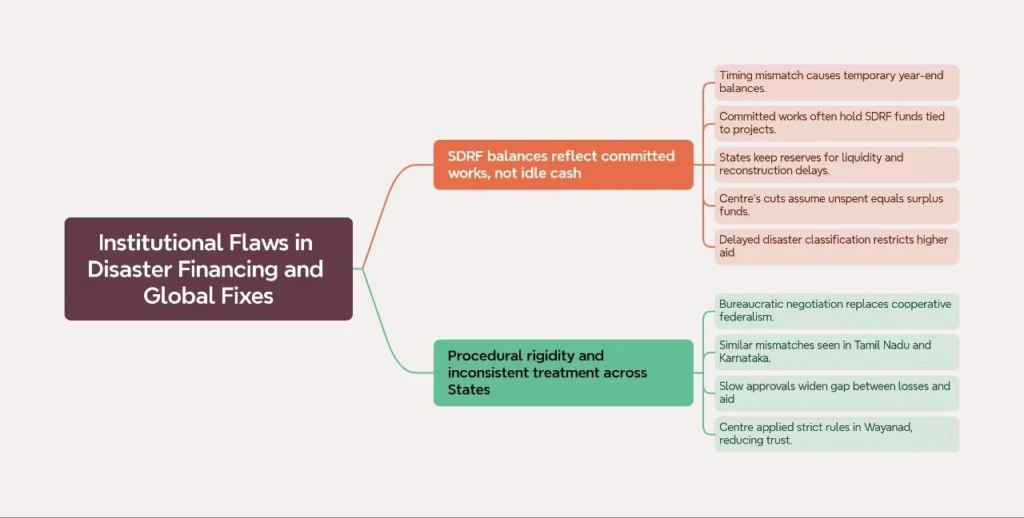
Global objective-trigger models and lessons for India:
- Examples include FEMA, FONDEN, Philippines indices.
- Insurance facilities use satellite data for rapid payouts
- Possible triggers: rainfall intensity, fatalities per million.
- Loss-to-GSDP ratio or per-capita damage thresholds applicable.
Rebuilding the Federal Spirit:
- Opportunity for Reform: The Sixteenth Finance Commission has an opportunity to reframe this architecture.
- Update Relief Norms: Reflect current costs.
- Revise Allocation Criteria: Use a comprehensive vulnerability index.
- Grant-Based Assistance: Ensure that disaster assistance remains grant-based rather than debt-based.
India’s disaster-financing system must evolve from procedural charity to a rules-based partnership. The next flood or landslide should not leave States pleading for what the Constitution already guarantees a cooperative, equitable, and timely response
La Excellence IAS Academy, the best IAS coaching in Hyderabad, known for delivering quality content and conceptual clarity for UPSC 2025 preparation.
FOLLOW US ON:
◉ YouTube : https://www.youtube.com/@CivilsPrepTeam
◉ Facebook: https://www.facebook.com/LaExcellenceIAS
◉ Instagram: https://www.instagram.com/laexcellenceiasacademy/
GET IN TOUCH:
Contact us at info@laex.in, https://laex.in/contact-us/
or Call us @ +91 9052 29 2929, +91 9052 99 2929, +91 9154 24 2140
OUR BRANCHES:
Head Office: H No: 1-10-225A, Beside AEVA Fertility Center, Ashok Nagar Extension, VV Giri Nagar, Ashok Nagar, Hyderabad, 500020
Madhapur: Flat no: 301, survey no 58-60, Guttala begumpet Madhapur metro pillar: 1524, Rangareddy Hyderabad, Telangana 500081
Bangalore: Plot No: 99, 2nd floor, 80 Feet Road, Beside Poorvika Mobiles, Chandra Layout, Attiguppe, Near Vijaya Nagara, Bengaluru, 560040