
Paper: GS – III, Subject: Environment and Ecology, Topic: Environment Impact Assessment, Issue: India’s Environmental Jurisprudence.
Context:
India’s environmental jurisprudence, once a global benchmark for judicial activism, shows signs of dilution through recent policy shifts and court decisions prioritizing development over strict ecological safeguards.
Key Highlights:
Key points:
Dilution of Environmental Impact Assessment (EIA) framework:
- Recent policy shift allowing EIAs without specific details of project location/area reduces scientific scrutiny.
- Move towards post-facto and conditional clearances weakens preventive environmental governance.
Judicial shift from precaution to accommodation:
- Earlier landmark judgments emphasised strict protection:
- Vellore Citizens Welfare Forum (1996) – precautionary principle.
- M.C. Mehta cases – mining bans in Aravallis and public trust doctrine.
- Common Cause (2017) – illegal mining cannot be regularised later.
- Recent trends indicate acceptance of diluted standards (e.g., height-based definition of Aravallis, recall of judgments against retrospective clearances).
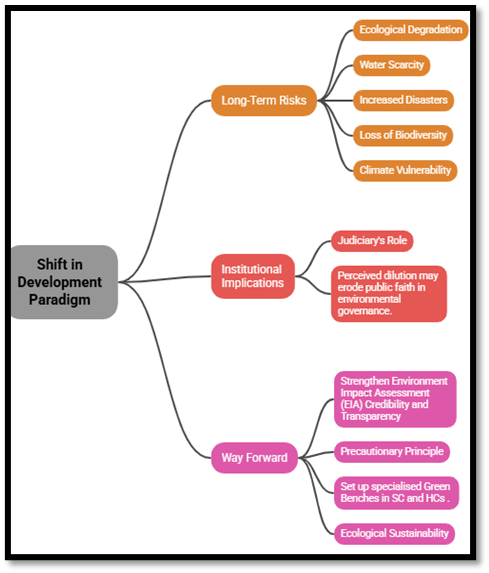
Ecological consequences:
- Aravalli degradation: Loss of groundwater recharge, biodiversity, and natural barriers against desertification. (Issue Relating to Definition of Aravalli Hills and Ranges, 2025)
- Mangrove destruction: Weakens coastal protection, increases flood risk, and damages carbon sinks.
- Himalayan infrastructure (Char Dham): Landslide risks, river disturbance, and fragile ecosystem stress. (the Himalayan ecosystem in Citizens for Green Doon vs Union of India (2021))
Constitutional concerns:
- Article 21: Right to life includes a clean and healthy environment.
- Article 48A: Duty of the State to protect and improve the environment.
- Article 51A(g): Citizen duty to safeguard nature.
Governance and procedural fairness issues:
- Environmental clearances for large projects often fast-tracked.
- Public hearings reduced to formalities; objections treated as obstruction.
- Corporate influence vs ecological safeguards debate.
The fading of India’s environmental jurisprudence poses a significant threat to the country’s ecological integrity and the well-being of its citizens. The prioritization of economic development over environmental protection, coupled with the weakening of environmental norms and the shifting stance of the judiciary. A renewed commitment to environmental justice, grounded in constitutional principles and ecological science, is essential to ensure a sustainable future for India.
Source: (The Hindu)
La Excellence IAS Academy, the best IAS coaching in Hyderabad, known for delivering quality content and conceptual clarity for UPSC 2026 preparation.
FOLLOW US ON:
◉ YouTube : https://www.youtube.com/@CivilsPrepTeam
◉ Facebook: https://www.facebook.com/LaExcellenceIAS
◉ Instagram: https://www.instagram.com/laexcellenceiasacademy/
GET IN TOUCH:
Contact us at info@laex.in, https://laex.in/contact-us/
or Call us @ +91 9052 29 2929, +91 9052 99 2929, +91 9154 24 2140
OUR BRANCHES:
Head Office: H No: 1-10-225A, Beside AEVA Fertility Center, Ashok Nagar Extension, VV Giri Nagar, Ashok Nagar, Hyderabad, 500020
Madhapur: Flat no: 301, survey no 58-60, Guttala begumpet Madhapur metro pillar: 1524, Rangareddy Hyderabad, Telangana 500081
Bangalore: Plot No: 99, 2nd floor, 80 Feet Road, Beside Poorvika Mobiles, Chandra Layout, Attiguppe, Near Vijaya Nagara, Bengaluru, 560040