
Paper: GS – II, Subject: Polity, Topic: Judiciary, Issue: Issues in the Subordinate Judiciary.
Context:
The lower judiciary – litigation, pendency, stagnation India’s lower judiciary is struggling with massive pendency, inefficiency, and structural weaknesses, with nearly 4.69 crore cases pending in district courts and overburdening the system.
Key Highlights:
Issues in the Subordinate Judiciary:
Prolonged Litigation and Pendency:
- Inefficient Procedures: The Code of Civil Procedure and Civil Rules of Practice, intended to streamline court proceedings, often contribute to delays.
- Subordinate judges spend a significant amount of time on administrative tasks like issuing summons, receiving vakalatnamas, and calling cases, leaving them with limited time for substantive case disposal.
- Ministerial Work Overload: The current system forces judges to handle clerical and ministerial tasks, diverting their attention from core judicial functions.
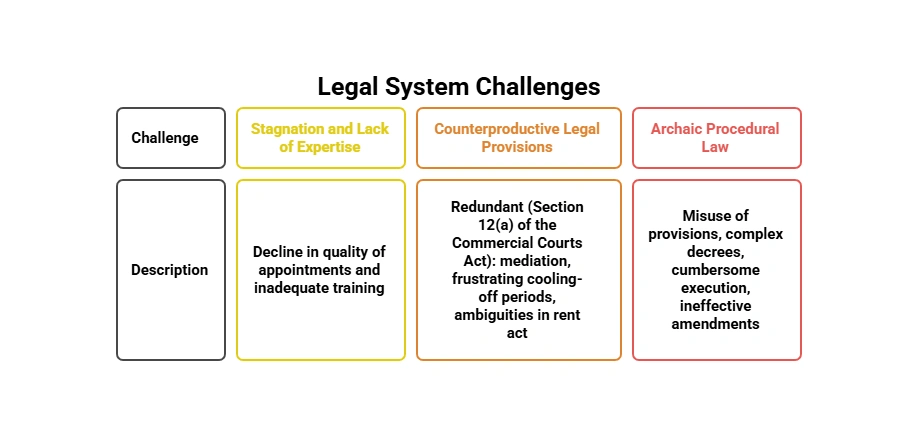
Solutions to Improve the Subordinate Judiciary:
Procedural Reforms:
- Dedicated Ministerial Court: Establish a dedicated court in each district court to handle ministerial tasks such as calling cases, recording ex parte evidence, issuing summons, and receiving vakalatnamas and written statements.
- Streamlined Case Listing: The ministerial court can prepare a daily list of cases for trial and arguments, which can be posted on the website in the evening.
- Automatic Continuation of Final Decree Proceedings: Make final decree proceedings an automatic continuation of preliminary decree proceedings, eliminating the need for a fresh application.
- Simplify Execution Proceedings: Reduce the number of rules under Order XXI of the Code of Civil Procedure and streamline the process of execution of decrees and awards.
Enhanced Training and Development:
- High Court Bench Training: Mandate that newly appointed civil judges and senior civil judges undergo training with different High Court Benches to observe court proceedings, judge-lawyer interactions, and judgment analysis.
- Continuous Professional Development: Implement ongoing training programs to keep judges updated on new laws, legal developments, and best practices.
Improving the Quality of Judicial Appointments:
- Prioritize Experienced Lawyers: Emphasize the appointment of experienced lawyers with a proven track record in various branches of law.
- Rigorous Selection Process: Implement a rigorous selection process that assesses candidates’ legal knowledge, analytical skills, and judicial temperament.
Addressing Pendency in the Higher Judiciary:
- Expeditious Disposal of Cases: The higher judiciary should prioritize the expeditious disposal of cases while ensuring a thorough and fair hearing.
- Embrace Modern Technology: Implement technology-driven solutions such as e-filing, virtual hearings, and case management systems to improve efficiency.
Improving India’s lower judiciary demands comprehensive reforms better procedures, stronger training, updated laws, and higher-quality appointments to boost efficiency, cut pendency, and ensure timely justice.
La Excellence IAS Academy, the best IAS coaching in Hyderabad, known for delivering quality content and conceptual clarity for UPSC 2025 preparation.
FOLLOW US ON:
◉ YouTube : https://www.youtube.com/@CivilsPrepTeam
◉ Facebook: https://www.facebook.com/LaExcellenceIAS
◉ Instagram: https://www.instagram.com/laexcellenceiasacademy/
GET IN TOUCH:
Contact us at info@laex.in, https://laex.in/contact-us/
or Call us @ +91 9052 29 2929, +91 9052 99 2929, +91 9154 24 2140
OUR BRANCHES:
Head Office: H No: 1-10-225A, Beside AEVA Fertility Center, Ashok Nagar Extension, VV Giri Nagar, Ashok Nagar, Hyderabad, 500020
Madhapur: Flat no: 301, survey no 58-60, Guttala begumpet Madhapur metro pillar: 1524, Rangareddy Hyderabad, Telangana 500081
Bangalore: Plot No: 99, 2nd floor, 80 Feet Road, Beside Poorvika Mobiles, Chandra Layout, Attiguppe, Near Vijaya Nagara, Bengaluru, 560040