
Paper: GS – II, Subject: Polity, Topic: Judiciary, Issue: Judicial Removal Process in India.
Context:
A recent impeachment notice moved in Parliament seeking the removal of a High Court judge has brought renewed attention to India’s constitutional mechanism for judicial removal.
Key Highlights:
The Constitutional and Legal Framework for Judicial Removal:
The removal of judges from the Supreme Court and High Courts in India is governed by Articles 124(4), 124(5), 217(1)(b), and 218 of the Constitution. While the Constitution uses the term “removal,” the process is commonly referred to as “impeachment.”
| Article 124(5): Article 124(5) empowers Parliament to make a law to “regulate the procedure for the presentation of an address” and for “investigation and proof of the misbehaviour or incapacity of a judge” does not leave any space for the Speaker/Chairman to refuse admission of the motion. |
Key Provisions:
- Grounds for Removal: A judge can be removed on the grounds of “proved misbehaviour or incapacity.”
- Definition of Misbehaviour: While not explicitly defined in the Constitution, the courts have interpreted “misbehaviour” to include conduct that brings dishonor to the judiciary, wilful misconduct, corruption, lack of integrity, offences involving moral turpitude, and wilful abuse of judicial office.
- Procedure for Removal:
- An address must be passed by each House of Parliament with a majority of the total membership and a two-thirds majority of the members present and voting.
- The address is then sent to the President, who issues an order removing the judge.
- Parliament is empowered to enact a law to regulate the procedure for investigating charges against the judge.
- The Judges (Inquiry) Act, 1968: This Act, along with the Judges Inquiry Rules, outlines the detailed procedure for the impeachment of judges.
The Impeachment Motion Procedure:
The Judges (Inquiry) Act, 1968 lays down the procedure for moving an impeachment motion:
- Notice of Motion: A motion must be submitted to the Speaker (Lok Sabha) or the Chairman (Rajya Sabha), signed by at least 100 Members of the Lok Sabha or 50 Members of the Rajya Sabha, respectively.
- Admissibility by Speaker/Chairman: The Speaker/Chairman has the power to admit or disallow the motion.
- Investigation Committee: If the motion is admitted, the Speaker/Chairman appoints a committee consisting of a Supreme Court judge, a High Court Chief Justice, and a distinguished jurist to investigate the charges.
- Parliamentary Debate and Vote: If the committee finds the judge guilty of misbehaviour or incapacity, the motion for removal is debated and voted upon in each House of Parliament.
- Presidential Order: If both Houses pass the motion with the required majority, the President issues an order removing the judge.
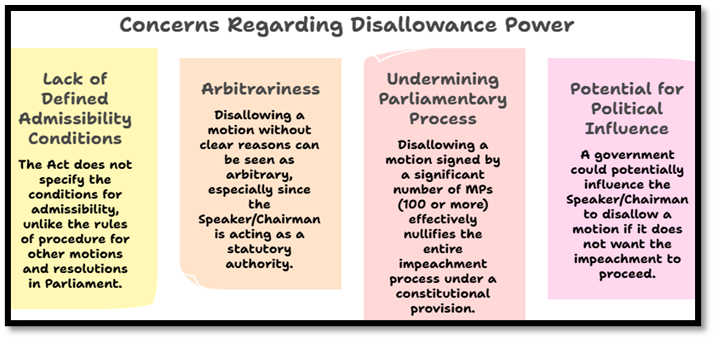
The provision granting the Speaker/Chairman the power to disallow a motion for judicial removal needs to be revisited. It allows the government to potentially thwart the operation of a serious constitutional provision for removing an unworthy judge. This loophole undermines the independence of the judiciary and the accountability of judges.
Source: (The Hindu)
La Excellence IAS Academy, the best IAS coaching in Hyderabad, known for delivering quality content and conceptual clarity for UPSC 2026 preparation.
FOLLOW US ON:
◉ YouTube : https://www.youtube.com/@CivilsPrepTeam
◉ Facebook: https://www.facebook.com/LaExcellenceIAS
◉ Instagram: https://www.instagram.com/laexcellenceiasacademy/
GET IN TOUCH:
Contact us at info@laex.in, https://laex.in/contact-us/
or Call us @ +91 9052 29 2929, +91 9052 99 2929, +91 9154 24 2140
OUR BRANCHES:
Head Office: H No: 1-10-225A, Beside AEVA Fertility Center, Ashok Nagar Extension, VV Giri Nagar, Ashok Nagar, Hyderabad, 500020
Madhapur: Flat no: 301, survey no 58-60, Guttala begumpet Madhapur metro pillar: 1524, Rangareddy Hyderabad, Telangana 500081
Bangalore: Plot No: 99, 2nd floor, 80 Feet Road, Beside Poorvika Mobiles, Chandra Layout, Attiguppe, Near Vijaya Nagara, Bengaluru, 560040