
Paper: GS – I/II, Subject: Society and Social Justice, Topic: Social Sector – Education, Issue: Learning Beyond Mandatory Attendance.
Context:
The Delhi High Court has ruled that law students may sit for examinations without meeting rigid attendance requirements, reaffirming that learning cannot be enforced through coercive surveillance and questioning bureaucratic approaches to higher education.
Key Highlights:
The Alternative: Cultivating Curiosity and Engagement
- Dialogic Encounter: Education should be a dynamic exchange of ideas, fostering critical thinking and shared inquiry, as emphasized by Paulo Freire.
- Teacher’s Role: Teachers should strive to make their classes indispensable by offering valuable insights, stimulating discussions, and creating an atmosphere of intellectual excitement.
- Learning by Desire: The most effective learning environments are those where students attend out of genuine interest and anticipation, not obligation.
- Experiential Learning: Taking learning outside the classroom, such as reading poetry in nature or discussing philosophical concepts in a natural setting, can enhance understanding and engagement.
The Sorry State of Indian Universities:
- Bureaucratic Rigidity: Indian universities are often stifled by excessive bureaucracy and administrative control, hindering intellectual freedom and innovation.
- Erosion of Autonomy: Increasing central control has transformed campuses into intellectual vassals, where dissent is silenced and loyalty is prioritized over scholarly merit.
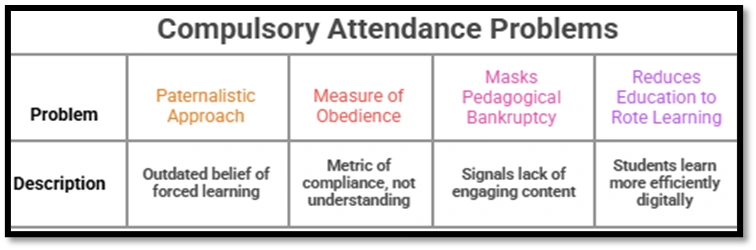
- Pedagogical Pacification: Mandatory attendance policies serve as a tool to suppress student autonomy and intellectual curiosity within this restrictive environment.
A Transformative Possibility:
- Reimagining Pedagogy: The High Court ruling compels educators to innovate and create more engaging learning spaces.
- Intrinsic Motivation: Shifting the focus from external compulsion to intrinsic curiosity can foster a more dynamic and evolving learning process.
- Learning as Discovery: The true university should facilitate discovery and critical thinking, rather than simply disseminating information.
- Trusting Student Autonomy: Universities should trust students’ intellectual autonomy and focus on the quality of teaching rather than surveillance.
Conclusion:
The Delhi High Court’s ruling presents an opportunity to rethink the fundamental principles of higher education. By removing the coercive element of compulsory attendance, universities can foster intellectual curiosity, encourage innovation in teaching methods, and empower students to take ownership of their learning. The future of education depends on recognizing that true learning cannot be mandated but must be cultivated through freedom, engagement, and a commitment to intellectual inquiry.
La Excellence IAS Academy, the best IAS coaching in Hyderabad, known for delivering quality content and conceptual clarity for UPSC 2025 preparation.
FOLLOW US ON:
◉ YouTube : https://www.youtube.com/@CivilsPrepTeam
◉ Facebook: https://www.facebook.com/LaExcellenceIAS
◉ Instagram: https://www.instagram.com/laexcellenceiasacademy/
GET IN TOUCH:
Contact us at info@laex.in, https://laex.in/contact-us/
or Call us @ +91 9052 29 2929, +91 9052 99 2929, +91 9154 24 2140
OUR BRANCHES:
Head Office: H No: 1-10-225A, Beside AEVA Fertility Center, Ashok Nagar Extension, VV Giri Nagar, Ashok Nagar, Hyderabad, 500020
Madhapur: Flat no: 301, survey no 58-60, Guttala begumpet Madhapur metro pillar: 1524, Rangareddy Hyderabad, Telangana 500081
Bangalore: Plot No: 99, 2nd floor, 80 Feet Road, Beside Poorvika Mobiles, Chandra Layout, Attiguppe, Near Vijaya Nagara, Bengaluru, 560040