
Paper: GS – II, Subject: Polity, Topic: Legislature, Issue: Juvenile Justice (Care and Protection of Children) Act, 2015.
Context:
It has been ten years since the Juvenile Justice (Care and Protection of Children) Act, 2015 transformed India’s approach to youth crime by introducing a “transfer system” for 16-18-year-olds accused of heinous offenses. In December 2025, a Private Member’s Bill was introduced in Parliament proposing to lower this age threshold even further from 16 to 14 years.
Key Highlights:
The Core Proposal:
- Current Law: Children aged 16–18 accused of “heinous offenses” (crimes punishable by 7+ years imprisonment) undergo a preliminary assessment. If found to have adult-like mental capacity, they can be tried as adults.
- Proposed Amendment: The Bill seeks to include children aged 14–16 in this category, potentially exposing them to adult trials and prisons.
Key Arguments Against the Amendment:
This move prioritizes retribution over rehabilitation and ignores the developmental realities of childhood. The critique rests on four main pillars:
The Flaws of the ‘Transfer System’:
The current system for 16–18-year-olds is already viewed as problematic. The mechanism is arbitrary and lacks scientific rigor.
- Lack of Tools: No psychological tools currently exist that can accurately determine if a child has “adult-level capacity” or can retrospectively assess their state of mind at the time of the offense.
- Inequality: Two children with similar backgrounds may face vastly different outcomes (rehabilitation vs. adult prison) based purely on the subjective opinion of the Juvenile Justice Board (JJB).
Consequences of Lowering the age of juvenility:
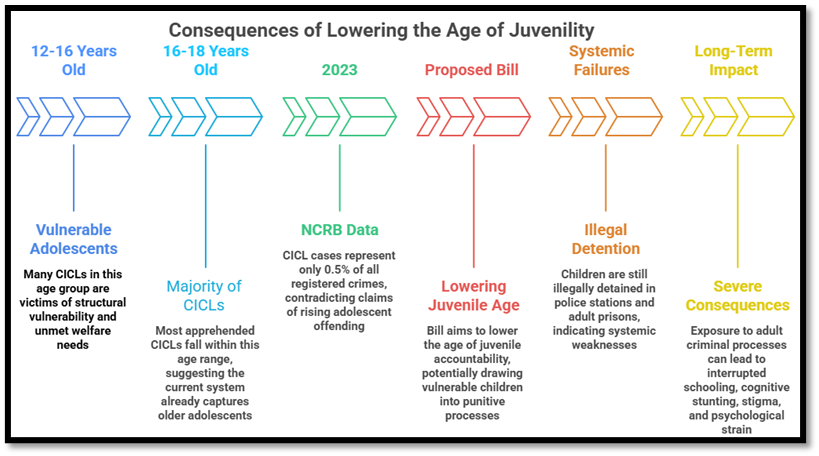
The Cost of Adult Prisons:
Exposing 14-year-olds to the adult criminal justice system has severe, irreversible consequences:
- Interruption of education and cognitive development.
- Lasting psychological strain and trauma.
- Increased risk of stigma and recidivism (re-offending) due to the punitive environment.
The Way Forward:
The analysis concludes that the solution is systemic repair, not harsher punishment.
- Reject Retribution: The system should not “blur the distinction between adolescence and adulthood.”
- Invest in Prevention: Resources should be directed toward early intervention, family strengthening, mental health support, and education.
- Accountability: The focus should be on fixing the institutions that fail to protect children, rather than transferring the consequences of that failure onto the children themselves.
Source: (The Hindu)
La Excellence IAS Academy, the best IAS coaching in Hyderabad, known for delivering quality content and conceptual clarity for UPSC 2026 preparation.
FOLLOW US ON:
◉ YouTube : https://www.youtube.com/@CivilsPrepTeam
◉ Facebook: https://www.facebook.com/LaExcellenceIAS
◉ Instagram: https://www.instagram.com/laexcellenceiasacademy/
GET IN TOUCH:
Contact us at info@laex.in, https://laex.in/contact-us/
or Call us @ +91 9052 29 2929, +91 9052 99 2929, +91 9154 24 2140
OUR BRANCHES:
Head Office: H No: 1-10-225A, Beside AEVA Fertility Center, Ashok Nagar Extension, VV Giri Nagar, Ashok Nagar, Hyderabad, 500020
Madhapur: Flat no: 301, survey no 58-60, Guttala begumpet Madhapur metro pillar: 1524, Rangareddy Hyderabad, Telangana 500081
Bangalore: Plot No: 99, 2nd floor, 80 Feet Road, Beside Poorvika Mobiles, Chandra Layout, Attiguppe, Near Vijaya Nagara, Bengaluru, 560040