
Paper: GS – II, Subject: International Relations, Topic: Global Issues, Issue: Pakistan Geopolitical Shift.
Context:
Pakistan has re-emerged as a strategically relevant actor in West Asia, benefiting from shifting regional security dynamics. This renewed acceptance coincides with the consolidation of power by Asim Munir, Pakistan’s Army Chief, and growing geopolitical churn involving Gaza, Iran, Israel, and Arab Gulf states.
Key Highlights:
Field Marshal Munir’s Ascendancy and Geopolitical Opportunities:
- Exploiting Geopolitical Shifts: Field Marshal Asim Munir has capitalized on the changing geopolitical landscape to position Pakistan as a relevant player.
- Narrative Warfare: Pakistan has effectively used narrative warfare to its advantage, given its limited resources and strategic options.
Background:
- Pakistan historically oscillated between central and peripheral roles in West Asian geopolitics.
- Relations with Gulf states suffered earlier due to:
- Pakistan’s refusal to join the Saudi-led Yemen campaign (2015)
- Economic instability and IMF dependence
- Over time, military-to-military ties, rather than civilian diplomacy, have driven Pakistan’s foreign policy traction.
- The rise of regional insecurity post-2023 has pushed Arab states to reassess partners with military depth and manpower.
Data & Examples:
- Strategic Mutual Defence Agreement (SMDA) signed between Pakistan and Saudi Arabia in September 2025.
- Pakistan’s military seen as:
- A source of trained manpower
- A contributor to peacekeeping / security roles, including possible future missions around Gaza.
- Pakistan aligned diplomatically with Gulf positions on Gaza conflict.
- Improved optics with the UAE and Saudi Arabia after years of strained relations.
Evolving Security Dynamics in West Asia:
- Impact of the Gaza War: The ongoing Gaza war and the expansion of Israeli military campaigns across the region have reshaped Arab powers’ views on regional security.
- Collective Defence Ideation: Arab states have moved towards a more collective approach to defence, recognizing that the U.S. military may not always come to their aid.
- Attacks on Qatar: Attacks on Qatar, including an Israeli missile strike targeting Hamas’s political leadership and an Iranian strike on the Al Udeid air base, have further heightened security concerns in the region.
Key Highlights:
- Pakistan’s military leadership, not civilian government, is the primary driver of renewed engagement.
- Gulf states increasingly value stability and military capability over ideological alignment.
- Pakistan benefits from:
- Arab anxieties over Iran-Israel conflict escalation
- Reduced certainty of direct US military intervention
- Renewed strategic trust with Saudi Arabia marks a diplomatic comeback.
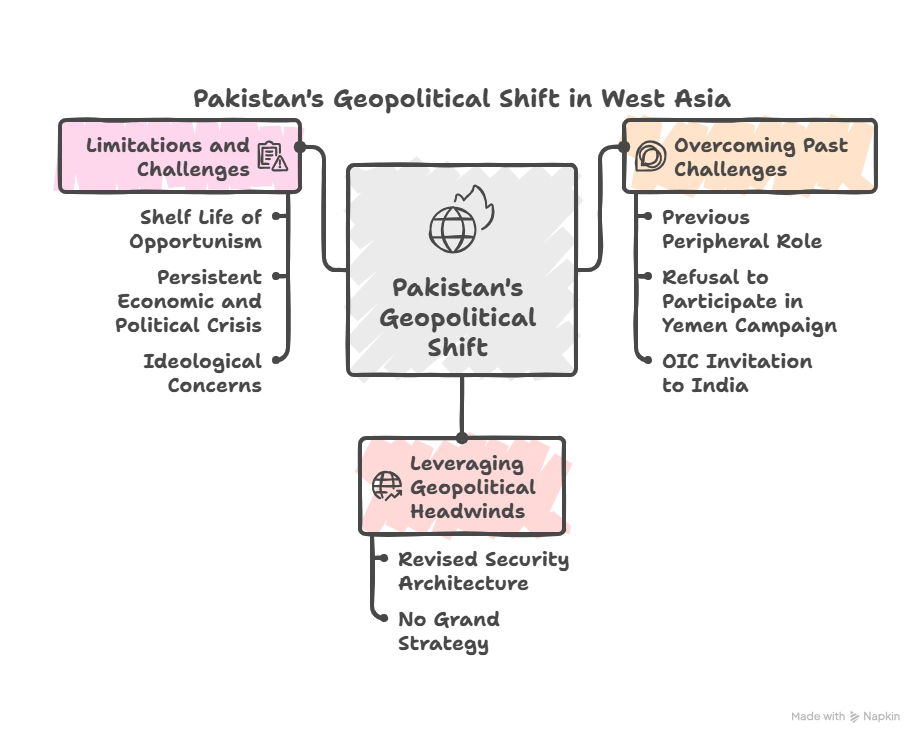
Pakistan’s return to West Asia’s “good graces” is the outcome of geopolitical necessity rather than strategic reinvention. While the military establishment has capitalised on prevailing regional insecurity, this window of opportunity is fragile. Without addressing internal economic fragility and political instability, Pakistan’s renewed relevance is likely to remain short-term and conditional, rather than a durable transformation.
La Excellence IAS Academy, the best IAS coaching in Hyderabad, known for delivering quality content and conceptual clarity for UPSC 2025 preparation.
FOLLOW US ON:
◉ YouTube : https://www.youtube.com/@CivilsPrepTeam
◉ Facebook: https://www.facebook.com/LaExcellenceIAS
◉ Instagram: https://www.instagram.com/laexcellenceiasacademy/
GET IN TOUCH:
Contact us at info@laex.in, https://laex.in/contact-us/
or Call us @ +91 9052 29 2929, +91 9052 99 2929, +91 9154 24 2140
OUR BRANCHES:
Head Office: H No: 1-10-225A, Beside AEVA Fertility Center, Ashok Nagar Extension, VV Giri Nagar, Ashok Nagar, Hyderabad, 500020
Madhapur: Flat no: 301, survey no 58-60, Guttala begumpet Madhapur metro pillar: 1524, Rangareddy Hyderabad, Telangana 500081
Bangalore: Plot No: 99, 2nd floor, 80 Feet Road, Beside Poorvika Mobiles, Chandra Layout, Attiguppe, Near Vijaya Nagara, Bengaluru, 560040