
Paper: GS – III, Subject: Science and Technology, Topic: Intellectual Property Rights, Issue: Patent Rights vs Public Health.
Context:
That Bharat has several options under its existing legal framework to address the balance between patent rights and public health. These options, compliant with the TRIPS agreement, can be strategically employed to ensure access to essential medicines and deter abusive patenting practices.
Key Highlights:
Legal Options Available to Bharat under Patents & Competition Law:
| Provision | Legal Basis | Key Power / Provision | Practical Application | Public Health Benefit |
| Section 47(4), Patents Act, 1970 | Government Use & Importation | Allows Central/State governments to import patented medicines without patentee consent for government-run or supported healthcare facilities | Import of costly patented drugs (e.g., oncology medicines) for public hospitals; can be extended to credible non-government healthcare institutions | Ensures affordable access to essential medicines, especially in rural and underserved areas |
| Section 66, Patents Act, 1970 | Revocation in Public Interest | Empowers Central Government to revoke patents that are “mischievous to the State” or “prejudicial to the public” | Identification and revocation of patents involving evergreening or abusive enforcement in sectors like health and agriculture | Prevents public harm and avoids prolonged litigation by proactively removing harmful patents |
| Section 92A, Patents Act, 1970 | Compulsory Licence for Export | Permits compulsory licensing for manufacturing patented drugs for export to countries lacking pharma manufacturing capacity | Indian generic manufacturers supply affordable medicines to African and other developing nations | Strengthens Bharat’s role as the “pharmacy of the Global South” and promotes global health equity |
| Section 102, Patents Act, 1970 | Eminent Domain (Government Acquisition) | Allows the government to acquire a patent or patent application for public purposes via Gazette notification | Direct acquisition of critical patented technologies for public health emergencies | Enables direct state control over vital inventions while ensuring fair compensation to patentees |
| Competition Act, 2002 | Abuse of Dominant Position | Penalizes anti-competitive practices such as excessive pricing, patent evergreening, and market foreclosure | Action against pharmaceutical firms misusing patent monopolies | Protects consumers, ensures fair pricing, and safeguards access to essential medicines |
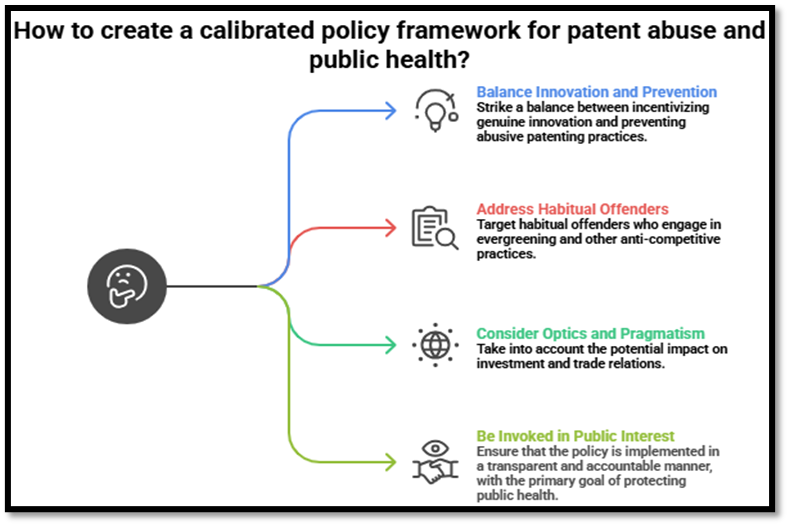
Bharat possesses a robust legal framework that allows it to balance patent rights with public health concerns. By strategically utilizing the provisions within the Patents Act and the Competition Act, Bharat can ensure access to essential medicines, deter abusive patenting practices, and contribute to global public health.
Source: (The Indian Express)
La Excellence IAS Academy, the best IAS coaching in Hyderabad, known for delivering quality content and conceptual clarity for UPSC 2026 preparation.
FOLLOW US ON:
◉ YouTube : https://www.youtube.com/@CivilsPrepTeam
◉ Facebook: https://www.facebook.com/LaExcellenceIAS
◉ Instagram: https://www.instagram.com/laexcellenceiasacademy/
GET IN TOUCH:
Contact us at info@laex.in, https://laex.in/contact-us/
or Call us @ +91 9052 29 2929, +91 9052 99 2929, +91 9154 24 2140
OUR BRANCHES:
Head Office: H No: 1-10-225A, Beside AEVA Fertility Center, Ashok Nagar Extension, VV Giri Nagar, Ashok Nagar, Hyderabad, 500020
Madhapur: Flat no: 301, survey no 58-60, Guttala begumpet Madhapur metro pillar: 1524, Rangareddy Hyderabad, Telangana 500081
Bangalore: Plot No: 99, 2nd floor, 80 Feet Road, Beside Poorvika Mobiles, Chandra Layout, Attiguppe, Near Vijaya Nagara, Bengaluru, 560040