
Paper: GS – I/II, Subject: Society and Social Justice, Topic: Welfare schemes, mechanisms, laws and institutions related to children, Issue: Protecting Children in Digital Age.
Context:
The increasing concern over children’s mental health in the digital age has led to calls for stricter regulations on social media use. Recently, several states in India – including Andhra Pradesh, Karnataka, and Kerala – have proposed banning social media access for children below the age of 16.
Key Takeaways:
Psychological Impact of Social Media on Children:
- Immersive & Addictive Design: Platforms use algorithms to keep users engaged, often amplifying insecurities.
- Dopamine Reward Cycle: Likes, comments, and notifications trigger dopamine, leading to compulsive usage and lower self-esteem.
- Gradual Psychological Harm: Prolonged exposure can cause anxiety, sleep problems, and body image issues.
- Comparison Culture: Children compare themselves with idealized online images, leading to feelings of inadequacy and low self-worth.
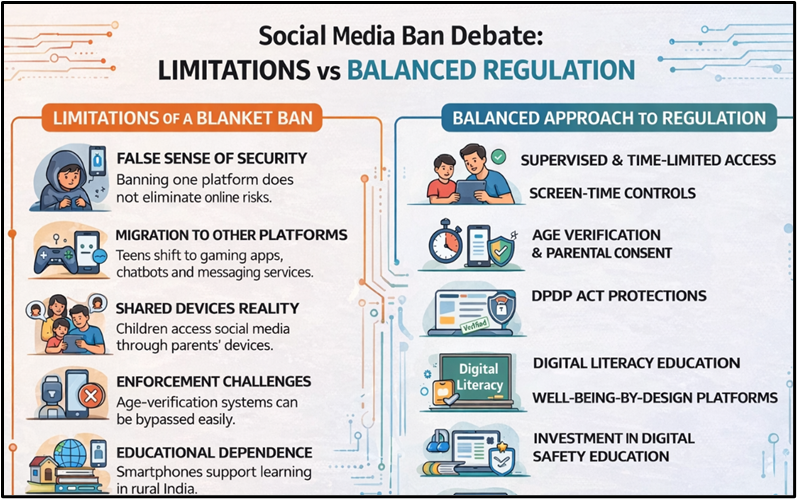
Why a Social Media Ban for Under-16s Is Not a Complete Solution?
- Popular policy ≠ effective policy: A blanket ban may create a false sense of security for policymakers and parents without addressing the full spectrum of online risks.
- Risks exist beyond social media:
- Young people interact across multiple digital spaces – gaming platforms, AI chatbots, messaging apps, and VoIP services.
- Banning social media alone may simply push them to less regulated online spaces.
- Practical enforcement challenges: In many households, devices are shared and children can easily access the internet through parents’ accounts or by bypassing restrictions.
- Digital access reduces inequality:
- In India, smartphones often act as educational tools, especially in rural areas.
- Data from ASER 2024 shows over 50% of rural students use smartphones for learning, making blanket restrictions problematic.
- Inter-generational digital dependence: Many parents – particularly mothers with limited schooling – depend on children for digital assistance, showing how deeply digital tools are embedded in households.
What India Should Focus on Instead:
- Smart regulation instead of blanket bans: Policy must balance child safety, digital access, and socio-economic realities.
- Leverage the Digital Personal Data Protection Act (DPDP): The law introduces age verification, limits on targeted advertising to minors, and parental consent requirements.
- Adopt “Well-Being-by-Design” digital platforms: Platforms should incorporate addiction safeguards, safer contact systems, transparency norms, and accountability mechanisms.
- Strengthen parental controls and platform responsibility
- Invest heavily in digital safety education: Both children and parents need structured digital literacy and online safety training.
Conclusion:
Social media regulation for children’s needs balance over bans, combining supervision, education, and responsible access to build resilience, empowering safe digital navigation in a connected world.
Source: (The Indian Express)
La Excellence IAS Academy, the best IAS coaching in Hyderabad, known for delivering quality content and conceptual clarity for UPSC 2026 preparation.
FOLLOW US ON:
◉ YouTube : https://www.youtube.com/@CivilsPrepTeam
◉ Facebook: https://www.facebook.com/LaExcellenceIAS
◉ Instagram: https://www.instagram.com/laexcellenceiasacademy/
GET IN TOUCH:
Contact us at info@laex.in, https://laex.in/contact-us/
or Call us @ +91 9052 29 2929, +91 9052 99 2929, +91 9154 24 2140
OUR BRANCHES:
Head Office: H No: 1-10-225A, Beside AEVA Fertility Center, Ashok Nagar Extension, VV Giri Nagar, Ashok Nagar, Hyderabad, 500020
Madhapur: Flat no: 301, survey no 58-60, Guttala begumpet Madhapur metro pillar: 1524, Rangareddy Hyderabad, Telangana 500081
Bangalore: Plot No: 99, 2nd floor, 80 Feet Road, Beside Poorvika Mobiles, Chandra Layout, Attiguppe, Near Vijaya Nagara, Bengaluru, 560040