
Paper: GS – III, Subject: Internal Security, Topic: Left wing Extremism, Issue: Decline of Maoism in India.
Context:
Maoist-related violence in India has decreased significantly, with violent incidents reducing by almost 90% from 2010 to 2025. The number of Left-Wing Extremism (LWE)-affected districts has also fallen dramatically, from 126 in 2010 to just 11 in October 2025. Currently, only three districts – Bijapur, Narayanpur, and Sukma in south Bastar – are categorized as most affected.
Key Highlights:
Historical Context: The Rise of Maoism in Dandakaranya
The Maoists entered the Dandakaranya region (DKK) in the early 1980s due to increasing pressure in Andhra Pradesh. The region’s dense forests, rugged terrain, and proximity to multiple states (Andhra Pradesh, Chhattisgarh, Maharashtra, Odisha, and Telangana) made it an ideal “rear area” for the Maoists, with the Bastar division serving as the hub.
Several factors contributed to the Maoists’ initial success in the DKK:
- Geographical Remoteness: The region’s isolation made it difficult for the government to exert control.
- Rugged Terrain: The difficult terrain provided a natural advantage to the Maoists, who were familiar with the area.
- Marginalized Tribal Inhabitants: The tribal population felt neglected and disenfranchised, making them susceptible to Maoist ideology.
- Administrative Neglect: Official policies that maintained tribal belts as exclusive areas led to a lack of development and governance in the region.
- Governance Deficit: The absence of effective governance allowed the Maoists to establish their parallel government.
- Exploitation of Grievances: The state’s focus on resource extraction and the tribal struggle for “jal-jungle-zameen” (water, forest, land) provided fertile ground for Maoist recruitment and propaganda.
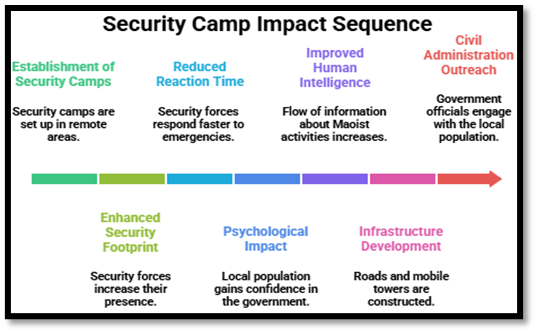
The Path Forward: Addressing Structural Issues
- Implementation of Constitutional Guarantees: The government must fully implement constitutional guarantees enshrined in Acts such as the Panchayats Extension to Scheduled Areas Act (PESA) and the Forest Rights Act (FRA).
- Strengthening Civil Administration: In areas where governance has been minimal, the civil administration must start from scratch, building institutions and delivering essential services.
- Long-Term Development Plan: A task force should be established to develop a prospective plan for the region until 2047, as part of the Viksit Bharat vision.
Conclusion:
The security forces have played a crucial role in curbing Maoist influence in India, providing a platform for the government to carry forward the mission for sustainable peace. By addressing the underlying structural issues and implementing constitutional guarantees, the government can ensure that the gains made in the fight against Maoism are consolidated and that the region can finally achieve lasting peace and prosperity.
La Excellence IAS Academy, the best IAS coaching in Hyderabad, known for delivering quality content and conceptual clarity for UPSC 2026 preparation.
FOLLOW US ON:
◉ YouTube : https://www.youtube.com/@CivilsPrepTeam
◉ Facebook: https://www.facebook.com/LaExcellenceIAS
◉ Instagram: https://www.instagram.com/laexcellenceiasacademy/
GET IN TOUCH:
Contact us at info@laex.in, https://laex.in/contact-us/
or Call us @ +91 9052 29 2929, +91 9052 99 2929, +91 9154 24 2140
OUR BRANCHES:
Head Office: H No: 1-10-225A, Beside AEVA Fertility Center, Ashok Nagar Extension, VV Giri Nagar, Ashok Nagar, Hyderabad, 500020
Madhapur: Flat no: 301, survey no 58-60, Guttala begumpet Madhapur metro pillar: 1524, Rangareddy Hyderabad, Telangana 500081
Bangalore: Plot No: 99, 2nd floor, 80 Feet Road, Beside Poorvika Mobiles, Chandra Layout, Attiguppe, Near Vijaya Nagara, Bengaluru, 560040