
Paper: GS – I/II, Subject: Society and Social Justice, Topic: Population and Associated Issues, Issue: Silver Economy in Kerala: Unlocking the Age Dividend.
Context:
Kerala is entering an advanced stage of demographic transition where a significant share of its population is elderly. This is not just a welfare issue but a structural transformation of society. The real policy challenge is to convert ageing from a burden into an opportunity, by building a productive and dignified ecosystem for the elderly.
Key Takeaways:
BACKGROUND: Population ageing refers to a rising proportion of elderly (60+) due to declining fertility and increasing life expectancy. Kerala is India’s frontrunner in this transition, with the elderly expected to exceed 20% of its population by 2026 (against National Average of 12%).
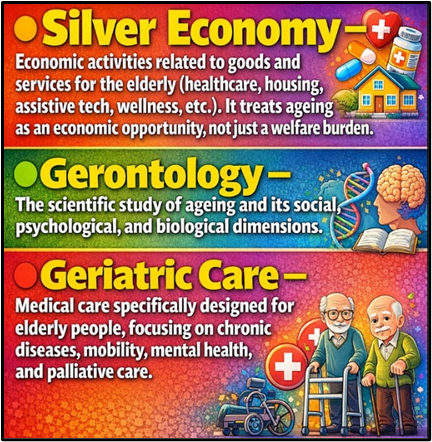
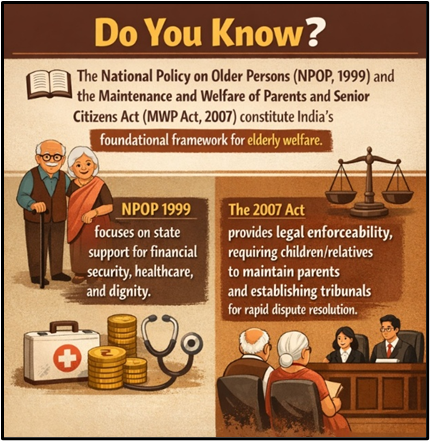
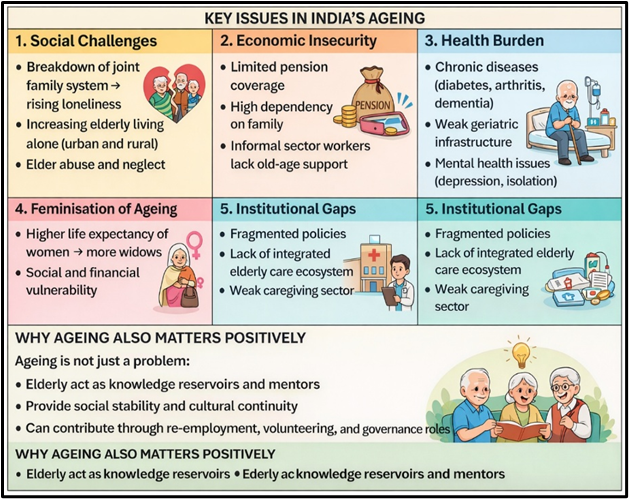
Kerala’s ageing is a result of its success in education, healthcare, and demographic control, but this success now creates pressure on existing infrastructure.
CORE ANALYSIS: FROM KERALA CASE TO GENERAL MODEL:
The article essentially argues that ageing must be reimagined through a “silver economy framework” rather than a welfare-centric approach.
1. Reimagining Ageing: From Dependency to Productivity: Instead of viewing the elderly as dependents, policy must integrate them into economic and social systems. This includes creating sectors like elder-care services, wellness tourism, rehabilitation, and assistive technologies.
2. Age-Friendly Infrastructure and Housing:
The article suggests retirement ecosystems, but the broader idea is:
- Develop age-friendly cities and housing with universal design (ramps, safety features, accessible transport).
- Promote mixed-income models to avoid exclusion.
- Encourage “ageing in place”, where elderly live in their own homes supported by technology and community care.
3. Healthcare System Transformation:
Ageing societies require a shift from general healthcare to specialised care:
- Expansion of geriatric departments and trained professionals
- Focus on chronic diseases, dementia, and palliative care
- Integration of preventive care + wellness approaches (nutrition, mental health, lifestyle)
The article emphasises that ageing increases multimorbidity, requiring a completely different healthcare model.
4. Technology and Home-Based Care:
A major policy innovation suggested:
- Use of digital health monitoring, wearable devices, AI tools
- Strengthening home-based care systems instead of institutionalisation
- Leveraging frontline workers (like ASHA) for decentralised care
This reduces both cost burden and social isolation.
5. Social and Psychological Dimension:
Ageing is not just economic—it is deeply social:
- Rise in loneliness due to nuclear families and migration
- Need for intergenerational spaces and community engagement
- Reimagining old-age homes as community centres, not abandonment spaces
6. Governance Shift: The core message is a transition from: Welfare Model → Integrated Ageing Ecosystem. (fragmented schemes → coordinated health + housing + social security + technology)
SHIFT TO INDIA: AGEING AS A NATIONAL ISSUE
While Kerala is ahead, India is moving in the same direction. Elderly population expected to reach 173 million by 2026. Around 75% suffer from chronic illnesses, and many lack financial security
WAY FORWARD:
- Develop integrated elderly care policy combining health, housing, and social security.
- Promote private investment in silver economy with regulatory safeguards.
- Strengthen geriatric healthcare workforce and training systems.
- Scale digital health and home-based care models.
- Foster community-based and intergenerational support systems.
SYLLABUS LINKAGE – GS PAPER I – (INDIAN SOCIETY: Population and associated issues
& Social empowerment); GS PAPER II (Welfare schemes for vulnerable sections &health sector).
Source: (The Indian Express)
La Excellence IAS Academy, the best IAS coaching in Hyderabad, known for delivering quality content and conceptual clarity for UPSC 2026 preparation.
FOLLOW US ON:
◉ YouTube : https://www.youtube.com/@CivilsPrepTeam
◉ Facebook: https://www.facebook.com/LaExcellenceIAS
◉ Instagram: https://www.instagram.com/laexcellenceiasacademy/
GET IN TOUCH:
Contact us at info@laex.in, https://laex.in/contact-us/
or Call us @ +91 9052 29 2929, +91 9052 99 2929, +91 9154 24 2140
OUR BRANCHES:
Head Office: H No: 1-10-225A, Beside AEVA Fertility Center, Ashok Nagar Extension, VV Giri Nagar, Ashok Nagar, Hyderabad, 500020
Madhapur: Flat no: 301, survey no 58-60, Guttala begumpet Madhapur metro pillar: 1524, Rangareddy Hyderabad, Telangana 500081
Bangalore: Plot No: 99, 2nd floor, 80 Feet Road, Beside Poorvika Mobiles, Chandra Layout, Attiguppe, Near Vijaya Nagara, Bengaluru, 560040