
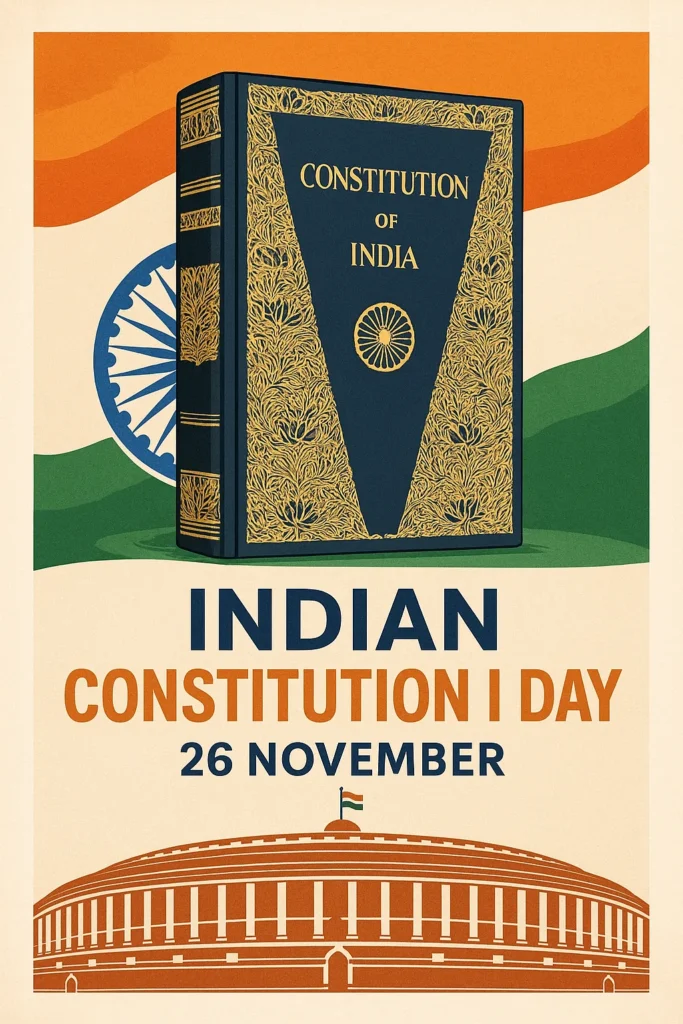
A gripping story for Constitution Day
On a chilly November morning in 1949, as mist curled around the grand pillars of the Parliament House, a strange silence hung in the air. Inside the Constituent Assembly Chamber, the members took their seats one by one. Some were nervous. Some were hopeful. A few were exhausted after almost three years of relentless debates.
But each of them knew — this was no ordinary day.
This was the day India would give itself a soul.
Tomorrow, when we celebrate November 26 — Constitution Day, we aren’t celebrating a date on a calendar.
We are celebrating the moment India finally looked at itself in the mirror and said:
“This is who we are. And this is who we dream to become.”
Let me take you back into the heart of that story…
A Nation With No Map, Yet Millions of Dreams
The India of 1946 was not the India you see today.
It was fractured, wounded, anxious — yet bursting with imagination.
The freedom struggle had ended.
But the real struggle had just begun:
How do you unite 560 princely states, 14 major languages, hundreds of cultures, and millions of aspirations?
The British left behind no blueprint.
No manual.
No model.
And yet, on December 9, 1946, 389 people gathered under one roof with a courage that can still give us goosebumps. They were not professional constitution-makers.
They were teachers, farmers’ sons, poets, lawyers, social reformers, and freedom fighters. Their life stories were their only qualification.
Think about it — a Constitution written not by elites, not by victors, not by conquerors, but by ordinary Indians with extraordinary conviction.
The Drafting: A Battle of Minds and a Symphony of Ideas
If someone made a Netflix series on India’s constitution-making, it would have everything — drama, conflict, politics, idealism, hope, heartbreak, and brilliance.
Inside the Assembly Hall, debates would stretch for hours.
Sometimes one speech changed the entire direction of the draft.
Sometimes two people fiercely argued yet left the hall as friends.
And at the center of it all, sat Dr. B.R. Ambedkar, pen in one hand and the weight of 300 million Indians on his shoulders.
He was calm.
He was sharp.
He was determined.
Every clause was questioned.
Every comma debated.
Every article revised.
Hansa Mehta changed global history by replacing “all men” with “all human beings” in the Universal Declaration of Human Rights — a bold contribution that later echoed in our own Constitution.
Sardar Patel stitched the federal structure with the precision of a surgeon.
Nehru poured the spirit of India’s civilisational ideals into the Preamble.
Rajendra Prasad brought the Assembly together when disagreements reached boiling point.
Dakshayani Velayudhan gracefully reminded the nation that equality cannot wait for better times.
They didn’t write a document.
They wrote the most ambitious love letter to India’s future.
November 26, 1949 — The Day the Hall Stood Still
After 2 years, 11 months, and 18 days…
after 11 sessions…
after 165 days of debate…
after analysing 7635 amendments…
the Constitution of India was adopted.
No fireworks.
No slogans.
Just a deep, overwhelming quiet.
The kind of silence that comes when you realise you’ve created something that will outlive you.
Dr. Ambedkar stood up to speak.
His voice didn’t tremble; but hearts did.
He warned that political democracy is meaningless without social democracy.
He reminded India that the Constitution is only as strong as the people who uphold it.
He asked the nation to never idolise or demonise leaders — but to trust principles.
When the final signatures were placed, the Assembly knew:
This was the moment India finally found its voice, direction, and destiny.
January 26, 1950 — From Paper to Pulse
Why wasn’t the Constitution enforced immediately?
Because January 26 held emotional weight. It was the day in 1930 when India declared Purna Swaraj — complete independence.
So, on January 26, 1950, the Constitution came alive.
India became a Republic.
The first breath of a new era was taken.
But November 26 remained immortal — the day India chose the path of a democratic, inclusive, plural Republic.
Why Constitution Day Still Gives Us Goosebumps?
In a world where countries fight over identity and power, India’s Constitution remains a miracle — not because it was perfect from Day 1, but because it dared to dream.
Here’s why it still matters today:
1. A Document Written for the Weak, Not the Powerful
Most constitutions protect rulers.
Ours protects citizens.
The poor, the voiceless, the discriminated, the forgotten — the Constitution stands with them first.
2. It Makes Every Citizen a Participant, Not a Spectator
Voting is not a ritual.
It is the way you shape history.
The Constitution doesn’t ask us to agree.
It asks us to engage.
3. It Is the World’s Longest Written Constitution — by Choice
Because India is not “one idea.”
It is many ideas living together.
Our Constitution respects that complexity.
4. It Believes in Debate, Not Obedience
Disagreement is not a threat to India.
It is what keeps India alive.
The Constituent Assembly itself was a masterclass in debate.
5. It Is a Living Document
73 years later, it still breathes.
It still evolves.
It still grows with the nation.
The Constitution is not ink on paper.
It is a relationship between the State and the people.
Seven Ways to Cherish November 26 Today
Here is how each of us can make Constitution Day meaningful:
1. Read the Preamble — Slowly
Feel those words.
They are a promise from the past to your future.
2. Teach a Child About Rights and Duties
A single conversation can shape a lifetime.
3. Watch a Short Clip of the Constituent Assembly Debates
It will show you what respectful disagreement looks like.
4. Reflect on How You Use Your Rights
Speech. Liberty. Equality.
Every right becomes powerful only when exercised responsibly.
5. Celebrate Diversity, Not Just Tolerance
India was never meant to be monochrome.
Its beauty is in its colours.
6. Thank the People Who Keep Democracy Alive
Teachers. Journalists. Activists. Judges. Civil servants.
And above all — voters.
7. Do One Small Act of Fraternity
A smile.
A gesture of kindness.
A conversation without judgement.
Ambedkar said fraternity is the glue that holds India together.
The Final Scene: The Promise We Renew Every Year
Imagine the Constituent Assembly Hall again.
The wooden desks.
The ancient lamps.
The echoes of speeches that shaped history.
Now imagine one empty chair.
That chair belongs to you.
To every Indian born after 1950.
Because the Constitution was never meant to end with the signatures of 389 members.
It was meant to be completed by you — through your actions, choices, courage, empathy, and responsibility.
As we celebrate Constitution Day, remember this:
You don’t just live in India.
India lives in you.
You don’t just enjoy rights.
You carry forward a legacy.
You don’t just celebrate the Constitution.
You continue its story.
And the story is still being written —
every day,
by every citizen,
in every corner of this vast, beautiful, complicated, magnificent nation.
Happy Constitution Day.
May the spirit of justice, liberty, equality, and fraternity guide you today and always.
La Excellence IAS Academy, the best IAS coaching in Hyderabad, known for delivering quality content and conceptual clarity for UPSC 2025 preparation.
▶️ FOLLOW US ON:
◉ Youtube : https://www.youtube.com/@CivilsPrepTeam
◉ Facebook: https://www.facebook.com/LaExcellenceIAS
◉ Instagram: https://www.instagram.com/laexcellenceiasacademy/
▶️ GET IN TOUCH:
Contact us at info@laex.in, https://laex.in/contact-us/
or Call us @ +91 9052 29 2929, +91 9052 99 2929, +91 9154 24 2140
▶️ OUR BRANCHES:
Head Office: H No: 1-10-225A, Beside AEVA Fertility Center, Ashok Nagar Extension, VV Giri Nagar, Ashok Nagar, Hyderabad, 500020
Madhapur: Flat no: 301, survey no 58-60, Guttala begumpet Madhapur metro pillar : 1524, Rangareddy Hyderabad, Telangana 500081
Bangalore: Plot No: 99, 2nd floor, 80 Feet Road, Beside Poorvika Mobiles, Chandra Layout, Attiguppe, Near Vijaya Nagara, Bengaluru, 560040