
Paper: GS – III, Subject: Economy, Topic: Agriculture and allied Sector, Issue: AgriPV: Balancing Agriculture and Energy.
Context:
Agri-photovoltaics (AgriPV) emerges as a promising approach, allowing farmers to cultivate crops while generating solar energy on the same land.India aims to achieve 300 GW of installed solar capacity by 2030 and net-zero emissions by 2070.
Key Takeaways:
PM-KUSUM scheme:
Increased Budget Allocation: The 2026-27 Budget nearly doubled the outlay for the to ₹25,000 crore, emphasizing the government’s commitment to enhancing solar power production focused on farmers.
Objectives:
- Provide energy and water security to farmers.
- Enhance farmers’ incomes.
- Decarbonize the agricultural sector through decentralized solar pumps and power plants.
Understanding AgriPV:
Definition: AgriPV integrates solar systems with farming, enabling farmers to generate electricity while cultivating crops on the same land.
Design Variations:
- Elevated Systems: Panels mounted a few meters above ground to allow crops to grow below.
- Row-Based Systems: Panels positioned between crop rows to minimize shading.
- Vertical Systems: Upright panels capturing sunlight from both sides.
- Greenhouse-Integrated Systems: Panels on roofs or walls to maintain a controlled growing environment.
Importance of Local Adaptation: The suitability of AgriPV designs depends on local climate, irrigation practices, and crop types, necessitating systematic planning.
Crop Selection for AgriPV:
- Shade-Tolerant Crops: These crops thrive in partially shaded areas under solar panels. Examples include leafy vegetables and herbs.
- Sunlight-Dependent Crops: Crops requiring more sunlight perform better in spaces between rows of panels. Suitable options vary by region:
- Madhya Pradesh: Tomato, onion, garlic, turmeric, ginger, leafy vegetables, and tulsi.
- Karnataka and Maharashtra: Ragi, jowar, grapes, tomato, potato, chillies, banana, and brinjal.
Economic Viability and Business Models:
- Ownership Models:
- Farmers can own and operate AgriPV systems, using a portion of the electricity generated and selling the surplus.
- Collective development through Farmer Producer Organisations or cooperatives can enhance bargaining power and access to finance.
- Private Developer Involvement: Developers can lease farmland, sharing revenues or paying fixed rents to farmers.
- Public Sector Role: State governments or public agencies can develop AgriPV systems to support local energy needs.
Conclusion:
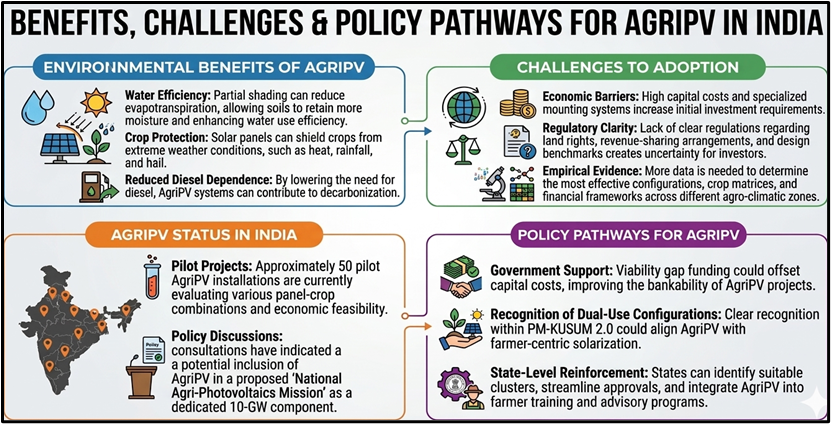
AgriPV presents a viable pathway for India to balance its energy transition goals with agricultural productivity. By leveraging dual-use land for solar energy generation and crop cultivation, AgriPV can enhance farmer incomes and contribute to sustainable development. With the right policy frameworks and support, AgriPV can move from pilot projects to a scalable model, addressing both energy and food security challenges in India.
Source: (The Hindu)
La Excellence IAS Academy, the best IAS coaching in Hyderabad, known for delivering quality content and conceptual clarity for UPSC 2026 preparation.
FOLLOW US ON:
◉ YouTube : https://www.youtube.com/@CivilsPrepTeam
◉ Facebook: https://www.facebook.com/LaExcellenceIAS
◉ Instagram: https://www.instagram.com/laexcellenceiasacademy/
GET IN TOUCH:
Contact us at info@laex.in, https://laex.in/contact-us/
or Call us @ +91 9052 29 2929, +91 9052 99 2929, +91 9154 24 2140
OUR BRANCHES:
Head Office: H No: 1-10-225A, Beside AEVA Fertility Center, Ashok Nagar Extension, VV Giri Nagar, Ashok Nagar, Hyderabad, 500020
Madhapur: Flat no: 301, survey no 58-60, Guttala begumpet Madhapur metro pillar: 1524, Rangareddy Hyderabad, Telangana 500081
Bangalore: Plot No: 99, 2nd floor, 80 Feet Road, Beside Poorvika Mobiles, Chandra Layout, Attiguppe, Near Vijaya Nagara, Bengaluru, 560040