
Paper: GS – II, Subject: International Relations, Topic: International Institutions, Issue: Asia-Pacific Malaria Elimination.
Context:
The World Malaria Report 2025, released by the World Health Organization (WHO), assesses global and regional progress towards the 2030 malaria elimination target under the Sustainable Development Goals (SDG-3).
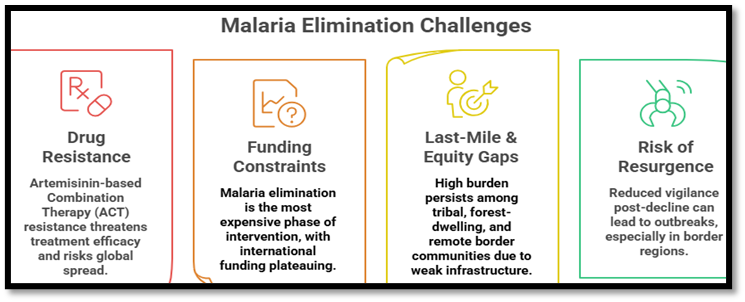
- While the Asia-Pacific region shows declining malaria cases, emerging challenges such as drug resistance, funding gaps, and last-mile delivery issues raise doubts about meeting the 2030 deadline.
Key Takeaways:
Key Findings from the Report:
- Estimated malaria cases in Asia-Pacific fell from about 9.6 million (2023) to ~8.9 million (2024).
- Significant reductions observed in Pakistan, Cambodia, Lao PDR, Vietnam, and parts of India.
- Progress largely driven by 10 high-burden countries in the region.
- However: Artemisinin resistance is rising in the Greater Mekong Sub-region and Global funding for malaria control has declined, increasing programmatic risks.
Why Asia-Pacific Shows Hope:
- Strong National Elimination Commitments
- Many countries have time-bound elimination goals.
- India aims to eliminate indigenous malaria by 2027 and achieve zero transmission by 2030.
- Improved Surveillance & Case Management
- Shift from control to case-based surveillance.
- Faster detection, classification, and response mechanisms.
- Technological & Vaccine Advances
- Introduction of RTS,S and R21 malaria vaccines.
- Potential to reduce child mortality and disease burden when integrated with existing tools.
India’s Position:
- India has made substantial progress, with many districts reporting zero transmission.
- Challenges remain in:
- Northeast and forested tribal belts
- Migrant populations and cross-border transmission
- India is shifting from malaria control to elimination mode, emphasizing:
- Surveillance-driven response
- Community-based interventions
- Integration with primary healthcare
Way Forward:
- Sustained & Predictable Financing at global and national levels.
- Regional Cooperation for cross-border surveillance and data sharing.
- Strict Drug Stewardship to prevent resistance.
- Integrated Approach combining: Vaccines, Vector control, Digital surveillance and Community participation
- Treat malaria elimination as a development investment, not just a health cost.
While the Asia-Pacific region has made significant progress in reducing malaria cases, it is not entirely on track to meet the 2030 malaria elimination target. To achieve the elimination goal, the region needs to address these challenges by enhancing surveillance, targeting interventions, sustaining investment, maintaining drug efficacy, promoting regional coordination, and addressing funding constraints.
Source: (The Hindu)
La Excellence IAS Academy, the best IAS coaching in Hyderabad, known for delivering quality content and conceptual clarity for UPSC 2026 preparation.
FOLLOW US ON:
◉ YouTube : https://www.youtube.com/@CivilsPrepTeam
◉ Facebook: https://www.facebook.com/LaExcellenceIAS
◉ Instagram: https://www.instagram.com/laexcellenceiasacademy/
GET IN TOUCH:
Contact us at info@laex.in, https://laex.in/contact-us/
or Call us @ +91 9052 29 2929, +91 9052 99 2929, +91 9154 24 2140
OUR BRANCHES:
Head Office: H No: 1-10-225A, Beside AEVA Fertility Center, Ashok Nagar Extension, VV Giri Nagar, Ashok Nagar, Hyderabad, 500020
Madhapur: Flat no: 301, survey no 58-60, Guttala begumpet Madhapur metro pillar: 1524, Rangareddy Hyderabad, Telangana 500081
Bangalore: Plot No: 99, 2nd floor, 80 Feet Road, Beside Poorvika Mobiles, Chandra Layout, Attiguppe, Near Vijaya Nagara, Bengaluru, 560040