
Paper: GS – II, Subject: International Relations, Topic: Global Grouping, Issue: Board of Peace Initiative.
Context:
U.S. President Donald Trump launched a new multilateral initiative called the “Board of Peace” during the World Economic Forum (WEF), Davos. The platform aims to facilitate conflict resolution, beginning with ceasefire efforts in Gaza and extending to other global conflicts.
- Notably, India remained absent, while only 19 countries participated, despite claims of wider global support.
Key Takeaways:
| About the Board of Peace for Gaza: It is a U.S.-led, invitation-only mechanism proposed under President Trump’s Gaza peace plan to oversee post-conflict governance, stabilisation, and reconstruction in Gaza. It represents a shift towards ad hoc conflict-management arrangements outside traditional UN-centric frameworks. Origin: It was first proposed in October 2025. UN Backing: UNSC Resolution 2803, which authorised supervision of Gaza’s transition till 2027 |
Key Highlights:
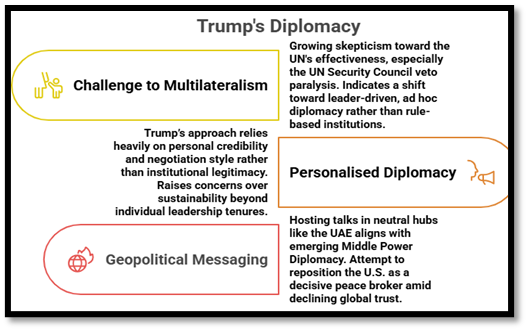
- The Board of Peace is envisioned as an alternative global conflict-resolution platform, implicitly challenging the relevance of the United Nations.
- Trump claimed 59 countries had signed on, but representation at the launch was limited to 19 countries.
- Focus areas include:
- Gaza ceasefire and post-war governance under U.S. supervision
- Proposed US–Russia–Ukraine trilateral talks to be held in the UAE
- Several close U.S. allies and major powers, including India, were absent.
India’s Absence: Why It Matters:
- Strategic Autonomy: India traditionally avoids platforms that dilute established multilateral norms.
- UN-Centric Approach: India supports reform of the UN rather than parallel institutions.
- West Asia Sensitivities: India maintains balanced relations with Israel, Palestine, Iran, and Arab states.
- Ukraine Conflict: India has consistently advocated dialogue without aligning with Western pressure blocs.
India’s absence reflects principled non-alignment, not disengagement.
Concerns & Limitations:
- Legitimacy Deficit: No legal mandate or universal representation.
- Selective Participation: Absence of major stakeholders weakens outcomes.
- Risk of Politicisation: Peace initiatives tied to electoral or personal agendas.
- Overlap with Existing Mechanisms: Duplication without accountability.
Way Forward:
- Strengthening inclusive multilateral platforms rather than fragmenting global governance.
- Reforming the United Nations Security Council to reflect contemporary geopolitical realities.
- Encouraging issue-based coalitions with transparency and regional consent.
- India can play a bridging role through platforms like G20, BRICS, SCO, and Track-II diplomacy
The “Board of Peace” underscores growing global dissatisfaction with existing institutions but also exposes the risks of fragmented, personality-driven diplomacy. India’s calibrated distance reinforces its commitment to inclusive, rule-based global order, positioning it as a responsible stakeholder rather than a reactive participant.
Source: (The Indian Express, The Hindu)
La Excellence IAS Academy, the best IAS coaching in Hyderabad, known for delivering quality content and conceptual clarity for UPSC 2026 preparation.
FOLLOW US ON:
◉ YouTube : https://www.youtube.com/@CivilsPrepTeam
◉ Facebook: https://www.facebook.com/LaExcellenceIAS
◉ Instagram: https://www.instagram.com/laexcellenceiasacademy/
GET IN TOUCH:
Contact us at info@laex.in, https://laex.in/contact-us/
or Call us @ +91 9052 29 2929, +91 9052 99 2929, +91 9154 24 2140
OUR BRANCHES:
Head Office: H No: 1-10-225A, Beside AEVA Fertility Center, Ashok Nagar Extension, VV Giri Nagar, Ashok Nagar, Hyderabad, 500020
Madhapur: Flat no: 301, survey no 58-60, Guttala begumpet Madhapur metro pillar: 1524, Rangareddy Hyderabad, Telangana 500081
Bangalore: Plot No: 99, 2nd floor, 80 Feet Road, Beside Poorvika Mobiles, Chandra Layout, Attiguppe, Near Vijaya Nagara, Bengaluru, 560040