
Paper: GS – III, Subject: Environment and Ecology, Topic: Land Degradation, Issue: Sand Mining in Chambal: Ecology vs Economy.
Context:
The article discusses the problem of illegal sand mining in central India, particularly in the Chambal region. It highlights how this issue is not just environmental but also deeply linked to livelihood, governance failure, and organized crime. The judiciary, especially the Supreme Court of India, has taken serious note of the situation.
Key Takeaways:
Background: Sand Mining & Legal Framework
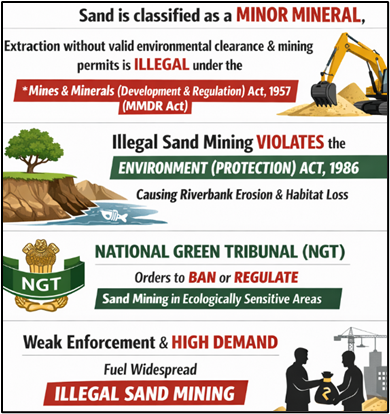
- Sand is a critical natural resource used extensively in construction and infrastructure development.
- River sand plays an important ecological role by maintaining river flow, supporting biodiversity, and preventing erosion and groundwater depletion.
Ecological Importance of Chambal Region:
- The National Chambal Ghariyal Sanctuary is a protected ecosystem spread across three states: Rajasthan, Madhya Pradesh, and Uttar Pradesh.
- It is crucial for the survival of critically endangered species such as the gharial, red-crowned roofed turtle, and the Ganges river dolphin.
- These species depend heavily on river sandbanks and sandbars for nesting, breeding, and survival.
Illegal Sand Mining and Its Scale:
- Organized criminal groups are illegally extracting sand from the Chambal river system.
- The Supreme Court of India has described these groups as “modern dacoits,” highlighting the seriousness of the problem.
- The mining mafia expanded to meet the increasing demand for sand during India’s construction boom.
- These groups exploit administrative gaps and jurisdictional confusion among Rajasthan, Madhya Pradesh, and Uttar Pradesh.
Governance Failure and Weak Enforcement:
- Despite bans by courts and the National Green Tribunal, illegal sand mining continues unchecked.
- State governments have often failed to take decisive action and sometimes shift responsibility instead of enforcing the law effectively.
Rising Violence and Criminalisation:
- Illegal sand mining has become highly violent between 2017 and 2024.
- Tractor trolleys used for mining have been used to attack forest guards and police personnel.
- Miners have even opened fire on police teams during raids.
- Mining groups use local villagers to track police movements using mobile applications and GPS systems.
- By 2023, mining syndicates in the Gwalior-Chambal region were using semi-automatic weapons, often overpowering local enforcement agencies.
Attempts to Legalise Mining:
- Due to their inability to control illegal mining, some states attempted to legalise sand mining within sanctuary areas.
- Madhya Pradesh proposed limited mining in two districts, but the National Green Tribunal stalled the proposal, leading to its withdrawal.
- Rajasthan made a similar attempt in March, but the court intervened and blocked the move.
Livelihood Crisis in Chambal Region:
- The Chambal ravines are not suitable for traditional agriculture, limiting economic opportunities.
- Many young men are therefore compelled to turn to sand mining as a source of livelihood.
- The mining mafia recruits these individuals as foot soldiers.
- When authorities act against illegal mining, local communities often oppose enforcement due to their dependence on mining income.
Judicial Intervention:
- The Supreme Court of India took suo motu cognisance of Rajasthan’s move to legalise sand mining.
- Justice Sandeep Mehta reminded the state of legal provisions under the National Security Act and state-specific Goonda Acts.
- This reflects the judiciary’s concern over lawlessness and weak governance.
Governance vs Judicial Overreach:
- While judicial intervention is necessary, the article suggests that courts should focus on disciplining regulatory authorities rather than replacing them.
- Effective governance requires strengthening institutions rather than excessive reliance on judicial action.
Core Insight: Limits of Force:
- Chambal has a history of violence, but force alone cannot resolve the issue of illegal mining.
- Strict crackdowns without addressing underlying causes may increase local resentment and strengthen criminal networks.
Way Forward:
- Sustainable solutions require restoring lawful livelihood options for local populations.
- There is also a need for credible, consistent, and fair enforcement of laws.
- A balanced approach combining economic alternatives and strong governance is essential to address the issue.
- Illegal sand mining in the Chambal region represents a complex governance and livelihood crisis where long-term solutions must balance ecological conservation, economic needs, and institutional accountability.
UPSC SYLLABUS LINKAGE – (GS Paper III: Environment and Ecology – Conservation of Natural resources).
Source: (The Hindu)
La Excellence IAS Academy, the best IAS coaching in Hyderabad, known for delivering quality content and conceptual clarity for UPSC 2026 preparation.
FOLLOW US ON:
◉ YouTube : https://www.youtube.com/@CivilsPrepTeam
◉ Facebook: https://www.facebook.com/LaExcellenceIAS
◉ Instagram: https://www.instagram.com/laexcellenceiasacademy/
GET IN TOUCH:
Contact us at info@laex.in, https://laex.in/contact-us/
or Call us @ +91 9052 29 2929, +91 9052 99 2929, +91 9154 24 2140
OUR BRANCHES:
Head Office: H No: 1-10-225A, Beside AEVA Fertility Center, Ashok Nagar Extension, VV Giri Nagar, Ashok Nagar, Hyderabad, 500020
Madhapur: Flat no: 301, survey no 58-60, Guttala begumpet Madhapur metro pillar: 1524, Rangareddy Hyderabad, Telangana 500081
Bangalore: Plot No: 99, 2nd floor, 80 Feet Road, Beside Poorvika Mobiles, Chandra Layout, Attiguppe, Near Vijaya Nagara, Bengaluru, 560040