
Paper: GS – II, Subject: International Relations, Topic: India’s relations with other nations, Issue: India-Canada uranium deal.
Context:
The recent visit of Canadian Prime Minister Mark Carney to India resulted in a landmark agreement between India’s Department of Atomic Energy and Cameco, a Canadian uranium supplier.
- This deal is pivotal for India’s nuclear energy strategy, aiming to significantly increase its nuclear power production by 2047.
Key Takeaways:
Key Details of the Agreement:
- Supplier: Cameco, a Canadian uranium company.
- Quantity: 22 million pounds (approximately 10,000 tonnes) of uranium.
- Duration: Supply scheduled between 2027 and 2035.
- Contract Value: 26 billion Canadian dollars (approximately $1.9 billion).
Dependence on Imported Uranium:
Current Situation:
- Domestic Production: India has substantial uranium deposits, but they are of low quality (0.02% to 0.45% uranium content) compared to global averages (1% to 2%).
- Import Reliance: Over 70% of India’s uranium needs are met through imports, primarily from Kazakhstan, Canada, Uzbekistan, and Russia.
Historical Context:
- Previous Suppliers: India has a long-standing relationship with Cameco, having received uranium supplies as recently as 2020-21.
- Nuclear Collaboration: Canada has historically played a significant role in India’s nuclear development – Establishment of the CIRUS reactor in the 1950s.
Domestic Uranium Production:
Current Capacity:
- Annual Consumption: India consumes approximately 1,500 to 2,000 tonnes of uranium annually.
- Future Projections: The annual requirement could rise to 5,400 tonnes, with domestic production expected to meet only about 30% of this demand.
Mining Landscape:
- Operational Mines: The majority of uranium production occurs in Jharkhand and Andhra Pradesh, with seven active mines.
Diversifying Supply Sources: With the new agreement with Cameco, India is now sourcing uranium from four countries: Uzbekistan, Kazakhstan, Canada, and Russia. Future agreements may include suppliers from Australia or the United States.
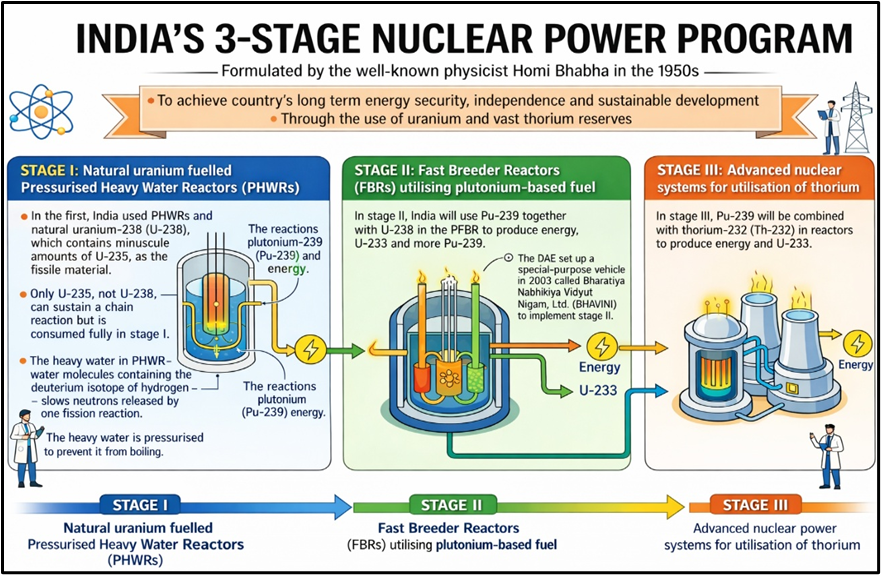
Challenges:
- Slow Progress: The three-stage program, conceptualized in the 1950s, has faced significant delays.
- Technological Development: India needs to develop specialized reactors for thorium utilization, which are not yet in use.
Conclusion:
The recent uranium supply agreement with Canada is a significant step in India’s nuclear energy expansion plans. India’s long-term ambition to transition to a thorium-based nuclear program remains a critical aspect of its energy security strategy.
Source: (The Indian Express)
La Excellence IAS Academy, the best IAS coaching in Hyderabad, known for delivering quality content and conceptual clarity for UPSC 2026 preparation.
FOLLOW US ON:
◉ YouTube : https://www.youtube.com/@CivilsPrepTeam
◉ Facebook: https://www.facebook.com/LaExcellenceIAS
◉ Instagram: https://www.instagram.com/laexcellenceiasacademy/
GET IN TOUCH:
Contact us at info@laex.in, https://laex.in/contact-us/
or Call us @ +91 9052 29 2929, +91 9052 99 2929, +91 9154 24 2140
OUR BRANCHES:
Head Office: H No: 1-10-225A, Beside AEVA Fertility Center, Ashok Nagar Extension, VV Giri Nagar, Ashok Nagar, Hyderabad, 500020
Madhapur: Flat no: 301, survey no 58-60, Guttala begumpet Madhapur metro pillar: 1524, Rangareddy Hyderabad, Telangana 500081
Bangalore: Plot No: 99, 2nd floor, 80 Feet Road, Beside Poorvika Mobiles, Chandra Layout, Attiguppe, Near Vijaya Nagara, Bengaluru, 560040