
Paper: GS – III, Subject: Internal Security, Topic: Maritime Security, Issue: India’s Maritime Strategy.
Context:
India maritime policy is deeply rooted in its geography, with the Himalayas and the Indian Ocean defining its boundaries and influencing its history. The maritime domain holds immense significance for India, encompassing historical, strategic, economic, and technological dimensions.
Key Highlights:
Maritime History:
- Ancient and Medieval Capabilities: Indian sailors demonstrated remarkable capabilities in reaching distant corners of the west and east, serving as a source of pride and inspiration.
- Jawaharlal Nehru’s Observation: Nehru emphasized that control over the Indian Ocean equates to control over India’s seaborne trade and, ultimately, its independence.
- Historical Evolution: The handbook traces the historical evolution of India’s maritime reach, focusing on the Cholas, Marathas, Europeans, and Indo-Arab maritime trade.
- The Cholas: Referred to as “The Nautical Tigers,” highlighting their maritime prowess.
- K.M. Panikkar’s Ideas: Critical analysis of Panikkar’s ideas and their relevance to contemporary geopolitics.
- Future Perspective: The Indian Ocean should be viewed as a place, the home of a majority of the world’s human population, rather than merely a space for transit.
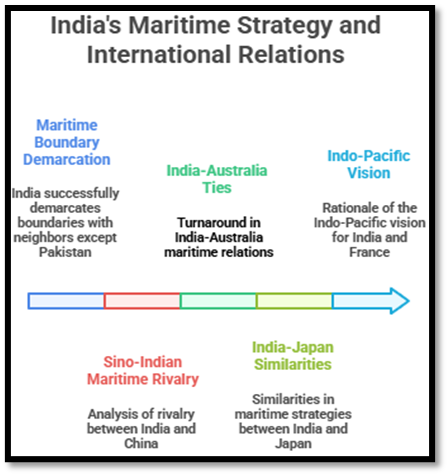
Maritime Institutions, Connectivity, and Governance:
- Maritime institutions, connectivity, and governance in South Asian states, including India, Bangladesh, Sri Lanka, and China.
- Power Projection: India has been successful in shaping its maritime power projection, particularly in curbing piracy in the Arabian Sea, transforming the Navy into a net security provider.
- Geopolitical Rivalries:
- Hedging System: Argues for a “hedging system” considering the U.S. strategy for the Indo-Pacific.
- Increased Maritime Presence: Advocates for increasing India’s maritime presence to create a “political and economic confluence of like-minded regional powers.”
Indo-Pacific Strategy:
- India’s vision, strengths, and partnerships in the Indo-Pacific have dominated strategic discourse.
- However, recent crises in other regions and the U.S. National Security Strategy (NSS) 2025, which takes a softer view of China, have somewhat eroded its salience.
Refinement Needed:
- Reassessment: India needs to refine its Indo-Pacific strategy in the context of these evolving geopolitical dynamics.
Economic and Technological Developments:
- The handbook addresses economic and technological developments in the maritime domain, including underwater domain awareness (UDA), underwater systems, maritime security, the Blue Economy revolution, climate resilience, and coastal security.
Key Areas: Blue Economy: Focus on all dimensions of the Blue Economy, providing the latest research and analyses.
- Policy Recommendations: Recommendations made in the volume merit close consideration by policymakers.
Conclusion:
India’s maritime policy has evolved through history, strategy, and economics, The Routledge Handbook of Maritime India highlights the need for refined strategy, international cooperation, and technology to secure Indian Ocean interests.
Source: (The Hindu)
La Excellence IAS Academy, the best IAS coaching in Hyderabad, known for delivering quality content and conceptual clarity for UPSC 2026 preparation.
FOLLOW US ON:
◉ YouTube : https://www.youtube.com/@CivilsPrepTeam
◉ Facebook: https://www.facebook.com/LaExcellenceIAS
◉ Instagram: https://www.instagram.com/laexcellenceiasacademy/
GET IN TOUCH:
Contact us at info@laex.in, https://laex.in/contact-us/
or Call us @ +91 9052 29 2929, +91 9052 99 2929, +91 9154 24 2140
OUR BRANCHES:
Head Office: H No: 1-10-225A, Beside AEVA Fertility Center, Ashok Nagar Extension, VV Giri Nagar, Ashok Nagar, Hyderabad, 500020
Madhapur: Flat no: 301, survey no 58-60, Guttala begumpet Madhapur metro pillar: 1524, Rangareddy Hyderabad, Telangana 500081
Bangalore: Plot No: 99, 2nd floor, 80 Feet Road, Beside Poorvika Mobiles, Chandra Layout, Attiguppe, Near Vijaya Nagara, Bengaluru, 560040