
Paper: GS – II, Subject: International Relations, Topic: Agreements involving India and/or affecting India’s interests, Issue: India–US trade deal.
Context:
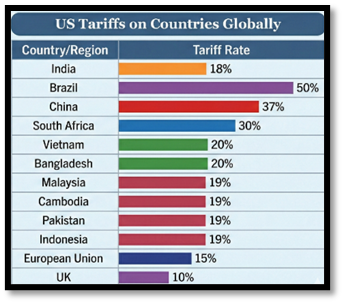
The recent trade agreement between India and the United States, focusing on the reduction of US tariffs on Indian goods from 50% to 18%, the implications of this deal, and the surrounding circumstances.
Key Takeaways:
Background: Previous Tariffs: India was previously subjected to a 50% tariff by the US, comprising a 25% penalty for purchasing Russian oil and a 25% reciprocal tariff.
Russian Oil Purchases:
- Trump stated Modi agreed to cease Russian oil purchases, favoring US and potentially Venezuelan oil. However, Modi did not mention this publicly. India has been reducing Russian oil imports, which dropped to their lowest in two years by December 2025.
- Negotiations: Protracted negotiations between the two countries had been ongoing since April, aiming to address the high tariff rate that disadvantaged Indian exports.
- Timing: The announcement of the trade deal coincides with the conclusion of talks on the India-EU trade agreement.
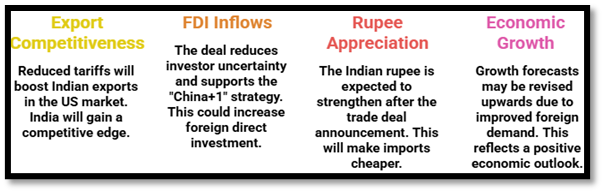
Trade Deal Benefits:
Trump’s Claims and Unanswered Questions:
- Commitment to US Goods: As part of the agreement, India has reportedly committed to increasing its purchases of American goods.
- Zero Tariffs and Non-Tariff Barriers: Trump also stated that India would reduce tariffs and non-tariff barriers against the US to zero.
- Clarification Needed: The External Affairs Ministry is yet to respond to questions regarding the details of the agreement and the claims made by President Trump
Strategic Significance:
- Deepening India–US Strategic Partnership:
- The tariff reduction signals strong political trust and long-term commitment beyond transactional trade.
- Reinforces the Comprehensive Global Strategic Partnership between India and the US.
- US Ally and China Counterweight: The trade deal reinforces the strategic alignment between India and the US, with the US viewing India as an ally and a counterweight to China.
- Global Trade Order: The agreement reflects the US’s efforts to rewrite the norms of the global trade order.
Strengthening Indo-Pacific Architecture:
- Economic integration complements security cooperation under Quad and Indo-Pacific Strategy.
- Trade becomes a pillar of rules-based Indo-Pacific order.
Geo-economics Leverage for India:
- Lower tariffs enhance India’s export competitiveness in the US market
- Strengthens India’s bargaining power in other FTAs (EU, UK, ASEAN).
Strategic Hedge in a Fragmenting World:
- As global trade fragments into blocs, the deal helps India secure access to the largest consumer market.
- Reduces vulnerability to protectionism in advanced economies.
Expert Opinions:
- Chief Economic Advisor (CEA): V Anantha Nageswaran believes that the tariff cut will remove uncertainty for global investors and boost FDI inflows.
India–US trade deal boosts Indian exports and investment via tariff cuts, but lacks clarity on India’s commitments, including US imports and Russian oil, highlighting India’s strategic role against China.
Source: (The Indian Express, The Hindu)
La Excellence IAS Academy, the best IAS coaching in Hyderabad, known for delivering quality content and conceptual clarity for UPSC 2026 preparation.
FOLLOW US ON:
◉ YouTube : https://www.youtube.com/@CivilsPrepTeam
◉ Facebook: https://www.facebook.com/LaExcellenceIAS
◉ Instagram: https://www.instagram.com/laexcellenceiasacademy/
GET IN TOUCH:
Contact us at info@laex.in, https://laex.in/contact-us/
or Call us @ +91 9052 29 2929, +91 9052 99 2929, +91 9154 24 2140
OUR BRANCHES:
Head Office: H No: 1-10-225A, Beside AEVA Fertility Center, Ashok Nagar Extension, VV Giri Nagar, Ashok Nagar, Hyderabad, 500020
Madhapur: Flat no: 301, survey no 58-60, Guttala begumpet Madhapur metro pillar: 1524, Rangareddy Hyderabad, Telangana 500081
Bangalore: Plot No: 99, 2nd floor, 80 Feet Road, Beside Poorvika Mobiles, Chandra Layout, Attiguppe, Near Vijaya Nagara, Bengaluru, 560040