
Paper: GS – III, Subject: Economy, Topic: Agriculture, Issue: Rice Production – Impact on Groundwater.
Context:
India’s dominance in global rice trade accounting for about 40% of world rice exports is intensifying a looming groundwater crisis, especially in water-stressed States like Punjab and Haryana, where rice cultivation is rapidly depleting aquifers.
Key Takeaways:
Background:
- India overtook China in 2023 to become the world’s largest rice producer.
- Rice exports have nearly doubled over the last decade, crossing 20 million tonnes annually.
- This export-led growth has been supported by Minimum Support Price (MSP) and power subsidies, encouraging water-intensive rice cultivation even in ecologically unsuitable regions.
Core Issue: Rice–Water Paradox:
- Rice requires 3,000–5,000 litres of water per kg, making it highly groundwater-intensive.
- In Punjab & Haryana:
- Groundwater depth has fallen from 30–50 feet to 80–200 feet.
- Many districts are officially classified as “over-exploited” or “critical” aquifers.
- Despite strong monsoons in recent years, aquifer recharge remains inadequate due to excessive extraction.
Key Drivers:
- Policy Distortions:
- MSP for rice has risen by ~70% over the past decade.
- Free or subsidised electricity incentivises uncontrolled groundwater pumping.
- Export Push:
- India produces far more rice than required for domestic consumption.
- Global food security dependence on Indian rice limits export restrictions.
- Weak Crop Diversification:
- Alternative crops (millets, pulses) receive short-term and insufficient incentives.
- Market assurance for non-rice crops remains poor.
Implications of Depletion:
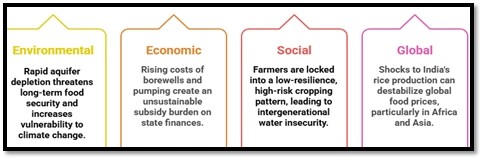
Government Response & Gaps:
- States like Haryana have offered incentives (₹7,500/ha) to shift to millets.
- However:
- Incentives are short-term and seasonal.
- No assured procurement comparable to rice.
- Past farm law reforms attempting diversification faced political resistance.
Way Forward:
- Rationalise MSP and power subsidies to reflect water scarcity.
- Promote crop diversification with long-term price assurance.
- Shift procurement towards millets and pulses (nutrition + water efficiency).
- Strengthen groundwater governance under the Atal Bhujal Yojana.
- Align trade policy with ecological sustainability, not just export competitiveness.
India’s rice export success hides a deepening groundwater crisis, driven by subsidies and water-intensive farming, demanding sustained policy reforms, crop diversification, and long-term incentives for environmentally sustainable agriculture.
La Excellence IAS Academy, the best IAS coaching in Hyderabad, known for delivering quality content and conceptual clarity for UPSC 2025 preparation.
FOLLOW US ON:
◉ YouTube : https://www.youtube.com/@CivilsPrepTeam
◉ Facebook: https://www.facebook.com/LaExcellenceIAS
◉ Instagram: https://www.instagram.com/laexcellenceiasacademy/
GET IN TOUCH:
Contact us at info@laex.in, https://laex.in/contact-us/
or Call us @ +91 9052 29 2929, +91 9052 99 2929, +91 9154 24 2140
OUR BRANCHES:
Head Office: H No: 1-10-225A, Beside AEVA Fertility Center, Ashok Nagar Extension, VV Giri Nagar, Ashok Nagar, Hyderabad, 500020
Madhapur: Flat no: 301, survey no 58-60, Guttala begumpet Madhapur metro pillar: 1524, Rangareddy Hyderabad, Telangana 500081
Bangalore: Plot No: 99, 2nd floor, 80 Feet Road, Beside Poorvika Mobiles, Chandra Layout, Attiguppe, Near Vijaya Nagara, Bengaluru, 560040