
Paper: GS – II, Subject: International Relations, Topic: Global Issues, Issue: Israel-US Joint Missile Strike in Iran.
Context:
Israel launched a pre-emptive strike on Tehran with U.S. backing to curb Iran’s nuclear programme. Iran retaliated against Israel and U.S. bases across the Gulf. The escalation widened into a regional crisis, compounded by Supreme Leader Ayatollah Ali Khamenei’s death.
Key Takeaways:
| Khamenei’s Legacy: Became President in 1981; succeeded Ayatollah Khomeini as Supreme Leader in 1989. Transformed Iran into powerful regional player and arch-foe of US and Israel. Established network of proxies across region (“Axis of Resistance”). Built indigenous technology and strengthened Islamic Revolutionary Guard Corps (IRGC). |
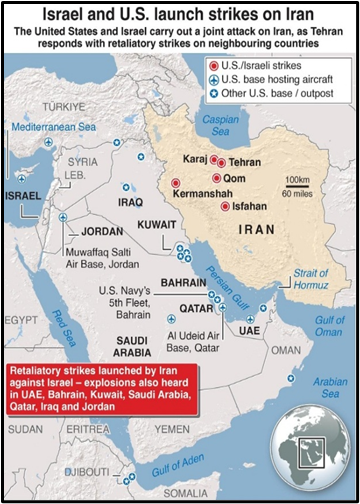
- Israel initially announced missile strikes on Iranian targets.
- A US official later confirmed the attacks were part of a joint military operation.
- Trump called the operation “massive and ongoing,” and the US Department of Defense named it Operation Epic Fury.
Iran’s Response:
- Iran retaliated by launching missiles toward northern Israel.
- Air-raid sirens were activated, and Israeli air defence systems intercepted incoming projectiles.
Iran expanded its response by targeting US-linked military facilities across the Middle East, including:
- Al Udeid Airbase (Qatar)
- Al-Salem Airbase (Kuwait)
- Al-Dhafra Airbase (UAE)
- US Fifth Fleet Headquarters (Bahrain)
Reports also indicated explosions in Saudi Arabia and attacks on US bases in Jordan.
Diaspora and Evacuation Concerns:
- India has significant diaspora exposure:10,000 Indians in Iran
- Over 41,000 in Israel
- 8–9 million across the wider Gulf:
Embassies issued advisories amid airspace closures and flight disruptions.
- India’s approach reflects past experience, including the evacuation of over 3,000 nationals during the previous Israel–Iran flare-up.
Strategic and Economic Stakes:
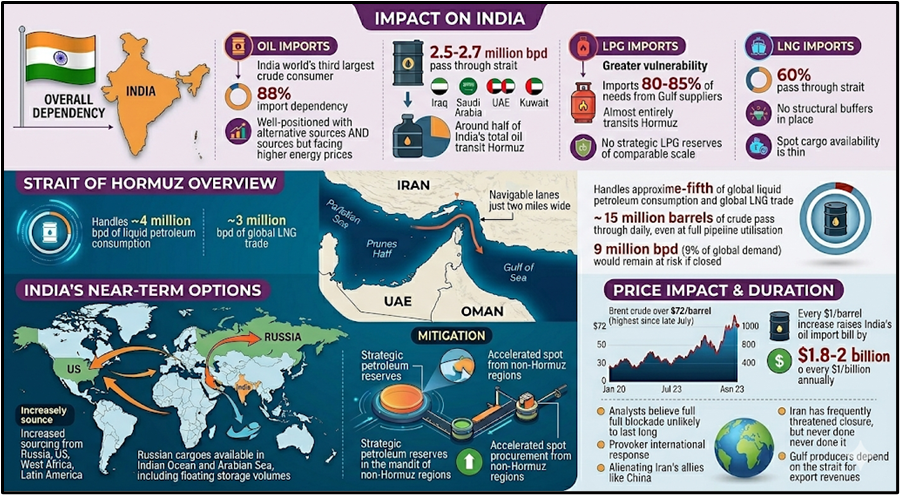
Beyond citizen safety, India’s energy security is at risk.
- Nearly 60% of India’s energy imports come from the region, and threats to close the Strait of Hormuz raise concerns over oil supply disruptions.
- The US role and President Trump’s explicit stance on Iran further complicate India’s balancing act between strategic partner Israel and longstanding partner Iran.
A Tightrope of Strategic Autonomy:
- India’s response mirrors its approach to the Russia–Ukraine war: maintaining strategic autonomy, avoiding public condemnation, keeping communication channels open, and prioritising national interests.
- However, as the Middle East conflict expands and US involvement deepens, India’s room for calibrated neutrality may narrow.
- The evolving regional dynamics will test New Delhi’s diplomatic agility in preserving its core interests.
The escalating conflict has transformed a bilateral confrontation into a region-wide crisis with global implications. Khamenei’s death deepens Iran’s uncertainty, while rising tensions threaten energy security and stability, making restraint and diplomacy crucial to prevent a broader war.
Source: (The Indian Express, The Hindu)
La Excellence IAS Academy, the best IAS coaching in Hyderabad, known for delivering quality content and conceptual clarity for UPSC 2026 preparation.
FOLLOW US ON:
◉ YouTube : https://www.youtube.com/@CivilsPrepTeam
◉ Facebook: https://www.facebook.com/LaExcellenceIAS
◉ Instagram: https://www.instagram.com/laexcellenceiasacademy/
GET IN TOUCH:
Contact us at info@laex.in, https://laex.in/contact-us/
or Call us @ +91 9052 29 2929, +91 9052 99 2929, +91 9154 24 2140
OUR BRANCHES:
Head Office: H No: 1-10-225A, Beside AEVA Fertility Center, Ashok Nagar Extension, VV Giri Nagar, Ashok Nagar, Hyderabad, 500020
Madhapur: Flat no: 301, survey no 58-60, Guttala begumpet Madhapur metro pillar: 1524, Rangareddy Hyderabad, Telangana 500081
Bangalore: Plot No: 99, 2nd floor, 80 Feet Road, Beside Poorvika Mobiles, Chandra Layout, Attiguppe, Near Vijaya Nagara, Bengaluru, 560040