
Paper: GS – II, Subject: Polity, Topic: Judiciary, Issue: Judicial Diversity in India.
Context:
A Private Member Bill has been introduced by P. Wilson, Rajya Sabha MP from Dravida Munnetra Kazhagam (DMK).
- Constitutional mandate for social diversity in judicial appointments
- Establishment of regional benches of the Supreme Court.
Key Takeaways:
What Does the Constitution Provide?
Judicial Appointments:
- Article 124: Judges of the Supreme Court are appointed by the President after consulting the Chief Justice of India (CJI).
- Article 217: Judges of High Courts are appointed by the President after consulting the CJI, the Chief Justice of the High Court, and the Governor of the State.
- Article 130: The Supreme Court’s seat is designated in Delhi or other locations as approved by the CJI with the central government’s consent.
What is the Collegium System?
Historical Context: Until the 1980s, judges were appointed by the government after consulting the judiciary.
- The First Judges case (1981) upheld the executive’s primacy in judicial appointments.
- The Second Judges case (1993) established the collegium system to maintain judicial independence and reduce political influence.
- The Third Judges case (1998) reaffirmed this system.
Structure of the Collegium:
- The collegium for the Supreme Court consists of the CJI and four senior judges.
- For High Courts, it includes the CJI and two senior judges.
Functioning:
- The collegium proposes appointments and sends recommendations to the Central government.
- The government can return recommendations but must comply if the collegium reiterates them.
Challenges:
- The collegium system has faced criticism for lack of transparency and alleged nepotism.
- There is a significant underrepresentation of marginalized groups in judicial appointments.
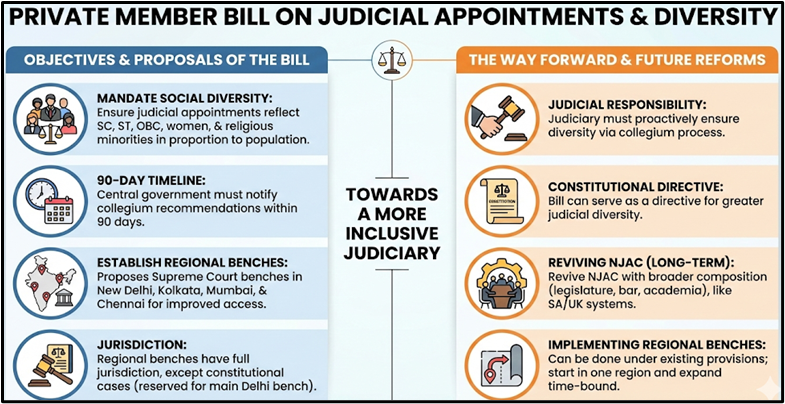
The Bill emphasizes increasing diversity and creating regional benches to enhance access to justice. While the collegium safeguards judicial independence, reforms are necessary to correct underrepresentation and promote inclusivity.
Source: (The Hindu)
La Excellence IAS Academy, the best IAS coaching in Hyderabad, known for delivering quality content and conceptual clarity for UPSC 2026 preparation.
FOLLOW US ON:
◉ YouTube : https://www.youtube.com/@CivilsPrepTeam
◉ Facebook: https://www.facebook.com/LaExcellenceIAS
◉ Instagram: https://www.instagram.com/laexcellenceiasacademy/
GET IN TOUCH:
Contact us at info@laex.in, https://laex.in/contact-us/
or Call us @ +91 9052 29 2929, +91 9052 99 2929, +91 9154 24 2140
OUR BRANCHES:
Head Office: H No: 1-10-225A, Beside AEVA Fertility Center, Ashok Nagar Extension, VV Giri Nagar, Ashok Nagar, Hyderabad, 500020
Madhapur: Flat no: 301, survey no 58-60, Guttala begumpet Madhapur metro pillar: 1524, Rangareddy Hyderabad, Telangana 500081
Bangalore: Plot No: 99, 2nd floor, 80 Feet Road, Beside Poorvika Mobiles, Chandra Layout, Attiguppe, Near Vijaya Nagara, Bengaluru, 560040