
Paper: GS – II, Subject: International Relations, Topic: Regional and Global groupings, Issue: NATO at a Crossroads.
Context:
Rising tensions between the United States and European allies over NATO commitments signal a potential shift in the transatlantic security architecture, with implications for global stability, alliance politics, and the future of the rules-based international order.
Key Takeaways:
BACKGROUND:
- North Atlantic Treaty Organization (NATO) founded in 1949, with the signing of the North Atlantic Treaty or Washington Treaty.
- Headquarters: Brussels (Belgium)
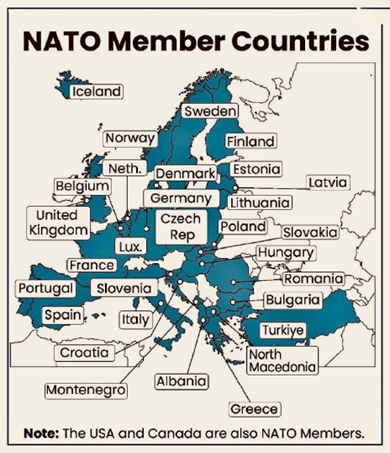
- Nature: NATO is a political and military alliance of 32 countries from Europe and North America.
- It is founded on the principle of collective defence (Article 5 of the Treaty), meaning that even if one NATO Ally is attacked, then it is considered that all NATO Allies are attacked.
- The 32 members are Albania, Belgium, Bulgaria, Canada, Croatia, Czechia, Denmark, Estonia, Finland, France, Germany, Greece, Hungary, Iceland, Italy, Latvia, Lithuania, Luxembourg, Montenegro, Netherlands, North Macedonia, Norway, Poland, Portugal, Romania, Slovakia, Slovenia, Spain, Sweden, Türkiye, United Kingdom, and United States.
CORE ANALYSIS:
What is Happening?
- The U.S. has led NATO for almost 75 years.
- US President Trump has:
- Criticized NATO as unfair to the U.S.,
- Suggested possible withdrawal from NATO.
- Complained that Europe spends too little on defence.
- This creates uncertainty about U.S. commitment to Europe’s security.
WHY IS THIS IMPORTANT?
1. Security Concerns in Europe
- NATO protects Europe from threats like Vladimir Putin’s Russia.
- Weakening NATO means, Europe becomes vulnerable, especially after the Ukraine war.
2. Middle East Link:
- U.S. wanted Europe to support operations in West Asia (Iran context).
- Europe’s limited support increased tensions with the U.S.
- Recently Italy and Spain denied Airspace for U.S. Aircrafts involved in war against Iran.
- Many NATO countries also refused to collaborate on opening the strait of Hormuz, which was currently tightly controlled by Iran.
LEGAL POINT:
- However, The President of the United States cannot unilaterally withdraw from NATO.
- Such a decision requires either a two-thirds majority approval in the Senate or an Act of Congress, as per the provisions of the National Defense Authorization Act, 2024 of U.S.
- This serves as an important constitutional check on executive power of Trump.
BROADER GLOBAL IMPACT:
- If the United States withdraws from NATO, it may lead to the weakening of global institutions such as the World Trade Organization (WTO) and the United Nations (UN). It could also mark the decline of the U.S.-led global order, often referred to as Pax Americana.
- Such a move may create a power vacuum that could be filled by other major powers such as China and Russia, as well as emerging middle powers.
- Additionally, it could lead to a trust deficit, with allies becoming uncertain about the reliability of U.S. commitments in the future.
IMPACT ON EUROPE:
In response, Europe may need to build its own independent defence capabilities. It may also have to increase its military spending and redesign its overall security architecture from scratch.
FINAL TAKEAWAY:
The article highlights a potential turning point in global geopolitics. The weakening of transatlantic relations could push Europe towards greater strategic autonomy and may significantly reshape the international order that has existed since the end of the Second World War.
UPSC SYLLABUS LINKAGE – GS PAPER II (International relations; bilateral and multilateral agreements)
Source: (The Hindu)
La Excellence IAS Academy, the best IAS coaching in Hyderabad, known for delivering quality content and conceptual clarity for UPSC 2026 preparation.
FOLLOW US ON:
◉ YouTube : https://www.youtube.com/@CivilsPrepTeam
◉ Facebook: https://www.facebook.com/LaExcellenceIAS
◉ Instagram: https://www.instagram.com/laexcellenceiasacademy/
GET IN TOUCH:
Contact us at info@laex.in, https://laex.in/contact-us/
or Call us @ +91 9052 29 2929, +91 9052 99 2929, +91 9154 24 2140
OUR BRANCHES:
Head Office: H No: 1-10-225A, Beside AEVA Fertility Center, Ashok Nagar Extension, VV Giri Nagar, Ashok Nagar, Hyderabad, 500020
Madhapur: Flat no: 301, survey no 58-60, Guttala begumpet Madhapur metro pillar: 1524, Rangareddy Hyderabad, Telangana 500081
Bangalore: Plot No: 99, 2nd floor, 80 Feet Road, Beside Poorvika Mobiles, Chandra Layout, Attiguppe, Near Vijaya Nagara, Bengaluru, 560040