
Paper: GS – II, Subject: Polity, Topic: Rights issues, Issue: SC Judgement on OBC Creamy Layer Criteria.
Context:
The Supreme Court clarified how the “creamy layer” within Other Backward Classes (OBCs) should be determined.
Key Takeaways:
Key Findings of the Supreme Court:
- The current creamy layer income limit fixed by the Central Government is ₹8 lakh per year, calculated based on parental income.
- The 2004 DoPT clarification required that salary income of parents working in PSUs and private sector jobs be counted while applying the parental income limit as decided by Central Government.
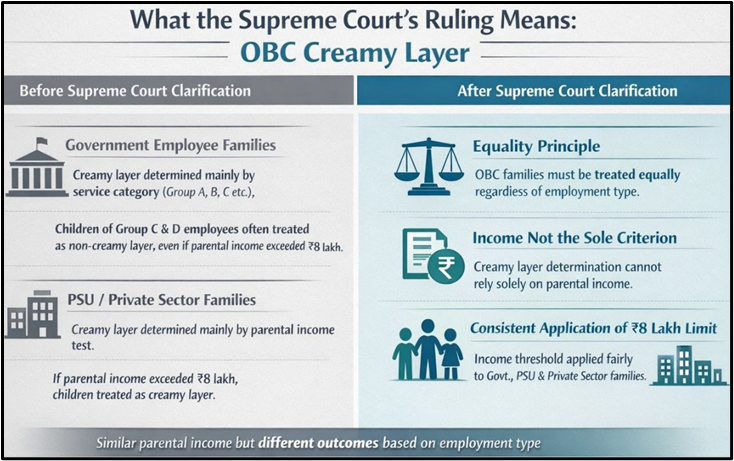
- However, similar treatment was not applied in the same way to government employees, because creamy layer status for government servants was determined mainly based on service category rather than parental income alone.
How Government Service Categories Were Treated:
- Group A / Class I officers (such as IAS, IPS and senior central/state officers): children automatically treated as creamy layer, irrespective of parental income.
- Group B / Class II officers: children may fall under creamy layer depending on service conditions such as promotion stage and length of service.
- Group C and Group D government employees: children were generally treated as non-creamy layer because of the parent’s lower service status, even if the parental income from salary exceeded the ₹8 lakh threshold.
Resulting Inequality:
- For PSU and private sector employees, creamy layer status depended largely on parental income exceeding ₹8 lakh.
- For government employees, creamy layer status depended largely on service category (Group A, B, C etc.) rather than strictly on parental income.
- As a result, two OBC families with similar parental income could be treated differently depending only on whether the parent worked in government service or in the PSU/private sector.
- Such unequal treatment violates constitutional guarantees of Article, 14,15 & 16.
Background of the Creamy Layer Principle:
- The concept was introduced in the 1992 Supreme Court judgment in Indra Sawhney v. Union of India (Mandal case).
- The Court upheld 27% reservation for OBCs in central government employment.
- It also directed that socially and economically advanced members within OBC communities (called the creamy layer) must be excluded from reservation benefits, so that the policy benefits reach the genuinely disadvantaged sections of the OBC population.
Source: (The Indian Express, The Hindu, Live Mint)
La Excellence IAS Academy, the best IAS coaching in Hyderabad, known for delivering quality content and conceptual clarity for UPSC 2026 preparation.
FOLLOW US ON:
◉ YouTube : https://www.youtube.com/@CivilsPrepTeam
◉ Facebook: https://www.facebook.com/LaExcellenceIAS
◉ Instagram: https://www.instagram.com/laexcellenceiasacademy/
GET IN TOUCH:
Contact us at info@laex.in, https://laex.in/contact-us/
or Call us @ +91 9052 29 2929, +91 9052 99 2929, +91 9154 24 2140
OUR BRANCHES:
Head Office: H No: 1-10-225A, Beside AEVA Fertility Center, Ashok Nagar Extension, VV Giri Nagar, Ashok Nagar, Hyderabad, 500020
Madhapur: Flat no: 301, survey no 58-60, Guttala begumpet Madhapur metro pillar: 1524, Rangareddy Hyderabad, Telangana 500081
Bangalore: Plot No: 99, 2nd floor, 80 Feet Road, Beside Poorvika Mobiles, Chandra Layout, Attiguppe, Near Vijaya Nagara, Bengaluru, 560040