
Paper: GS – I/II, Subject: Society and Social Justice, Topic: Issues of women, Issue: Paid Menstrual Leave.
Context:
The Supreme Court expressed concerns that making paid menstrual leave a mandatory legal right could unintentionally harm women’s career prospects, while hearing a petition seeking a uniform law granting menstrual leave to working women and students.
Key Takeaways:
- The Supreme Court cautioned against making menstrual leave a compulsory statutory right.
- The Court noted that such a law might discourage employers from assigning important responsibilities to women.
- The Court distinguished between a legal mandate and voluntary employer policies.
- It encouraged voluntary initiatives by States and institutions instead of compulsory legislation.
- Some States such as Odisha, Karnataka, and Kerala provide menstrual leave to students in educational institutions.
Background / Historical Context:
- Menstrual leave debates in India focus on gender equality, workplace inclusion, and health rights.
- The Maternity Benefit Act, 1961 currently provides maternity leave but does not include menstrual leave provisions.
Significance of providing menstrual leave policy in India:
- Aligns with fundamental rights: Menstrual leave could be in line with Article 21 (Right to Life) and Article 14 (Right to Equality) of the Constitution.
- Additionally, the Constitution empowers the State to make special provisions for women and children under Article 15(3).
- Addresses the unique health needs of women: Menstruation is accompanied by a variety of moderate to severe symptoms such as cramps and fatigue, etc., impacting women’s daily lives.
- Further, lack of proper sanitation facilities at the workplace can impact women’s hygiene and reproductive health.
- Mitigates presenteeism: It would provide an opportunity for society and employers to reevaluate attitudes surrounding absenteeism and work ethic.
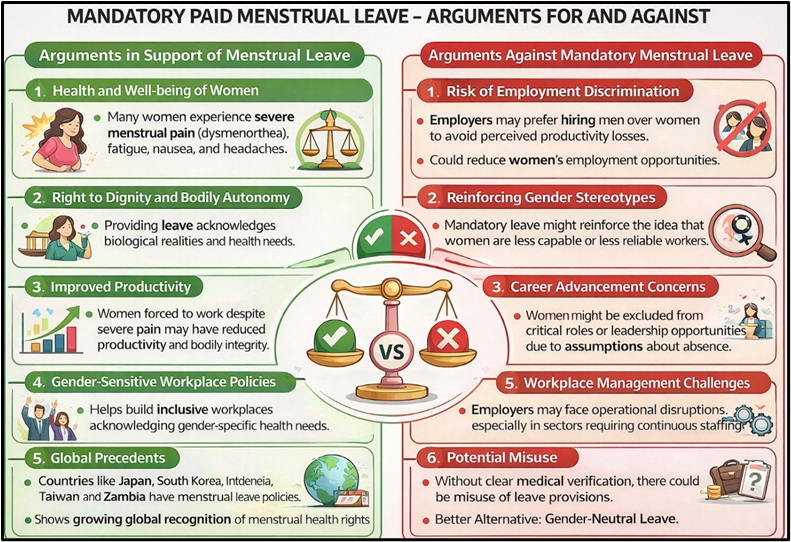
The Supreme Court highlighted the need to balance women’s health rights with risks of workplace discrimination, suggesting voluntary menstrual leave policies and broader gender-sensitive reforms as a more practical and balanced approach.
Source: (The Indian Express, The Hindu, Live Mint)
La Excellence IAS Academy, the best IAS coaching in Hyderabad, known for delivering quality content and conceptual clarity for UPSC 2026 preparation.
FOLLOW US ON:
◉ YouTube : https://www.youtube.com/@CivilsPrepTeam
◉ Facebook: https://www.facebook.com/LaExcellenceIAS
◉ Instagram: https://www.instagram.com/laexcellenceiasacademy/
GET IN TOUCH:
Contact us at info@laex.in, https://laex.in/contact-us/
or Call us @ +91 9052 29 2929, +91 9052 99 2929, +91 9154 24 2140
OUR BRANCHES:
Head Office: H No: 1-10-225A, Beside AEVA Fertility Center, Ashok Nagar Extension, VV Giri Nagar, Ashok Nagar, Hyderabad, 500020
Madhapur: Flat no: 301, survey no 58-60, Guttala begumpet Madhapur metro pillar: 1524, Rangareddy Hyderabad, Telangana 500081
Bangalore: Plot No: 99, 2nd floor, 80 Feet Road, Beside Poorvika Mobiles, Chandra Layout, Attiguppe, Near Vijaya Nagara, Bengaluru, 560040