
Paper: GS – III, Subject: Environment and Ecology, Topic: Sustainable Agriculture, Issue: Rice Cultivation: Methane Impact.
Context:
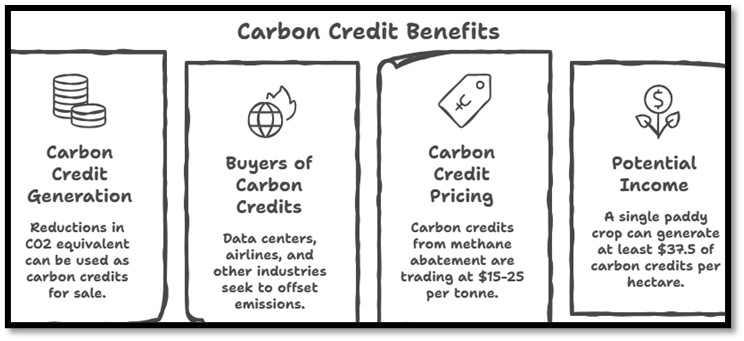
Rice farmers can increase their earnings by reducing methane emissions through Alternate Wetting and Drying (AWD) practices and generating carbon credits, all without compromising crop yields.
Key Takeaways:
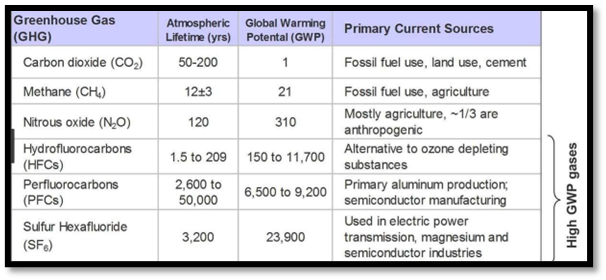
- Rice cultivation is a major source of methane emissions due to continuous flooding of paddy fields. Methane is a potent greenhouse gas with 28 times the global warming potential of CO₂ over 100 years.
- India, the world’s largest rice producer, faces a dual challenge of climate mitigation and farmer income security.
What is the New Practice? – Alternate Wetting and Drying (AWD)
- Periodic Drying: AWD involves periodically drying out paddy fields before re-flooding.
- Disrupting Anaerobic Conditions: The aim is to disrupt the anaerobic conditions that favor methane-producing microbes.
- Implementation: Farmers are advised to flood their fields for the first 20 days and then dry them out for about 12 days over the next 45 days, with two dry-down periods of six days each.
- Water Management: During dry-down, water is drained out to 10-15 cm below the soil surface.
| What is Methane? About: Methane is a chemical compound with the molecular formula CH₄, consisting of one carbon atom bonded to four hydrogen atoms. It is the simplest alkane and a primary component of natural gas. Physical Properties: It is odourless, colourless, tasteless, and lighter than air. Under complete combustion, it burns with a blue flame, producing carbon dioxide (CO₂) and water (H₂O) in the presence of oxygen. Major Sources of Methane: Natural Sources: Wetlands, where organic matter decomposes anaerobically. Agricultural Activities: Flooded rice paddies, which create anaerobic conditions, and livestock enteric fermentation, primarily from cattle. |
Traditional Rice Cultivation and Methane Emissions:
- In traditional rice cultivation, paddy seeds are first raised in nurseries and transplanted after 25–30 days into the main field, which is about ten times larger than the nursery area.
- After transplantation, the crop typically grows for 90–100 days, extending to 120 days or more for some varieties.
- For nearly the first 65 days of the cropping period, fields are kept continuously flooded with 4–5 cm of standing water.
- This practice mainly helps suppress weeds by creating oxygen-deficient conditions that prevent weed seed germination.
- Flooding becomes less necessary after the vegetative growth and tillering stage, when panicle formation begins.
Mitti Labs Study in Telangana:
- A study by Mitti Labs Ltd during the 2024 kharif season covered 30 paddy fields across three villages in Warangal district.
- 15 fields followed AWD
- 15 fields followed continuous flooding (CF)
- Water use: AWD fields used 3.14 million litres per acre, compared to 4.96 million litres under CF
- Methane emissions: AWD emitted 3.5 tonnes CO₂-equivalent per hectare, versus 6 tonnes under CF
- Crucially, grain yields remained unchanged at about 2.5 tonnes per acre under both AWD and CF.
- This makes AWD a low-effort, high-impact practice that conserves water and cuts emissions without affecting productivity.
Other Initiatives and Partnerships:
- Good Rice Alliance: A partnership between Bayer, Shell Energy India, and GenZero is promoting paddy cultivation through AWD and direct seeding.
- Farmer Enrollment: The alliance claims to have enrolled over 12,000 farmers across 13 states.
- Emissions Reduction: The alliance claims to have reduced methane emissions equivalent to around 120,000 tonnes of CO2 per year.
Conclusion:
AWD presents a promising approach for rice farmers to reduce methane emissions and generate income through carbon credits. This “low effort, high impact” practice can contribute to climate goals while providing economic benefits for farmers, particularly those with small or marginal land holdings
La Excellence IAS Academy, the best IAS coaching in Hyderabad, known for delivering quality content and conceptual clarity for UPSC 2026 preparation.
FOLLOW US ON:
◉ YouTube : https://www.youtube.com/@CivilsPrepTeam
◉ Facebook: https://www.facebook.com/LaExcellenceIAS
◉ Instagram: https://www.instagram.com/laexcellenceiasacademy/
GET IN TOUCH:
Contact us at info@laex.in, https://laex.in/contact-us/
or Call us @ +91 9052 29 2929, +91 9052 99 2929, +91 9154 24 2140
OUR BRANCHES:
Head Office: H No: 1-10-225A, Beside AEVA Fertility Center, Ashok Nagar Extension, VV Giri Nagar, Ashok Nagar, Hyderabad, 500020
Madhapur: Flat no: 301, survey no 58-60, Guttala begumpet Madhapur metro pillar: 1524, Rangareddy Hyderabad, Telangana 500081
Bangalore: Plot No: 99, 2nd floor, 80 Feet Road, Beside Poorvika Mobiles, Chandra Layout, Attiguppe, Near Vijaya Nagara, Bengaluru, 560040