
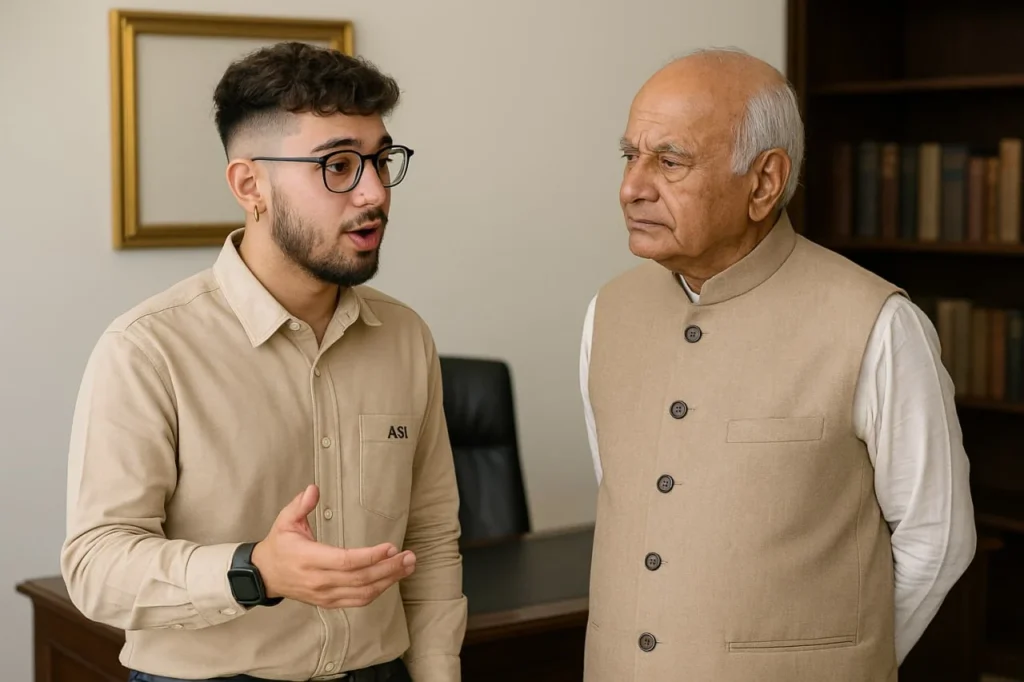
Gen Z: A Story of Generational Change, Digital Behaviour & Ethics
If you walk through any UPSC hub today — from Mukherjee Nagar’s crowded lanes to Hyderabad’s sleek libraries — you’ll sense a quiet revolution. Students no longer carry 10 kg of photocopied notes. Instead, they juggle between ChatGPT, Telegram channels, YouTube videos, and handwritten mind-maps.
A single aspirant might:
- solve MCQs on an app,
- clear doubts using AI,
- reply to friends with a meme,
- and then dive into ARC reports —
all within 15 minutes.
This is Generation Z — India’s youngest UPSC aspirants, born between 1997 and 2012.
But as this generation enters the civil services in large numbers, a profound question is being asked:
What happens to the timeless values of the civil services when an always-online, expressive, digital-first generation walks into an institution built on discipline, restraint, and hierarchy?
To understand the answer, let’s explore how generational change is reshaping governance — in India and around the world.
Why the Rise of Gen Z in UPSC Matters?
For decades, India’s bureaucracy has been led by:
- Gen X (1965–1980) → now senior, experienced, structured
- Millennials (1981–1996) → mid-level, balanced, adaptive.
But today’s exam halls are filled with Gen Z.
This matters because every generation brings its own values, communication patterns, and expectations. And these differences influence how officers make decisions, speak to citizens, and handle ethical dilemmas.
A recent study comparing Millennials and Gen Z found:
- Millennials → verify before reacting, communicate politely
- Gen Z → reacts quickly, values authenticity, uses emojis, sarcasm, and informal tones
Both care deeply about inequality and discrimination — but their styles differ so much that researchers call today’s digital space an “Angry Community.”
The question for India is:
When this digital behaviour enters governance, will it strengthen public trust or weaken it?
To answer this, let’s travel to the UK — a country that has already experienced this generational shift.
🇬🇧 A UK Lesson: When Young Digital Natives Enter Government
In 2020, the UK Cabinet Office noticed something unusual.
A wave of Gen Z analysts had joined various departments through fast-stream programs.
They were brilliant —
data-driven, digital-savvy, quick thinkers, transparent in communication.
But within months, internal review reports identified generational friction:
The younger officers communicated too directly.
Emails were short, sometimes abrupt.
Meetings were candid, sometimes too candid.
They preferred Slack messages over formal memos.
They challenged senior decisions openly.
Senior officers (mostly Gen X and older Millennials) felt this was:
- disrespectful,
- excessively informal,
- lacking institutional sensitivity.
Gen Z officers felt seniors were:
- slow,
- overly bureaucratic,
- unnecessarily formal,
- uncomfortable with transparency.
The UK government realized something critical:
Digital skills bring efficiency.
Generational values bring conflict.
Ethics must hold everything together.
So the UK created cross-generational collaboration modules, digital-communication guidelines, empathy training, and value-based leadership sessions.
#Gen Z. #Gen Z#Gen Z#Gen Z#Gen Z
The lesson?
Governance collapses when communication collapses.
Governance thrives when values guide communication.
India is now entering this same moment — but at a much larger scale.
🧭 Do Core Civil Service Values Still Hold?
India’s bureaucracy rests on timeless values:
- integrity
- humility
- impartiality
- respect
- compassion
- justice
- accountability
But Gen Z has grown up differently:
- fast information
- short-form content
- digital activism
- constant feedback loops
- instant expression
- emotional honesty
So the real question isn’t:
“Are Gen Z officers good or bad?”
The real question is:
“Can civil services values survive in a digital world where speed often replaces reflection?”
Consider this:
An officer who speaks empathetically on Instagram cannot treat citizens harshly offline.
A civil servant who tweets impulsively might make impulsive policy decisions.
Digital anger can become administrative anger.
Values cannot be:
- switched on and off,
- used only in the office,
- or practiced only during training.
They must flow across:
home → society → online spaces → bureaucracy → public life.
#UPSC #UPSC #UPSC #UPSC #UPSC
⚖️ Leadership Lessons: Gandhi and the Digital Youth
Let’s recall one of India’s most powerful ethical moments.
The Chauri Chaura Incident (1922)
When young protestors, full of anger, burned a police station, Gandhi suspended the entire Non-Cooperation Movement.
Why?
Because he believed:
“No goal is worth achieving through uncontrolled anger.”
This echoes strongly today.
Gen Z officers will:
- use virtual meetings
- manage public crises on social media
- take decisions faster
- face pressure from viral videos
- operate under constant digital scrutiny
But speed without restraint becomes aggression.
Digital confidence without humility becomes arrogance.
Data without ethics becomes injustice.
This is where Gandhi’s leadership meets Gen Z’s energy.
The answer is not to suppress Gen Z’s enthusiasm.
The answer is to channel it ethically.
🚀 Gen Z Strengths India Desperately Needs
Let’s be clear — Gen Z is not a liability.
They are a massive opportunity for India’s future.
Gen Z brings:
1. Speed
They process information quickly, respond fast, and adapt instantly.
2. Creativity
They think in innovative ways — perfect for solving long-standing governance bottlenecks.
3. Digital Mastery
From AI to big data to automation — they can modernize government systems faster than any previous generation.
4. Commitment
They deeply care about justice, fairness, and climate — values India needs today.
But these strengths need direction.
Without ethics:
- speed becomes carelessness,
- creativity becomes disruption,
- digital skills become shortcuts,
- confidence becomes ego.
🧱 The Ethical Framework Gen Z Needs: Principlism
Nilay introduces a powerful framework — principlism — essential for Gen Z officers.
1. Respect for Autonomy
Listen to every citizen.
Empower them.
Especially those at the margins.
2. Beneficence
Use your creativity to improve lives — not just systems.
3. Non-maleficence
Avoid harm caused by:
- careless words,
- impulsive decisions,
- rushed communication,
- digital insensitivity.
4. Justice
Ensure fairness in:
- policy,
- resource allocation,
- grievance redressal,
- law enforcement.
This ethical compass helps young officers navigate the noise of the digital world.
🤝 Three Generations, One Bureaucracy: Can It Work?
Picture a district office in 2032:
- Gen X Collector → calm, experienced, traditional
- Millennial Additional Collector → adaptive, balanced
- Gen Z probationer → rapid, innovative, expressive
Now imagine all three working together.
There will be:
- communication gaps,
- cultural misunderstandings,
- differences in speed and style.
But if each generation positions itself not as a rival but as a partner, governance becomes unstoppable.
The key?
Operate from a Balanced Adult State:
- rational
- empathetic
- ethical
- collaborative
And most importantly:
Assume good intent.
This was the UK’s solution.
And this will be India’s strength.
🌱 How Gen Z Can Transform Governance?
Gen Z does not have to choose between:
- tradition vs modernity
- values vs technology
They can integrate both.
Gen Z Can Lead By:
- using AI ethically
- improving transparency
- simplifying public services
- promoting citizen-first governance
- communicating with clarity
- ensuring inclusivity
The goal is not to modernize bureaucracy.
The goal is to humanize it.
#Gen Z #UPSC #Gen Z #UPSC #Gen Z #UPSC #Gen Z #UPSC #UPSC
For more such preparation strategies, you can read here: https://laex.in/category/preparation-strategy/
La Excellence IAS Academy, the best IAS coaching in Hyderabad, known for delivering quality content and conceptual clarity for UPSC 2025 preparation.
▶️ FOLLOW US ON:
◉ Youtube : https://www.youtube.com/@CivilsPrepTeam
◉ Facebook: https://www.facebook.com/LaExcellenceIAS
◉ Instagram: https://www.instagram.com/laexcellenceiasacademy/
▶️ GET IN TOUCH:
Contact us at info@laex.in, https://laex.in/contact-us/
or Call us @ +91 9052 29 2929, +91 9052 99 2929, +91 9154 24 2140
▶️ OUR BRANCHES:
Head Office: H No: 1-10-225A, Beside AEVA Fertility Center, Ashok Nagar Extension, VV Giri Nagar, Ashok Nagar, Hyderabad, 500020
Madhapur: Flat no: 301, survey no 58-60, Guttala begumpet Madhapur metro pillar : 1524, Rangareddy Hyderabad, Telangana 500081
Bangalore: Plot No: 99, 2nd floor, 80 Feet Road, Beside Poorvika Mobiles, Chandra Layout, Attiguppe, Near Vijaya Nagara, Bengaluru, 560040